Warning: Constant MAX_INLINE_MENTION_LENGTH already defined in /home/dkernohan/public_html/wp-content/plugins/semantic-linkbacks/includes/class-linkbacks-handler.php on line 4

Warning: Cannot modify header information - headers already sent by (output started at /home/dkernohan/public_html/wp-content/plugins/semantic-linkbacks/includes/class-linkbacks-handler.php:4) in /home/dkernohan/public_html/wp-content/plugins/indieauth/includes/class-indieauth.php on line 257

Warning: Cannot modify header information - headers already sent by (output started at /home/dkernohan/public_html/wp-content/plugins/semantic-linkbacks/includes/class-linkbacks-handler.php:4) in /home/dkernohan/public_html/wp-content/plugins/indieauth/includes/class-indieauth.php on line 257

Warning: Cannot modify header information - headers already sent by (output started at /home/dkernohan/public_html/wp-content/plugins/semantic-linkbacks/includes/class-linkbacks-handler.php:4) in /home/dkernohan/public_html/wp-content/plugins/indieauth/includes/class-indieauth.php on line 257

Warning: Undefined array key 3 in /home/dkernohan/public_html/wp-content/plugins/wp-youtube-player/wp-youtube-player.php on line 85

Warning: Undefined variable $doing_rss in /home/dkernohan/public_html/wp-content/plugins/wp-youtube-player/wp-youtube-player.php on line 92

Warning: Undefined array key 3 in /home/dkernohan/public_html/wp-content/plugins/wp-youtube-player/wp-youtube-player.php on line 85

Warning: Undefined variable $doing_rss in /home/dkernohan/public_html/wp-content/plugins/wp-youtube-player/wp-youtube-player.php on line 92
dkernohan – Page 20 – FOLLOWERS OF THE APOCALYPSE
Warning: Attempt to read property "plugins" on null in /home/dkernohan/public_html/wp-content/plugins/styles/classes/styles-customize.php on line 150

Author: dkernohan

  • Was HE funding a dry run for the NHS?

    I don’t know enough about the NHS or the bill to say anything useful about it, but I am opposed to it based on the comments from expert bodies and individuals that do. But I am struck by the parallels to the “There is No Alternative” rhetoric about HE funding.

    Compare:

    “To those people who doubt what we are doing I would say, because of the pressures we are facing, we cannot afford not to reform the NHS.” – Andrew Lansley

    with

    “The current system of funding for higher education is no longer fit for purpose” – David Willetts

    The second quote was fundamentally questioned this week via a report by HEFCE on the financial health of the HE sector. In 2010-11 the sector ran a £1000m operating surplus, the highest on record and a little over 4% of the total government income. And damningly, HEFCE cite the new model as providing a need for retrenchment and savings rather than a new golden era for universities and colleges.

    “Despite there being uncertainty about the future government policy for higher education, in particular student number controls, there is strong evidence that the sector is financially well prepared for the new funding system” (para 50.).

    And already we know that institutions will face a real terms cut in fee income the following year.

    Many commentators and experts (and even me!) have been saying this for nearly two years. Sadly we have been proven right.It seems it is not the current system of funding that is not fit for purpose. It is the new one.

    Expert opinion seems to say the same about the NHS reforms. It is possible, though unlikely, that the NHS Bill may still be rejected at this late stage. In comparison the HE Bill was rejected without a fight though the damage has already been done.

    I hope that the same will not be said about the NHS, either with or without the bill.

    post represents my own opinions only, and is available under a CC-BY license.
  • MarginCore – the binary divide

    Very few words from me – just one big picture. This is the allocation of “margin” student places to HEIs plotted against institutional QR (quality-linked research) funding.

    Unknownname

    Margin places have been allocated to institutions based on on “criteria of quality, demand and cost – only those institutions with average tuition fees in 2012-13 of £7,500 or less (net of fee waivers) were eligible to bid. HEFCE received bids from 203 institutions for 36,000 places. Final allocations were made on a pro rata basis” (the “pro-rata” being that everyone’s allocation was reduced to meet the total fit below the 20,000 places HEFCE could allocate.)

    I’d expected a positive correlation for widening participation funding, hypothesising that institutions with a focus on WP would be good at delivering efficient, effective and popular HE courses. But – of course – delivering HE to non-traditional learners is expensive, so this would play against such institutions having fees of £7,500 or less – and there’s no sense having extra places that mean you are running a course at more of a loss.

    But just look at the graph! I’ve never seen a clearer example of a teaching/research binary divide. I’d be interested to come back to this data when we get the AAB numbers.

    This is a personal post and should not be seen as representing  the views of any group or organisation. It is available under a CC-BY license.
  • my #openedspace

    Just what is “Open Education”? How does it fit with everything else? This post is one of three exploring the same issue from the perspectives of Amber Thomas, Lawrie Phipps and myself (and hopefully, others…) as a part of Open Education Week. It is available for reuse under a CC attribution license.

    Openedspace_dk

    There are three things I really want people to take away from this very simple model.

    1. Students are at the heart of the system
    2. Institutions, certification and the “learner journey” aren’t.
    3. Learning is the creation of knowledge.

    In trying to capture education in any kind of systems model, I’m unavoidably going to end up modelling a significant chunk of what we might call modern human civilisation. I’d be getting in to fairly fundamental ideas about learning as a thing that we do every day rather than as a discrete activity. In short I’m going to overreach my understanding and end up looking rather silly.

    The basis for my own mental model of learning and resource sharing comes from the English Folk Music tradition. It often suprises newcomers to this area of culture that there is no canon – no agreed set of tunes, songs, stories and dances. Instead there are numerous competing regional and cultural traditions, and there are variations even within these traditions

    Writing about this in “English Folk-Song: Some Conclusions“, legendary collector Cecil Sharp suggested that “one man sings a song, and then others sing it after him, changing what they do not like”. Rob Young, who recently produced a beautifully written history of interest in the English folk music tradition called “Electric Eden“, explains the idea further:

    “For [Cecil] Sharp, folk songs existed in constant transformation, a living example of an art form in a state of perpetual renewal […] Don’t seek the ‘original’ copy, insisted Sharp; focus on the transformations themselves – for they are the substance of the song”

    As soon as we start to record and fix songs – even if we take great pains to capture every variation we have discovered, we have lost what has made them live. Derrida neatly encapsulates this idea as différance. In any written or recorded folk music the subject is indeed “not present”.

    For me, the idea that one can learn any body of knowledge without knowingly or unknowingly altering it seems fundamentally improbable. And these alterations are not chance mutations, these are memetic improvements that are shared and disseminated – or discarded and lost. A history of knowledge would be a history of these refinements – their discovery, their use and their usurption. And without this movement – this story – knowledge is simply memorisation.

    Our modern cultural preoccupation with measurement and accreditation of learning plays against this narrative flow. Too often, I think, we are more concerned with the mastery of a body of knowledge (as if it were static and could be memorised) rather than the way in which the act of learning moves knowledge onwards.

    I’ve interpreted learning as a refining cycle, drawing on resources and on means of connecting to people. Whether this happens within or without an institution is immaterial, the proccess is the same. The institution is simply and at best a wonderful box to protect and nourish the mechanism. And if our strange and graceful machines can change the shape and nature of this box: allowing the contents to be more visible whilst retaining the resilience, so much the better.

    An institution can also steer and nurture enthusiasm, there are many paths that have already been taken and guidance about this should be welcomed.  Because are our thoughts our own, or do they come from others? Clearly, the answer here is both – the limits of my reading do not halt my speculation, and my speculation often drives my reading. Surely, I quietly suspect, somebody else has thought about this stuff too?

    At worst, the institiution is a codification engine, a printer of certificates showing that an approved course through the sum of human endeavor has been plotted and measured. The ability to convince others that you and your thoughts are worthy of attention is perhaps the greatest of social skills – the examination is a very poor proxy measure for this, and the database query is an even poorer proxy for the examination.

    Open learning – as painful as it is that we even need these terms – is natural learning. Or even folk learning. It is our own entry into a tradition that lives longer than us, than our cities and countries, than our economies and values. And accreditation? – accreditation is very useful to us as individuals in the short term. It currently has an enormous economic and social value. It is a worthy investment for the present. But we should not pretend that it has anything much to do with learning.

    I need hardly add – as it would be very clear to all intelligent readers – that these are my own views, and not those of my employers, colleagues or co-conspirators.


  • Venus in OERs

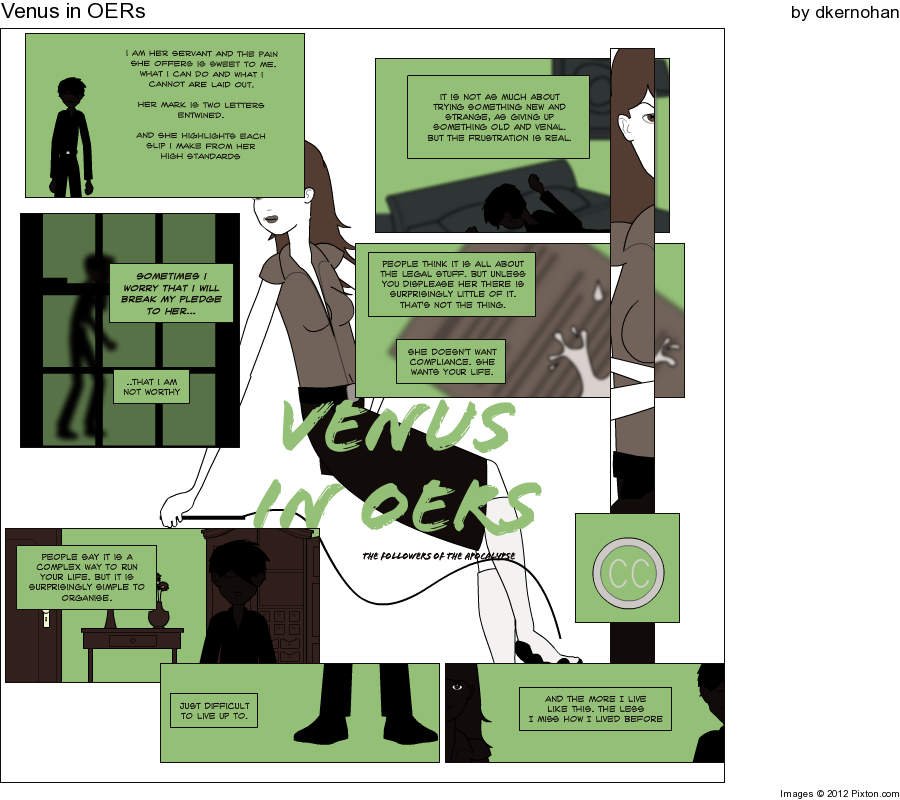
    Pixton_comic_venus_in_oers_by_dkernohan

    Okay, I’ve been thinking about doing this for ages, and Pixton (the comics thing I played with a few posts ago) seemed like the best way of presenting it. @ambrouk ‘s “My story of O(pen)” was a wonderfully positive look at the benefits of open, so here I am drawing both on this slightly one-sided view and her very interesting choice of title to realise that openess is a discipline, and like every discipline it can be both beneficial, enjoyable and very difficult to stick to.

    Brian Lamb expressed this rather well with his “frustrating misconceptions” on openness, the fact that people outside of “the lifestyle” have very odd ideas of how it actually works in practice – the things that seem to be the “point” when viewed from the outside are not the day-to-day benefits. And the huge elephant in the room, that Creative Commons is all about making better use of your copyright rather than abandoning it.

    Hope the comic is gnomic enough to be interesting without being incomprehensible!

    The existence of this post and Amber’s does not mean that there is a secret BDSM fetish scene at our mutual employers. As far as I am aware. All the bits of the comic I own are available under CC-BY, though note that the good folks at Pixton also require attribution and that their property is not used commercially.


  • #cetis12 open mic session

    Bharti Gupta spoke about the Landmap GeoSpatial Education Resources project. She’s based at MIMAS in Manchester, one of our nationally designated data centres. Landmap is a MIMAS service, running until July 2012, working with geospatial data and satellite imagery. It negotiates licenses for, and purchase, datasets on behalf of UK institutions, providing this data freely to end users via Shibboleth.

    Four datasets are available: optical/thermal, radar, elevation and feature. Optical imagery includes satellite, infra-red and aeriel photography (both historic and modern). Thermal data and radar data both allow investigation into many areas, such as the type and health of vegetation. The Elevation collection retains height, volume and 3D information. The feature collection covers the age, type and height of specific buildings, usable in estate management, fire prevention, network planning and CCTV location. The service also holds UKMap data, a multi-layered map base accurately locating buildings, garages, boundaries and trees.

    Landmap is supported by a learning zone which supports users in accessing and working with the provided data, via 15 free courses. These courses cover basic, immediate and advanced applications in image processing, resource creation and interpretation within a web-optimised pedagogic framework, and are currently in the process of being enhanced. The learning resources are currently accessible to UK HE via a Shibboleth authentication, but will shortly be made available under a Creative Commons license, and the team are working to include resources suitable for schools use at “A”-level.

    Thanks to Bharti (@dulcet_bg) for adding additional details to this section of the post. Her slides are available on slideshare. 

    Martin Hamilton posed the question “what happens after e-learning?”. eLearning used to be a niche activity, but many of the tools and approaches have now become mainstream in institutions beyond learning. Learning technologists should be digital literacy champions, dealing with social media and online practice, project management and other tools. Can we kill off the idea of an “eLearning” expert? Are these people now something else?

    A discussion around the room suggested that a decreasing focus in technology (other than legacy stuff like VLEs) mean that the need for a technical “service manager” is decreasing, and the role is now more centred on staff advice and support. There was a lovely anecdote (which I won’t cite to save blushes) about a top-down initiative to install electronic whiteboards in every room leading to another expensive project to re-instate traditional whiteboards. This was a great example of where technology is expected to lead pedagogy – the consensus was that this should be the other way round.

    Gill Ferrell covered the “redesigning the higher education data and information landscape” project, which she is working on with HESA (with UCAS, NUS, OFFA, HEFCE and others). This is a large scale, high-profile project looking at improving data quality and collection efficiency. Currently a large HE instituion can expect to be making up to 500 data returns to statutory and professional regulatory bodies, the project aims to streamline these multiple conversations. She offered an interesting perspective on the reactions of institutions to the idea of open student data. Questions seem to boil down to “who needs to see this data” and “how accurate does it need to be”. Scott Wilson drew an important distinction between data used for individual feedback and summary data for decision making (much as we did in yesterday’s session) – he made the point that data protection issues are often (wrongly) based on the assumption of the ability to drill-down at any level. He said that there are a series of interlocking mandates and quasi-mandates that mean standards-compliant data is a de-facto mandate in order to complete required data returns efficiently. Martin Hamilton further evidenced this, showing an image based on UCISA survey data around the ways in which the various institutional systems that can produce this required data need to link together.

    Fundamentally, institutional data is used both for knowledge and planning, and for funding. A certain amount of institutional control is expected over data linked to income, especially where projections and assumptions are required. Data attached to “big” funding will be collected however it is requested due to the stakes involved, but for lower-return returns (ahem) the temptation to just offer a take-it-or-leave it “this is our data. Format it how you like” approach must be enormous. It’s all a good case for open institutional data. I narrowly avoided a #UserDataBubble rant (which Scott W linked to Stafford Beer’s 70s rants about the backwards megaphone.) Generally we should only give people data that they actually want to do something useful with.

    Rob Englebright described the XCRI-CAP project as allowing people to “fix their plumbing” regarding the content and utility of course data. Drawing on Dave White (and teams) OLTF-linked assertion that information on courses is (Rob’s paraphrase) “bloody hard to find”. XCRI-CAP 1.2 (a format for course data feeds) is becoming BS8581(-1 and -2), a conformant profile of BS EN 15982. The programme is currently running, but there are a number of interesting things emerging around it, one of which being an XCRI-CAP validator and another being an aggregator. This aggregator now has an API, and Rob is looking for a small number of projects to “show us something interesting” combining this API with other data. As an example Scott Wilson showed us UCompare, which mashes up XCRI-CAP and fees/OFFA data.

    Shane Sutherland from Pebblepad offered an update on the ways in which the Pebblepad system complies with the Leap2A standard, in terms of allowing data around forms to be exported to other systems. By using a central repository, the system can allow particular forms and templates to ensure that customisations can be shared. However, Shane is keen that forms could be shared beyond Pebblepad using an open standard. He asked – “does anyone know of any existing standards that could be used to describe a form?”. 

    Significant standards related conversations followed, most of which went entirely over my head and over the head of many other people in the room. But I think Shane got some ideas to investigate.

    Mark Power offered an Augmented Reality “rant” (cheers @Lawrie for the quick mashup). He quickly brought us up to speed on the early days of AR, showing points of interest on a live camera overlay regarding “points of interest”, which is available to consumers but not yet in wide use. There are some similar general tools around image recognition. Generally he felt that AR needs to find a niche, and that enthusiasts who are becoming discouraged through lack of uptake would agree with this. It is in danger of being “buzzworded out of existence”.

    Rob Englebright brought up the “Scarlet” JISC LTIG project, that uses AR to show details of manuscripts, but Mark felt that the actual user experience is still lacking. Comparing the area to QR codes, he drew the point that AR is still dependent on individual applications, and the ability of a user to know that something is there. There are also simple technical engagement issues such as screen size. Generally, there are links both to continuing improvements in geospatial data sets (see Landmaps above), and image delivery.

    Lawrie suggest that AR data needs to be opened up, allowing for user created data and an end to the locked in “app experience”.

    Lawrie Phipps then reported that after a detailed assessment of conference beard activity that he has yet to see any evidence of badgers passing TB to academics over the conference wireless (this could be linked to ongoing wireless connectivity issues). There was a clear link to AR facial hair recognition research, and the potential display of clouds of angry and dangerous badgers around academics at conference on military grade head-up displays such as the Apple iPatch. And audio. But not location-tagging tweets, as such behaviour can lead to funding proposal based holiday discussion. 
  • #cetis12 systems mapping workshop and associated discussions

    John Lennon once memorably described the process of creativity as “doing bits that you join together”. And in many areas of activity there are a number of “bits” that one joins together, all of which have an effect on other “bits”. Putting that into #strokeandpose language, you could say that innovations play out in a complex socio-technical system, with a number of context dependent variables.

    The systems mapping approach allows us to keep focusing on strategic issues in order to describe causes and effects – identifying key potential issues (and potential solutions) without needing to quantify these issues. Fundamentally we are visually describing cause-and-effect relationships between issues on a strategic level.

    These maps are only useful where a context is described (and may be linked to the needs of a particular audience). Difference between systems dynamics and systems mapping is that the former deals with with quantified relationships. A map presents a mechanism but does not address the problem of measurement. That said, it must (says Adam Cooper) be possible to describe changes regarding the content of the boxes (even if this is just in terms of “more or less”).

    So we (Simon Grant, Christian Voight, Mark Johnson [for the love of all that is holy, read this man’s blog!!], Adam Cooper, me) set to describing a student perspective on the use of learner analytics to enhance the quality of a course. Which causes us to spend much time defining our terms, and led to the realisation that we have two systems that have the name “analytics”, one being the personal-level feedback and intervention learners expect as a result of their learning activity, the other being the summation of data concerning this (and other issues) used as to inform decision making at a course or institutional level. Mark attempted to bring these back together using a management cybernetics approach, but other than this we didn’t get very far in actually sketching out what is a very complex set of interactions.

    From looking at the work of other groups this was a common initial finding – the act of attempting to set out processes in this way seemed to be a great way of prompting critical conversations if not actually producing systems maps.

    What we actually ended up doing (after a lot of interesting discussion) was coming up with a range of potential student “drivers” for engagement with higher education. As follows:

    DRIVERS
    1. Employment. (we split this into exchange value and use value of education, very much in the marxist tradition)
    2. Pleasure. (we went for a split between joissance and plasir, after Lacan)
    3. Esteem. (split between peer status [extrinsic] and self-worth [intrinsic])

    (I’m sure that these drivers deserve further unpacking, this’ll maybe be done in a different blog post as it was slightly outside the scope of the session.)

    Based on these needs, we agreed that a potential student would need investment-grade data on one (or more – depending on preference) of these in order to make a decision regarding whether, where and what to study, and we went ahead and listed a load of data sources you could probably fill in yourself. The interesting thing for me was the recurrence of the idea of risk management within this conception of education. Upping the financial stakes for students seems to have increased the effect of these risk calculations in decision making – this seems to have been a direct and possibly intended consequence of the Browne Review of HE Funding and everything that followed.

    So… we can use a range of data to help manage risk, then? Well, part of the system mapping approach seems to be identifying precisely which data would be useful in making a particular decision. There was a lot of talk about the need for “filters” to support people in deciphering huge amounts of data in order to make a decision, and Systems Mapping could help us design these filters.

    From an institutional perspective, it could also help make better use of the increasingly over-hyped suite of system-level learner analytics packages – meaning that data can be used reliably and defensibly for particular well-defined purposes. Mapping causality and relationships seems like a fundamental and almost trivial activity, but we found that the act of actually sitting down and doing it opened up a number of important questions about what people were actually trying to do with learning analytics and why.

    As an absurd extrapolation of the data-driven approach, it is possible to argue for an endpoint which would result in the entire learning function of an educational institution actually being managed by a small shell script, responding to constantly updated metrics by instigating interventions. You can imagine a whole article about a Second Industrial Revolution where management functions become entirely automated (indeed in inventory management, futures trading and a few other areas this has already happened). 

  • 2become1

    Ever since I went back to working with Wonderbrass and rediscovered their love of unlikely pop covers, I’ve had this perfect, beautiful song stuck in my head. The chords are amazing, but the original Spice Girls version just goes too fast to properly experience them. (Craig Armstrong’s string arrangement still rules, however)


    (set your spirit free…)


    However, on slowing the progression down I was struck by how close it was to a certain classic ballad by none other than Jimi Hendrix.


    (fly on, little wing…)


    So for the last couple of months, on and off, I’ve been arranging, recording and tweaking a version of 2 become 1 with a more “little wing” approach. I’ve had help from some very talented people so hats off to:


    @cosmocat – UNU’s very own gospel soul diva, who generously consented to record the delicious vocal.


    Graham Reynolds – drummer with The Jellied Reels, who kindly recorded both of the drum parts.


    Jo Jones – Wonderbrass keyboardist, and teacher at Forte School of Music, who lent me a glockenspiel 🙂


    And thank you to the many, many people who have encouraged me to do this, and berated me for not doing so faster.


    So here it is, for your listening and sharing pleasure. The song remains the copyright of the composers  (Spice Girls/Rowe/Stannard), but this recording and arrangement are made available under a Creative Commons Attribution 3.0 Unported license.


    I’ll hopefully be doing a “Behind The Music” featurette on this recording sometime later tonight on #ds106radio, wherein I’ll try to cover how and, indeed, why.
  • aside: a quick note on the apocalypse

    Seems like everyone is predicting the end times these last couple of weeks, either as a rhetorical device or a cut-off point for existing practices. Years and dates have been mentioned – so much for “no man may know the day or the hour!”

    I realise that I’ve never really written properly about the apocalypse on here, which is odd given the title of my blog. My interest in eschatology is not a ghoulish fetish (those of you who have met me will know that I’m actually pretty cheerful and upbeat most of the time), but a fascination with narrative structures.

    Stories are brilliantly structured: they have a beginning, a middle and an end. And we (as a society) love stories… we love them so much that we expect events that we experience to have these attributes too. But actual human life is seldom as forthcoming, especially regarding endings. Things tend to peter out, tail away or flat-out stop being interesting. In an increasingly diverse and connected world, this becomes more readily apparent. The advent (so very 1990s!) of post-modernity has highlighted just how important these narrative structures have become.

    Enter the apocalypse. This is the ultimate “end”, a profound way of saying “this story is now finished”. My little boy says “The End” after every story he tells, even if it is a story I clearly want to know more about! I think he does it because endings are linked inextricably with beginnings. He wants to start telling a new story.

    In art we’ve seen an increase in the use of “apocalyptic” imagery as we entered this economic downturn. I’d argue that this is a wider cultural wish to end this story and switch to a new one. And idly watching speculative Hollywood fiction about some natural disasters is easier than actually doing something about the several man-made ones we are now in the middle of. At the end of the Hollywood apocalypse we see the triumph of humanity, justice, and the American way. In reality this is never quite so certain… and the final triumph is more of a few more snatched days, weeks or months before the next onslaught.

    To conclude, apocalypses beguile and dazzle because:

    they are dramatic. Saying “X is dead” is much more exciting than saying, “I don’t think X is really working”.

    Linked to this, they are irrevocably final, they appeal to the idea of completion…
    … and thus to the idea of a new, fresh beginning.
    they offer the possibility of individual and group heroism. Apocalyptica is littered with heroes: the prophet crying in the wilderness, the action man with the crow-bar caked with zombie, the well organised vault dwellers, Bruce Willis…
    Wish fulfilment: from St John of Patmos to the Swedenborgians to the DIYU crowd – it’s incredibly seductive to imagine all the things that you don’t like being swept away so you can be proven right all along…
    … especially politically. The far right dream of bunkers and guns, the far left of riots and revolution. If my involvement in OER has taught me one thing politically, it’s that the bridge from right libertarianism to left anarchism is surprisingly solid.

    As a follower of the apocalypse, I’m interested in what happens after all this heroism. Because amid the collapse and the destruction, war never changes. And the slow decline of ideas, the trickle of enthusiasm, is neither dramatic nor inspiring. But it is more true than all the stories we can tell.
  • The inflatable cathedral and the carnival.

    This post represents personal opinions only. It is available under a CC-BY licence.

    It’s rare that a blog post manages to implicitly offer a critique of itself, but this one by Ewen Le Borgne at the International Livestock Research Unit does so in a such a mesmerisingly symmetrical way that I can only assume that it is intentional.

    As a late 90s lit-crit student, I was of course introduced to Mikhail Bakhtin’s legendary “Rabelais and his world”, taking from it the central conceit of the carnivalesque in literature – you’d expect to come across this in any literature course. But what was maybe unique for me and my generation is that this discovery coincided with sudden and rapid growth of the world wide web. To me, as a precocious undergraduate, the web and the discourse of the web was a carnival, in the Bakhtinian sense that here was a place where social norms and hierarchies were shifted, where anything was fair game for reuse and parody, and where the marginalised and reviled found a new confident voice as their “superiors” were embarrassed, scared and tongue-tied.

    What no-one predicted was the way in which, over the following decade and a half, this discourse would become mainstream, the geek would (sorry, horrid cliché) inherit the earth, and the practices and protocols embedded in our early use of the web would come to define the way in which my generation and the ones after it expected intellectual property, publishing and knowledge management to work. This unexpected carnival radically re-conceptualised ideas of property, of the nature of the idea, of the idea of education and knowledge, of reputation and authority – we thought we were just downloading lost albums from Napster and writing about them on our Geocities pages, but it turned out we were living through the opening years of a revolution similar in scope to the advent of mechanisation.

    Writer Cathrynne M Valente recently described the impact of this rather better than I could:

    “Now that the internet has settled in to being a massive and integral part of our lives on Planet Earth, we are starting to see how it changes our culture in the medium to long term, how profoundly it skews even comparatively young predictions from 10-15 years ago. The internet is not a Singularity with a capital S, but it is a sea change sharing more in common with the industrial revolution than simply a new device.”

    And the carnival is still here, it is just that we have forgotten it in a rush to import pre-digital ideas of authority and property online. And Le Borgne’s post, with a call for a limited academian feast of fools, carefully constrained so as not to have any danger of disrupting anything, takes me back once again to Jim and Brian’s high water mark. But this is not my point.

    These days, we are complicit in selling the carnivalesque back to ourselves. Keynote talks and online seminars codify disruption as something that happens on a stage with a wireless headset mic and stock photos that aspire to the symbolic without ever quite reaching it. Andrew Orlowski slips this idea into a very amusing rant about Malcolm (Tipping Point) Gladwell:

    “You could say these [Vertical Marketing Bureaucrat roles] are non-productive jobs in non-productive companies: the skills required to prattle on about “horizontal marketing segmentation” have very little to do with traditional sales skills, or R&D. But what they rely on are the same things the New Bureaucrats rely on: measurement and monitoring.

    […] For want of a snappy description, and because it traverses the public and private sectors in a kind of League of the Clueless, I’ll call this new class the vertical marketing bureaucracy, or VMB). These are people whose ambition is to speak at, or at least attend, New Media Conferences. Gladwell is their passport. And because TV and posh paper executives are now essentially part of the same vertical marketing bureaucracy (VMB) too, they’re only too happy to report on Gladwell, the Phenomenon.”

    There’s now an established pattern for disruptive thought, a set of tropes and reference points that alert a bored audience that they are about to have their minds exploded by someone saying that learning is, like, all about people – and here are some numbers and graphs to prove it. Look, here’s a picture of a poor person I saw on my holidays. LOOK AT MY HOLIDAY SNAPS, PEOPLE. FEEL MY SOCIOCULTURAL TOURISM! So instead of the full-on feast of fools, we get a feast-lite: a hierarchy of fools… largely white, largely male, largely middle-class, largely Euro-American at the top doing TED talks, with a slightly wider pool of similarly attributed VMBs beneath them aping their styles at things like Learning Without Frontiers and other futurist conferences in exciting inflatable spaces with stages and lighting rigs. And below that, the general seeker after truth – a conference-goer often at public expense – who gets… what?

    They are no longer participants in the carnival. They are a backdrop to the official feast. A means of signifying to the Gladwell-esque that they have arrived. Whoop and holler, people.

    I don’t mind as much for New Media Conferences. I mean, people who voluntarily go to new media conferences deserve all they get. But when this Apple-toting licensed court jester approach sneaks in to serious conversations about education, I reach for my (metaphorical) revolver. Education (and the struggle for the soul of education) is far too important to trivialise with this cut-and-paste, cut-and-dried approach to disruption-by-numbers.

    There are a small but significant number of education keynotees who may read this, and I have annoyed them before. But to anyone contemplating a large scale public address in this sphere, I point you to these three words of advice from Rob Englebright.

    Purity. Truth. Beauty.
    Ptb-groom
    (the other rule of keynotes is always to use other peoples ideas. Though to be fair, Jim should absolutely use this slide and Rob would be delighted)

    Some words in conclusion from Prof. Michael Holquist (introduction to my 1984 edition of “Rabelais and his world”),  Mikhail Bakhtin, and François Rabelais.

    “Those who lived through [the Russian revolution of 1917] were willy nilly thrown into the work of history. No one was allowed the luxury of a spectator’s role. Those who normally seek the safety and anonymity of the gallery, such as peasants, workers, and – perhaps especially – intellectuals, to watch the kings, generals, prophets, and other public figures who occupy center stage go forward to volunteer their blood at Hegel’s “slaughter bench of history,” discovered they could not sit back and eat popcorn-or read books. The revolution gave a particularly Russian twist to Joyce’s line, “Here comes everybody.”” (Holquist)

    “[…] the official feasts of the Middle Ages, whether ecclesiastic, feudal or sponsored by the state, did not lead the people out of the established world order and created no second life. On the contrary, they sanctioned the existing pattern of things and reinforced them.” (Bakhtin) 

    “Friends, you will notice that in this world there are many more bollocks than men. Remember this.” (Rabelais)
  • The Origins of the Apocalypse #ds106 #DesignAssignments319

    This post represents my personal opinions only, and is available under a CC-BY license. [Both this post and indeed this entire blog have nothing at all to do with the Education for the Apocalypse session at #lwf12 – a conference so legendarily crap that they give you freeipads just for registering. If you are in London that day (and can avoid the myriad disruptive innovators talking about disruptive innovations like social media, mobile phones and gaming, just like at the 2007 JISC conference) it’s probably worth going to that session as it has @kerileef in it and she’s ace.]

    Lou McGill told me that if I was doing #ds106 this year, I had to do some of the visual assignments. Make art, dammit – these were the words she used. But the nice thing about ds106 is that you can do something you felt like doing anyway and then claim it as an assignment – so, inspired by GuiliaForsythe’s beautiful narrative about the #dailycreate and tagging, I wanted to do something visual with a narrative.

    Immediately I thought of a super-hero origins strip. I know very little about graphic narrative, but I love and have always loved origin strips – those background stories that tell you how Jim Groom became The Bava and got his powe (kudos, Cogdog!) or whatever. So, I thought I’d make an origin strip for the Followers of the Apocalypse, with more than a hint of the story of ds106 and edublogging in there too. I used Pixton which is an absolutely beautiful tool and I would recommend it to everyone.
    Here’s the assignment. 

    Unknownname