Category: Uncategorized
-
#stokescroft , #nhscuts and #unifees – who’s not listening?
This post represents my personal opinions, and not those of my employers, projects, or programmes I am or have been responsible for. This post is available under a CC-BY license.Three important news stories were sneaked out under the Mooreist Royal Wedding smokescreen.The first concerned continuing disturbances in the Stokes Croft region of Bristol. There have been squat clearances over the past couple of weeks, coincidentally round about the time a shiny new Tesco opened in the area to the disgust of local residences. The campaign against the Tesco has been – in the Stokes Croft manner – creative, idiosyncratic and popularly supported across the city, based around a network of small shops, communities, artists and activists. And on the other side, a multinational supermarket known for railroading planning laws and with two other shops within 10 minutes walk.Guess who the police and government are behind. Clue – it’s not the community.So a longstanding, peaceful squat in an otherwise unused building is raided using “anti-terror” laws with the pretext that Molotov Cocktails were being made to attack Tesco (so basically they had fuel, clothes and bottles in the building – watch your doors people!). Today they came back for the remainder of the “activists” in the same large squat, Telepathic Heights. In a police helicopter. Ending in a 2hr rooftop stand-off. This localised incident can be seen in the light of many other squat clearances and activist arrests today and armed police with shoot-to-kill orders, all to safeguard the Royal Wedding.Yeah, today the UK saw arrests without evidence or charge, mass evictions (squatting is, of course, legal) all supported by helicopters and police with orders to kill. ‘Scuse me while I don’t put the flags out and street party like it’s 1859.Another blink-and-you’ll miss it story came from our increasingly beleaguered University sector, where it emerged that the Office For Fair Access (OFFA) will not be requiring any of the universities that have recently been trebling their student fees to moderate their charges, even if their “access agreements” turn out to be (as with Cambridge) the same or similar to those which are currently in place. For all the “exceptional circumstance” talk, for all the “predicted £7,500 average”, for all the “tough new access requirements”, what we have here is market red in tooth and claw, and institutions out for what they can get away with. There are no safeguards, there is no moderation, this skewed and phony market in the intangible and often immeasurable personal opportunity good of education is all we have.The students that pointed this out were kettled, beaten, and patronised by the police and government. A failure in communication by the state apparently – not a total disconnect between what the coalition are trying to sell and what young people are trying to buy…Also trickled out today was the news that the expected 4% cuts to NHS primary care budgets will in fact be 7%, these cuts (never before achieved in any health service in the world) to be made during another unnecessary governance reorganisation (itself a direct contradiction of a manifesto promise, that will cost billions to implement) and, somehow, without cutting frontline services. The NHS reforms are currently “on hold” for a listening exercise which seems, like about student fees, to be merely another chance for us to be told what is happening (and if we don’t buy it, to be told “calm down, dear“.)For a government that has drastically cut public sector communications budgets, this is a beautifully ironic string of communication failures. And the sting comes, like in Stokes Croft, when the state conception of reality differs so profoundly from your own that you become a terrorist yourself.In the UK we have a government that cannot communicate, cannot consult and cannot deal with anything other than total agreement – carrying out wave after wave of the most destructive and poorly though out policy we have ever seen. And backing this up with an increasingly visible and violent police presence. This is not hyperbole. This is happening.[note: the sections on Stoke Croft have been updated on 30th April, following clarifications from “StokesCrofter”, below) -
We’re not in a “higher education” bubble, we’re in a “certainty” bubble
This post represents my personal opinions, and not those of my employers, projects, or programmes I am or have been responsible for. This post is available under a CC-BY license.Peter Thiel, former CEO of Paypal, Facebook investor, and likely fan of Ayn Rand, suggests that the market value of Higher Education is far above any real value, and that we should expect a crash in demand for HE as the market restores itself to equilibrium. Anya Kamenetz has been talking about this for far longer, and I think is basing her position on a similar argument – though I’d argue that she’s saying that HE needs to self-reconfigure to survive a market correction rather than flat out predicting doom and destruction.The real story here is that the link between higher study and higher earning is breaking down. Do download (and play with) the tables here from HESA. Between 2007-8 and 2008-9, the mean graduate salary for those who graduated from a full-time undergraduate course and found work in the same year was £19,500, whilst the national average salary was around £24,908.A UK graduate can expect to earn an average of £100,000 more over their lifetime. Under current arrangements, you could offset £21,198 of debt against that, with £9,000-a-year fees taken into account, more like £40,000. Add loan interest on, take inflation into account, and you’re really talking about comparatively little (if any) gain.At some point we are going to have to stop and ask ourselves whether higher education is an economic good. Whether we can justify individual educational expenditure by economic gains. We will answer no, apart from very specific job-linked training.And even then – given the pace of change around technology, the ways in which what we work on and how differs even from the start of the century, these gains are at best temporary. We are entering the age of ubiquitous lifelong learning, not just as a choice but as a requirement. I’d argue that this is a separate sector to traditional HE, and traditional HE may not be best placed to serve it.Yolande Knight, from the GEES subject centre and EDOR OER project, postulates that what HE is about is uncertainty:“At its most basic level, it was agreed that it could seem counter-intuitive for students to move from the ‘certainty of knowledge’ that seemed
to be taught at schools to the idea of ‘uncertainty’ that was introduced at university. However, it is important that this perceived ‘lack’ of understanding at school level is not assumed: it seems an easy scapegoat.”(Knight, Yolande “Knowledge, evidence, complexity and uncertainty: a summary” (Planet no. 17, December 2006)The recently fashionable Neo-Classical model of economic thought is lead by ideas of certainty and “know-ability” – the idea that all information is available and all risks are calculable (and insurable). I can’t really bring this up without mentioning that this might not have worked very well in recent times, though this feels a bit like a cheap shot. The education market is suffering from this same malaise at the moment – we’re teaching certainty – we’re teaching (or claiming to teach) based on “full and relevant information” (after Weintraub).But (and I’m with Keynes here): the world isn’t like that, and neither is education. Especially as we reach the higher levels of education, we (as academic and quasi-academic staff) do not know what it is our students will need to know. Keynes builds uncertainty (and thus flexibility and contingency) into his economic model, not via the management and “measurement” of risk, but via the acceptance of the existence of an unknowable future. Mark Johnson has been writing about Illych’s idea of “useful underemployment” which seems to be a very relevant model if resilience in this interpretation of education.What do students need to know? We don’t know. In such a situation, the only rational behaviour is to teach them how to find out for themselves.And the next stage is to work out how to convince everybody else. -
MarginCore and the dumb hand of the market.
This post represents my personal opinions, and not those of current or former employers, projects, or programmes I am or have been responsible for. This post is available under a CC-BY license.So, the hints coming out of the HEFCE annual conference regarding university funding were, firstly, the immanent appearance of the much delayed White Paper (now a running joke within the HEFCE exec), and, secondly, further tweaks to the Willetts-Browne funding model to avoid the now universal embarrassment that this model costs substantially more (we’re now up to £1bn in the mainstream press, it’s more than that as we know) than the current one. What we seem to be groping blindly towards is something called a core/margin model, and that I’m going to call MarginCore. This should come as no surprise to readers of this blog, as we called it back in December (see about 6 paras from the bottom). We also said it wouldn’t be a very good idea. For those of you who don’t read links in blog posts, here’s a recap: Each course, within each institution, has a set number of students it can recruit to it (the core allocation). Depending on how lucky they feel, institutions can then bid for Additional Student Numbers (ASNs) which are extra students they are allowed to recruit that year. If they do recruit them (and keep doing so, and meet various other requirements) their core is eventually reassessed. You may be impressed that I’ve got a whole actual acronym in there already, but this is for a very good reason. HEFCE ALREADY DOES THIS. Seriously. No word of a lie, this is how we currently do student number controls. As a Plan B goes, doing something we are already doing is fine with me, usually. But it doesn’t work in Browne-Willets land. Their tweak is that we allocate extra numbers to cheaper courses. As criteria go, it’s a bit rubbish. Currently, we allocate ASNs according to strategic subject priorities, and assess ASN bids based on ways in which the institution supports widening participation, meets student retention targets and generally has an ability to manage extra students. So you can see why “x is cheaper than y, therefore x should have more student numbers” is a bit rubbish. We can allocate student numbers for more sensible reasons than that, with a greater chance of successful outcomes.A MarginCore model based on price just accentuates the dumb effects of the markets – we are completely competing on price rather than any other metric. Welcome to Tesco Value U.The other option on the table is the Big Scary Teaching Funding Clawback, viz. the nasty Treasury takes away some of the money allocated to central (HEFCE) teaching spend under the new model. That won’t work either, mainly because all the central funding under the new model goes to band A and B subjects… courses in lab-based sciences and medicine. So – as the headline writers will clearly spin it – these cuts hits our future healthcare professionals disproportionally.Or I suppose you could claw back money already awarded to student numbers in the current model. That’s going to be popular with a student body that already seems to be the most active and the most politically engaged in a generation.Basically, this model of funding isn’t going to work. If the coalition wants to come out of this whole sorry episode with any shred of credibility they need to pull out now, before academics lose jobs and courses close in some idiotic “market”-led rationalisation. -
Do Vice Chancellors love Cox? The “celebrity academic”: a statistical analysis of UCAS data.
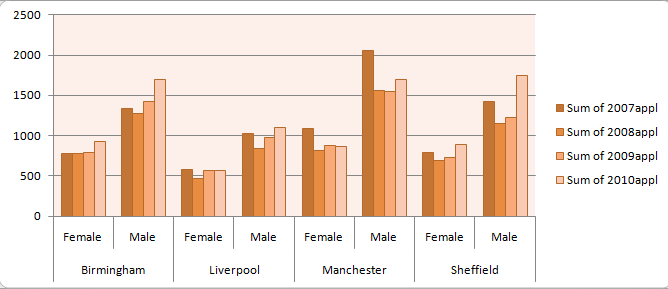
These are my views and not those of my employer, or of projects and programmes I am responsible for, or of moderately successful bands I used to play keyboards for. This post is available under a creative commons attribution CC-BY license.You cannot have watched television on a Sunday night in the UK over the past few weeks without witnessing the #wonders of Professor Brian Cox, the be-gortexed globetrotting human lens flare that defined popular physics in 2011. With his rock&roll background, his boyish enthusiasm and charm, and his habit of wearing t-shirts that display a startling level of nipple definition, many hearts have been set a-flutter and the phrase “stellar superfluid” has taken on a whole new layer of meaning.But Coxy isn’t your average media tart. He’s got an excellent research profile, and teaches particle physics at the University of Manchester. Which, you would think, is good news for the University – having an on-faculty TV heart-throb must help draw students (and thus funding) into the already world renowned School of Physics and Astronomy.The hypothesis here is that since the dawn of the Cox era (which, I would suggest happened in 2009-2010, just before he went – erm – supernova with Wonders of the Solar System), women looking to study physics would have been more likely to choose Manchester as a place to apply – so you would see a rise in applications to study physics in Manchester from UK domiciled females in 2010.Sadly for headline writers everywhere, this does not appear to be the case.(data taken from UCAS application stats, digest is attached)These figures refer to UCAS applications over 4 years, 2007-2010, looking at the University of Manchester and three comparator institutions with similar settings and league table standings for physics tuition (source, The Guardian).As can be seen, whereas Birmingham and Sheffield saw a substantial rise in female applications for physics between 2009 and 2010, and Liverpool stayed stable, applications from females to study physics at Manchester dropped slightly despite an overall rise in female physics applications from the UK (27988 in 2009, 31221 in 2010).There are a number of further variables that could be examined here – did Manchester change the number or nature of physics courses on offer in 2010? were there other unusual activities around physics at Manchester that could have had a negative effect on female applications? Or is the effect delayed – would we expect to see a jump in 2011 applications? Further research is both needed and outside of my capacity to conduct at this point.But even this basic analysis casts doubt on previous positive experience of (or familiarity with) academic faculty being an influence on undergraduate applications. There may be implications for the school of thought that suggests iTunes U or OER promotion will drive up applications, given that a popular and attractive BBC series does not appear to do so. -
Why even pragmatists should support the protestors on #26march
These are my views and not those of my employer, or of projects and programmes I am responsible for. This post is available under a creative commons attribution CC-BY license.The major barrier that movements around #march26 and other major UK protests need to address is the silent army of pragmatists. Now, a pragmatist is basically an idealist who thinks that the way the world is currently is pretty much the way it should be. It’s an odd ideal to have, but there you are. A pragmatist feels that we should be doing stuff that supports the way things are – making things that are already happening them cheaper/easier/more efficient/fairer. The important point here is a pragmatist is far more influenced by the dominant ideas around the way the world works than anyone else. The dominant idea about UK public policy at the moment is that the UK has too much debt, and we need to save money that we would otherwise spend on public services to pay it off. A pragmatist may be very upset about closures, cuts, and job losses, but fundamentally accepts that we have to do *something* to pay off the national deficit or debt, and that spending less is the way to do it. And, in a clever bit of marketing, the coalition has sold the restructuring of public services as “cuts” that will help pay off the national deficit/debt. It’s a classic logical fallacy: * we must do something (we must pay off the deficit/debt)
* this is something (let’s massively restructure the way public services work)
* therefore we must do this (changes to public services are the way to pay off the deficit/debt. I’m not going to get in to the discussions about why we don’t need to be worried about paying off the national deficit or debt, or why cutting public services is not a good way of doing this, simply because it has been done very well elsewhere. The trouble with it, is it is one website against the entirety of the mass media telling us that we need to start paying debt off. It’s right, but for most people it’s not compelling compared to what everyone else is saying.So, let’s (as a thought experiment) accept that we need to cut public services to pay off the national deficit/debt. What are the key coalition policies for doing this – and what do they actually mean in terms of public spending..NHS restructuring [costs at least £3bn]The big election promise here was that NHS funding was to be stable in real terms. However, a recent estimate puts the cost of the proposed NHS structural reforms close to £3bn, effectively taking £3bn pounds away from what we would be spending on actual healthcare.“Bonfire of the Quangos”/Civil Service Cuts [costs are “multibillion”]Closing organisations means transferring staff and functions to new locations, covering redundancy payments, and covering incidental costs. It is very unlikely that we will see any savings at all from cutting the quangos over the next 10 years. And it’s estimated that reorganisations in Whitehall (where senior civil servants work) cost £760m in the last parliament… how much will continued, and far more radical, reorganisation cost in this one?To take a glaring example from the main Civil Service, cuts to Her Majesty’s Revenue and Customs will mean less tax collectors who are collecting taxes (and thus meaning more taxes are avoided or uncollected.) To give one example, HMRC has been unable to fill 100 posts required to pursue large companies known to be skilled in tax avoidance because a 25% budget cut means it does not have the funds to pay staff. So the tax we are collecting is lower than expected.Benefit cuts. [costs impossible to calculate]Cuts to housing benefits put more pressure on the government to provide temporary accommodation. Cuts to incapacity benefits mean more people who are not physically or mentally fit enough to work are forced to work, leading to more pressure on the NHS. Cuts to unemployment benefit lead to more people working cash-in-hand, which means less tax is collected.University funding restructuring [costs at least £3bn]We’ve been all over this on this blog. The new funding method costs the tax payer at least £3bn more in this parliament than the current system, even more than that if (as seems to be happening) the average yearly course fee is greater than £7,500.Schools funding reform. (costs impossible to calculate)The big idea here is free schools, and less central control for “academy” schools, with more budgets deferred direct to head-teachers. Free-schools (effectively giving random strangers large sums to open schools with few safeguards, and funding surplus schools places) are unlikely to be a means of saving money and are simply a means of allowing the private sector (rather than parents) to start new schools with government funds, at a time when existing schools need £8.5bn of structural repairs. And the demise of centralisation has a cost – for example, £80m was “saved” by closing BECTA, an organisation that delivered an average £28bn yearly saving to the education sector by centralising procurement in IT.Library and local services cuts. (costs impossible to calculate)As an example, if every library was closed tomorrow, we would “save” £1.2bn . However, that would be 25,000 less employed people paying tax, and 25,000 more unemployed people claiming benefits. And there is the unquantifiable number of people who use library services to get back into employment, through re-skilling, self-education or finding work. Close libraries and that’s more tax gain lost, more people still claiming benefits.You really can’t even estimate the soical cost to this kind of cut. A Sure Start centre closing means parents can’t hold down jobs whilst caring for their children, means children grow up with less chance to do what they want in life. A local leisure centre closure means people can afford to take less exercise, pushing the national healthcare bill up. Cut subsidised bus services and ensure that many people can no longer travel to their place of work… less tax, more benefits.To conclude, every single one of these “flagship” spending cuts costs the country more than it saves. If you are a pragmatist, if you do believe that we need to cut public spending, get out and march. Because what the government is doing is the opposite, whilst we still lose services and support that the country badly needs.I’m not marching today, I’m caring for my son whilst my wife marches. But I support everyone who is protesting against these disastrous policies, in London, in their own homes or online. -
Followers of the Apocalypse Radio vol. 3
These are my views and not those of my employer, or of projects and programmes I am responsible for. This post is available under a creative commons CC-BY license. Material linked to contains rights owned by various sources, available under various licenses.
Here’s the gen on the latest Followers of the Apocalypse radio show on #ds106radioIf anyone is wondering what kind of music this is, the straight answer is “I dunno”. I say “drums & bass” but that is a fragmented genre that is pretty much meaningless. I’m no expert, but I think what I’m playing in this set is a mixture of old school D&B, darkcore, darkstep, EBM and industrial.If you want to hear this kind of music done properly, check out DJ Lee Chaos at chaos approved. He’s an astonishingly good west-of-the-uk based DJ playing pretty much this kind of music. I love his stuff.Full tracklist and on-demand listening for the Followers of the Apocalypse mix #3 on Mixcloud Helen Beetham speaking on “Digital Literacy and the role of the University” at Greenwich University, November 2010 In Our Time on BBC Radio 4 – “The Medieval University“, with Melvyn Bragg, Miri Rubin, Ian Wei and Peter Denley, March 2011 Jim Groom speaking at the City University of New York, “Going Loony at CUNY“, February 2011. In-game audio from the Fallout series of games. Sample from “Terminator: Salvation“ -
So what’s the deal with fair dealing?
These are my views and not those of my employer, or of projects and programmes I am responsible for. This post is available under a creative commons CC-BY license. I am not a lawyer or a legal expert, the post below reflects my interpretation of the law as I understand it, based on openly available materials.A few people are starting to question why we need creative commons licensing for resources when we have fair use and fair dealing exemptions for education and research in most IPR systems globally. Here’s why: 1. Fair use/fair dealing rights vary from jurisdiction to jurisdiction.Creative Commons is global, with teams of localised experts ensuring that the licenses are re-presented in language suitable for many jurisdictions. Using something under the terms of a CC license is the same in Boston, MA as it is in Boston, Lincolnshire. But “fair use” (the US terminology) for educational reasons is very different from “fair dealing” (the UK terminology) – fair dealing is much more restricted in the UK with much less scope for argument (an issue I’ll come to later).In the UK, fair dealing rights are set out under the 1988 Copyright Designs and Patents Act. You have rights to use an “excerpt” of a copyright work for non-commercial research or private study, criticism and review or news reporting. You’ll note that none of these are defined precisely – those of you attending #OER11 will hear me speak about an example where a non-commercial research exemption which seemed to me pretty watertight was successfully challenged.The web is global. Information is global. A jurisdiction-specific right is almost irrelevant in such a world2. Fair use/fair dealing rights don’t allow for republishing or sharing.Fair dealing allows for copies of excerpts of copyrighted works to be made for educational purposes by a librarian, tutor or student, for use by a known student or group of students. If you want to show your awesome materials to prospective students, you (legally) can’t. If you want to share slides with the woman you share your office with, you (legally) can’t. If you want to build something on top of data that is used under “fair dealing”, you (legally) can’t. And as implied above, if you want to use materials made by that guy from Michigan you met at that conference, you (legally) can’t.3. Fair use/fair dealing rights are legally arguable, CC licenses are clear and unarguable.This for me is key – fair dealing isn’t something that keeps you out of court, it’s an argument you can use in court to stop yourself being fined for breaching copyright. It’s not a watertight defence, there are (intentional) grey areas an in the end it will all come down to the interpretation of a judge. You’ll be very unlikely to get to a stage where you can argue fair use – and there’s no financial legal aid for doing so. You or your institution will pay to make this argument. You are more likely to settle out of court with a publisher who has serious money and can afford to keep taking you to court until you give them more. Fair dealing is an occasionally valid excuse for copyright infringement – it does not mean that you are exempt from copyright law, and does not grant you the range of tangible rights that a license does.There are very few examples of creative commons case law – this is because creative commons licenses are pretty much unarguable. They are clear, unambiguous user-friendly and well written. It’s not worth the bother of even going to court with a CC license, you know the license will be upheld.Here’s a lovely UK summary of fair dealing produced by the UK Copyright Service and made available under a Creative Commons license, which I think is rather telling.But this comes down to my interpretation. If people are going to talk about fair use/fair dealing as an alternative to creative commons at the very least we all need to learn more about it. I’d love a response from a real law person.And here is a response from a real law person – Naomi Korn at OER IPR support. Thanks Naomi! -
Second thoughts?
This post does not represent the views of my employer, or of programmes/projects I am responsible. It is available under a CC-BY license.In his #jisc11 keynote address (will add a link to a transcript when available), Professor Eric Thomas (the Bristol Vice-Chancellor, and technically my boss) spoke intelligently and thoughtfully about the severe issues that UK institutions will face under the Browne-Willetts funding model. He cited a study at Harvard that suggested that students from lower-income backgrounds are likely to be more risk averse when it comes to taking out loans. (paper with $5 access fee, wider news story) He made it clear that the rise in fees would not generate new funds for UK institutions, who would still be operating on the same narrow margins as currently. He agreed with my analysis that the lack of predictable income streams mean that institutions will struggle to work to these margins without cutting activities and academic investment. He argued well that we are moving to a chaotic environment, which no data on which to base sensible strategic decisions. And he outlined the spectre of cuts in student numbers, widening participation premiums and research funding that may be needed to pay for the “market” (his inverted commas, not mine.) I agree with him entirely, of course. I just wish he could have mentioned these concerns at the time of the vote in parliament, rather than being one of 16 UUK board members who signed a politically influential letter describing the new fees regime as “reasonable” and as having”fundamentally important progressive elements”. And which suggested that the alternative to the higher fee model would mean a likely cut in student numbers “enormously damaging to social mobility”.I wonder how many other VCs are currently having second thoughts? -
Cor baby – that’s really free?
These are my views and not those of my employer, or of projects and programmes I am responsible for. This post is available under a creative commons CC-BY license.
There’s a new market price for learning resources. Free. So say (in the UK) the Guardian, the TES and now mobile network operator 02.
That’s free as in beer, which is substantially better than £30 for a textbook. Isn’t it? For the uninterested end user (the same group who couldn’t care less that Wikipedia is mostly CC-BY-SA), yes. Unless they happen to feel that their personal information, contact details, browsing history and stated preference actually do have a market value beyond access to materials that are largely taxpayer funded anyway. Unless they want to use the resources in unexpected contexts, excerpt from them confidently and stay “legal” whilst doing so. Unless they have nagging suspicions that materials may be filtered, censored or altered by commercial entities who essentially see them as marketing tools. Unless they want to share materials they have found with colleagues and friends outside of the provisions of the provided service. Unless they don’t want to advertise the likes of O2 in their classroom, feeling perhaps that learning and the support of learning is not a branch of marketing or PR. Unless they happen to live or work outside of the UK, or whatever jurisdiction the material they want to use is available in. Unless they happen to think that maybe, the knowledge build up by centuries of human endeavour belongs to everyone and does not need to be commodified and marketised for consumption. This is the first great victory for free education. We’ve won – the open education, open everything, filthy-hippy team eduBeard have vanquished all before us. Yeah! We’ve broken publishing. The new model of knowledge sharing is here.Now, do we need to get on and break marketing? Maybe take a few pot-shots at capital and the creation of value on the way?
Some would say that we don’t. If there is no “value” in openness other than availability, we’ve completed our job and got the achievement badge. You can now get to learning materials at no cost to the end user. Sure, you may need to sign in, sign over your most valuable commodity (your information), abide by arbitrary rules, and surrender any thoughts of ownership, personal control or even long-term availability of resources. But that might be OK. That might be enough. For those on the other side: You’re going to be unpopular. The “no cost” argument is a strong one, as is the “reputational benefit to the provider”. One has been lost entirely, the other needs some serious analysis. And some unattractive, almost counter-intuitive politics need to be communicated, jargon- and assumption- free, in an attractive way. Oh, and some of the best funded and most able marketing professionals will be ranged against you, as you attack the very basis of their value assumptions. It’s going to be trouble.My wife (a huge inspiration both professionally and personally) shared the following quote from Hunter S Thompson with me recently:
“So we shall let the reader answer this question for himself: who is the happier man, he who has braved the storm of life and lived or he who has stayed securely on shore and merely existed?”
If we can’t do it for the truth, and we can’t do it for our rights, if we can’t do it for the future, we should do it because it is going to be the loudest, lairiest, mind-blowing headfuck of a ride in the end of civilisation.
Because if this is what winning feels like, then I’ve been playing the wrong game.
-
Dental Hygiene Dilemma
These are my views and not those of my employer, or of projects and programmes I am responsible for. This post is available under a creative commons CC-BY license.So David Wiley (@opencontent) has built up an extended riff about OER supporting learning being like giving away free toothbrushes to promote teeth cleaning. Brilliant. I love metaphors and analogy around the open education field, I suspect we simply don’t have the mental models and patterns that we need to get a feel from the opportunities and threats around open education – and stories or images are a really useful way of providing these, assuming that they describe situations that are analogous to the debate.Imagine a programme to promote dental hygiene that involved giving away free toothbrushes. How could you measure the impact of the free toothbrushes on dental hygiene, as opposed to, say, toothbrush ownership? Don’t people need toothpaste, running water and a patient parental figure to remind them to do their edges? Therefore you can’t measure the impact and the impact is unlikely to be total or anything close to total, so giving away toothbrushes is a waste of time.But what’s a better way to promote dental hygiene? A awareness-raising mass marketing campaign? Expensive, and less likely to work than giving away the toothbrushes (of course, giving away the toothbrushes is a mass marketing campaign, just one that actually gives people something useful rather than some glossy bits of paper.). Paying a dental nurse to stand next to everyone’s sink and explain how to brush your teeth properly? Prohibitively expensive. Compulsory dental inspections for all? Maybe a little bit nanny-state, even for a committed state-interventionist like me. Free toothbrush, toothpaste, indoor plumbing MOT, instructional video and a 1 in 1000 chance to tongue-kiss Jessica Alba? May be more effective than giving away toothbrushes, but pushes the expense up to unsustainable levels and still will not reach mass effectiveness. Or maybe you could release an OER…With the toothbrush model people get something actually useful (the toothbrush) which is reasonably cheap and also has a marketing and awareness raising function (if someone gave me a toothbrush I might think I may have bad teeth and need to brush more). It’s not going to improve dental hygiene in every case – but what will?It’s like that with OER release – sure it’s not a perfect way to promote learning, but it’s pretty good, pretty cheap and even if it doesn’t work for everyone at least you’ve put something out there that someone can use. If David Wiley or anyone else has come up with a better way to promote learning at a higher level pretty well without a great deal of expense or effort and with significant additional benefits I’d love to help design a programme to implement it.But more fundamentally I’m concerned with a growing confusion around the efficiency of innovation. Anya Kamenetz has been looking for a Moore’s law corollary for higher education: computers and systems are getting faster and more effective, so therefore education should be getting cheaper. If education is not getting cheaper, we are using the wrong innovations so we should stop.We know, as people actually putting innovation into practice, that this isn’t the case. There are countless studies that show that technology enhanced learning is more expensive than traditional models. But it can often be more effective in promoting learning. And can effectiveness lead to enhanced efficiency. Sometimes. Maybe. I don’t know, let’s test it.Innovation is, essentially, a shot in the dark. We have a hypothesis, we may even have a model. But until we start doing stuff we don’t know what is actually going to happen. It’s easy to think “OK, this didn’t do what we expected, let’s bin it”, but that also throws away a lot of unexpected benefits. And the unexpected benefits are the interesting ones.As a professional manager of programmes of innovation in eduction (stop sniggering, colleagues!) I’m actually more interested in stuff that doesn’t do what we expected but does do something else interesting. That’s where we learn about new ideas, and develop new hypotheses to test. If I just commissioned stuff that did exactly what I expected it would I’d be wasting everyone’s time.But sometimes, most of the time, we have ideas that mostly work. They do demonstrative good, but they don’t chance the world like we’d hoped. They’re good for some people, but not everyone. So we build up, gradually, a flexible, varied set of tools and practices, with those annoying, non-standardised differences. The tools and processes start getting out there, start becoming a part of mainstream practice. Learners start expecting them.And one day, it’s a whole new world outside. Explore it, but don’t forget your toothbrush.


