Episode two of the ongoing saga of failed Viz character, Morris Snooks.

Any resemblance to any mooc plaform – living, dead, or in beta – is entirely coincidental.
Purity * Truth * Beauty
Episode two of the ongoing saga of failed Viz character, Morris Snooks.
Any resemblance to any mooc plaform – living, dead, or in beta – is entirely coincidental.

David Kernohan – presentation at ALT-C2013, Nottingham. This is the complete text of the presentation, with added links for clarity
As long as there has been education, it has been broken. For all the struggles of the finest teachers, for all the ingenuity of the greatest publishers, for all the grand buildings, the government regulations, the league tables and swathes of measurement and data – sometimes some people did not learn something that it was expected that they would.
This is not their story.
It is, in fact, the story of an entirely different group of people, many of whom have seen some significant success in their own education, others of which gave up on the whole thing as a bad job and have been grumpily poking it with sticks ever since. These are the people who go around reassuring us that – not only is education broken, but it is clear that somebody should do something.
In this group I would include several commentators, salespeople, bloggers, Sir Michael Barbers… but most of all I would include journalists.
Education, and the use of technology in education, has not historically been a subject to set printers rolling (except possibly in a purely literal sense with Gutenberg in 1439). There was a brief period at the turn of the century… words such as UK eUniversity and Fathom.com spring, unbidden, to mind; and a short blip back in 2010 when everyone got so impressed with their iPad that they assumed it would replace just about every living and non-living entity in the observable universe. But still, it was an “interesting aside on page 4” thing, not a “hold the front page” thing. Sandwiched between a gratuitous picture of a semi-famous woman with dead eyes in a revealing dress and 8 densely packed paragraphs of political speculation read by no-one and believed by fewer.
And then, in 2011, the world changed. George Siemens drew the link between experiments in online Connectivism mainly conducted in Canada, and a bold initiative from Stanford University to share advanced courses in Robotics. Of course, that initiative became what we know as Udacity, and built upon a great deal of now largely forgotten work at Stanford by John Mitchell, developer of their in-house CourseWare platform, and decades of earlier research and development across the world.
Do you remember where you were when you read your first MOOC article in a proper newspaper? For most I imagine it was when the comment section of the New York Times threw a spectacular double punch in May 2012 – firstly David Brookes’ “Campus Tsunami”, followed a week later by Thomas Friedman’s “Come The Revolution”. These articles were sparked by the launch of an unprecedented third MOOC platform, MIT and Harvard’s EdX, alongside Udacity and Coursera which both spun out of Stanford.
These two early articles are in many ways emblematic of the way in which the MOOC has been presented. Monster-movie titles. A focus on millionaire rock-star entrepreneurs, who just happen to have done a bit of teaching and research. And each of these articles mentions the word “open” only once, the first in the context of the “wide-open” web, the second in the context of opening up opportunities to gain qualifications.
Interestingly, neither mention the word “MOOC”.
I examined the first substantial main-paper MOOC-related article (not comment, where possible) from a range of mainstream sources on the web. Reuters. The Washington Post. The Daily Telegraph. The Guardian. (interestingly the Daily Mail has yet to tackle the topic – do MOOCs cure or cause cancer? The ongoing obdurate online oncological ontology awaits urgent clarification).
| publication | date | title |
| New York Times |
02/11/2012 |
The Year of the MOOC |
| The Atlantic |
11/05/2012 |
The Big Idea That Can Revolutionise Higher Education: ‘MOOC’ |
| The Guardian |
11/11/2012 |
Do online courses spell the end for the traditional university? |
| Financial Times |
22/10/2012 |
Free, high-quality and with mass appeal |
| Washington Post |
03/11/2012 |
Elite education for the masses |
| BBC News |
20/06/2012 |
Top US universities put their reputation online |
| The Telegraph |
03/08/2012 |
Distance Learning: The Online Learning Revolution |
| Time |
18/10/2012 |
College is dead, long live college |
| Huffington Post |
05/08/2012 |
MOOCs From Elite Colleges Transform Online Higher Education |
| Fox News |
27/12/2012 |
Will college be free someday? |
| Reuters |
19/10/2012 |
Getting the most out of an online education |
I used text mining tools to visualise commonly linked concepts in these articles. Text mining is a complex and multifaceted methodology, and I don’t claim to understand it all. I simply plotted closely related words using a “communities” focused modularity, seeking words that frequently correspond. But just think of this as a slightly fancier wordle.

Again, one searches in vain for the word “open”. The larger, purple blobs are the most common – they focus on the nub of the story, as perceived by multiple journalists. Students, courses, online higher education offers. You can also see a turquoise community of terms dealing with (for anyone with press training) what looks like your paragraph 3 background stuff, names, locations. Sebastian Thrun (famed for not inventing Google Glass, driverless cars, StreetView and online learning) looms large. And the yellow blobs seem to describe the student experience… a free online class with videos, where you can get a certificate to show employers.
In 2010, Henry Giroux was lamenting the dumbing down of education in the review of Education, Pedagogy and Cultural Studies. In a long and densely argued article of parallels and sympathetic resonances between austerity in education and the Greek resistance to what he describes as neo-liberalism (before George Siemens decided we couldn’t do that any more), the following lines really stood out for me:
“while a number of other institutions are now challenging the market driven values that have shaped [western] society for the last thirty years, education seems to be one of the few spheres left that is willing to enshrine such values and, with no irony intended, does so in the name of reform.”
Richard Hall extends a similar argument to the sphere of technology in education:
“This increasingly competitive, efficiency-driven discourse focuses all activity on entrepreneurial activity with risk transferred from the State to the institution and the individual. The technology debate inside higher education, including MOOCs, falls within this paradigm and acts as a disciplinary brake on universities […]. What is witnessed is increasingly a denial of socialised activity beyond that which is enclosed and commodified, be it the University’s attempt to escape its predefined role as competing capital, or the individual’s role as competing, indentured entrepreneur.”
Or Lesly Barry, of the University of Louisiana at Lafayette said just last week:
“Many of us know the situation first-hand. Universities nationwide are being forced to curtail programs. Students graduate with a debt burden that severely limits their horizons. Many faculty are part-timers without access to a living wage, let alone resources for teaching or professional development. Libraries have had acquisitions budgets eliminated, and journal subscriptions cut. Faculty and students are no longer considered primary stakeholders in the university, and administrators are tasked with repurposing our institutions to more commercial ends.”
These values are enshrined not, in fact, by the actors in the education system but by observers of it – namely politicians, policy-makers and journalists. And, the increasingly techno-deterministic educational discourse, bringing with it a focus on quantitative measures and whispers of “artificial intelligence (in reality, a simple set of algorithms and a great paint job) means that increasingly the first two groups are relying on a summary provided by the third.
This is why the quality of education technology journalism is one of our bigger problems, and why I expend such a lot of energy writing and talking about it.
One of a very small numbers of generally great Education Technology journalists, Audrey Watters describes the problem:
“Indeed, much of the hullaballoo about MOOCs this year has very little to do with the individual learner and more to do with the future of the university, which according to the doomsayers “will not survive the next 10 to 15 years unless they radically overhaul their current business models”. […]“Will MOOCs spell the end of higher education?” more than one headline has asked this year (sometimes with great glee, other times with great trepidation). As UVA’s Siva Vaidhyanathan recently noted, “This may or may not be the dawn of a new technological age for higher education. But it is certainly the dawn of a new era of unfounded hyperbole.” The year of the MOOC indeed.”
I’ve had the experience of speaking to a huge variety of journalists about MOOCs – I’m the chap you phone up if Martin Bean’s phone is engaged and Martin Weller isn’t answering email (I’ve no illusions). Each time I’ve patiently and carefully taken journalists through the history, the nuance of the term, the pedagogic underpinning, what we already know about learning online and learning at scale. Each time they’ve gone away and written the article they want to, full of hype and natural disaster metaphors.
But maybe that’s just how to get page impressions. At least real decision makers get better advice than this.
It would be unfair to discuss the problem of MOOC hyperbole without a glancing mention of “Avalanche Is Coming”. Sir Michael Barber – a very interesting gentleman whom time pressures forbid me to examine in more detail at this juncture – was the lead writer behind IPPR’s much derided report into the “disruption of higher education”. Sir Michael is not a journalist – he has a background in education and government, so has absolutely no excuse for feeding this beast.
In a similar way to my corpus of MOOC articles, I’ve also produced a plot of commonly linked concepts in “Avalanche”:
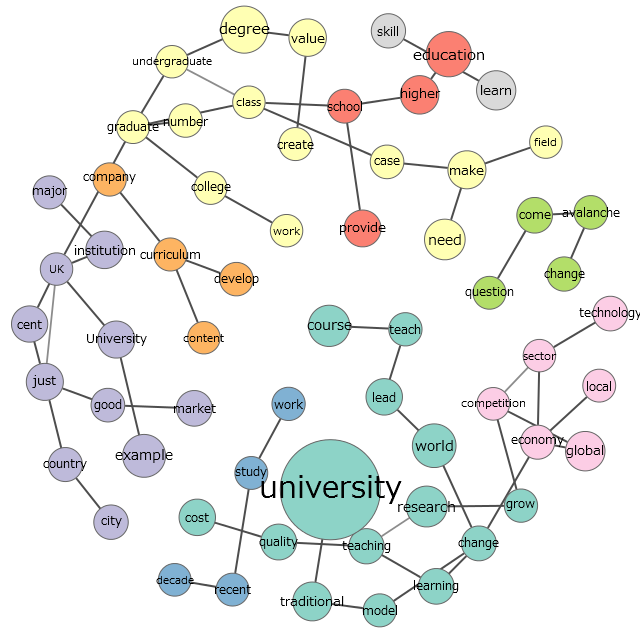
The repeated co-incidence of company, curriculum, develop and content was a particular delight (orange blobs). And open is nowhere to be found.
But, looking at the fine detail both of the co-incidence plot and the report itself we are looking at a superb example of the links between the MOOC hysteria and the commercial and instrumentalist unbundling project. The repeated emphasis on study leading to work, a need for change in order to facilitate competition and the internal dismantling and “de-organisation” that Deleuze and Guattari talk about before they get to the rhizomes in “A Thousand Plateaus”.
“Open” was the first organ that we lost. From a nuanced and specific position in the world of the open educational resource, it is a word reduced to a synonym for two senses of free – free of cost (free as in beer) and free of prerequisites (free as in ride). Freedom, of course, is another word for nothing left to lose – yet somehow we have managed to lose it anyway.
Mike Caulfield puts the birth of the basis of conceptual machine learning at 1954 with Skinner – but novelty and the notion of a response to changes in society is another key trope. We’ve decades of high quality research in the field of learning facilitated by machines, yet to the op-ed crowd MOOCs are the latest thing.
We are really still in search of Newman’s “intellectual daguerreotype”.
“The general principles of any study you may learn by books at home; but the detail, the colour, the tone, the air, the life which makes it live in us, you must catch all these from those in whom it lives already. You must imitate the student in French or German, who is not content with his grammar, but goes to Paris or Dresden: you must take example from the young artist, who aspires to visit the great Masters in Florence and in Rome. Till we have discovered some intellectual daguerreotype, which takes off the course of thought, and the form, lineaments, and features of truth, as completely and minutely as the optical instrument reproduces the sensible object, we must come to the teachers of wisdom to learn wisdom, we must repair to the fountain, and drink there. Portions of it may go from thence to the ends of the earth by means of books; but the fullness is in one place alone. It is in such assemblages and congregations of intellect that books themselves, the masterpieces of human genius, are written, or at least originated.”
And our press have mistaken a restatement of this possibility for the thing itself. Our position, as educators and as researchers in this field is to be honest, even to the point of negativity. David Wiley’s Reusability Paradox has not yet been solved, participation and engagement in online communities is still an exception rather than a rule, resources adapt to learners rather than the other way round, and fully online learning remains a niche. There is still so much work to be done.
Giroux, as cited above, talks of:
“a concerted ideological and political effort by corporate backed lobbyists, politicians, and conservatives to weaken the power of existing and prospective teachers who challenge the mix of economic Darwinism and right-wing conservatism now aimed at dismantling any vestige of critical education in the name of educational reform.”
As peculiar as it may now, seem, the open education movement began in opposition to this effort. Those of you who engaged with things like the SCORE project and the UKOER programme will remember the conversations with incredulous academics and managers. The range of benefits, exemplars, business models and rationales that we can all now rattle off – and the majority of these now have considerable evidence behind them, were far less clear in 2008 and 2009. The fear of “giving away the crown jewels” to the benefit of the world has been replaced by a huge eagerness to give away these same gemstones to private companies spun out of Stanford and the OU.
(and don’t think that it is because of OER not being aimed at students – Audrey Watters wrote only last week about a swathe of commercial lesson plan sites and courseware directories being the unexpected commercial edtech theme of the year)
As Brian Lamb and Jim Groom asked: “Has the wave of the open web crested, its promise of freedom crashed on the rocks of the proprietary web? Can open education and the corporate interests that control mainstream Web 2.0 co-exist?”
To look again to the way the New York Times reported the initial OCW idea, this time with Carey Goldberg “Auditing Courses at M.I.T., on the web and free”.
“Still, is the institute worried that M.I.T. students will balk at paying about $26,000 a year in tuition when they can get all their materials online?
”Absolutely not,” Dr. Vest [then M.I.T. President] said. ”Our central value is people and the human experience of faculty working with students in classrooms and laboratories, and students learning from each other, and the kind of intensive environment we create in our residential university.”
”I don’t think we are giving away the direct value, by any means, that we give to students,” he said. ”But I think we will help other institutions around the world.””
Looking across a range of OER/OCW articles from the mid-00s onwards (using the same methodological approach as the MOOC articles above) I came up with the following corpus:
| New York Times |
01/11/2010 |
For Exposure, Universities Put Courses on the Web |
| The Atlantic | x | x |
| The Guardian |
17/01/2007 |
The Great Giveaway |
| Financial Times |
21/04/2008 |
Adult Workers have a lot to learn online |
| Washington Post |
31/12/2007 |
Internet Access Is Only Prerequisite For More and More College Classes |
| BBC News |
23/10/2006 |
OU offers free learning materials |
| The Telegraph |
25/11/2010 |
Why free online lectures will destroy universities – unless they get their act together fast |
| Time |
27/04/2009 |
Logging on to the Ivy League [UNABLE TO ACCESS FULL TEXT] |
| Huffington Post |
10/08/2009 |
Narrowing the digital divide |
| Fox News |
29/12/2007 |
Internet opens elite colleges to all |
| Reuters | x | x |
| Times Higher Education |
24/09/2009 |
Get it out in the open |
And using the same plotting technique as above:

There was no talk here of “disrupting” education – if anyone was being disrupted it was the publishers who take the work of academics and sell it back to them. The concept of a “direct value” in on campus education now seems impossibly quaint – MOOC talk attempts to short circuit this by an elision of value and recognition in the offer of certification. These certificates, and the faltering attempts to link them to university credit, have entered what I’ve decided to call a Baudrillardian hyperreality of education, no longer signifying anything but the perceived importance of the processes that generate them.
Of course, the process (rather than the practice) of education is what drives the MOOC world. Writers without a critical perspective on both education and technology can be lulled into a simple skeumorphic model of replicated offline models re-established online. You can see large classes witnessing lectures by “rock star professors”, simple quizzes to reflect understanding, discussion groups, assignments and required reading. The process ensures that all of this is measured, monitored and recorded – both (somehow) to accurately gauge student achievement and to refine the process.
Hand and Sandywell, in “E-topia as Cosmopolis or Citadel”, suggest that:
“Adorno’s conception of the administered society and Foucault’s panopticon have been given digital wings, where societal regulation is seen as operating through the capillaries of information exchange. We shift from industrial to post-industrial forms of regulation. Where the original panopticon secured compliant bodies for the industrial process, the cybernetic panopticon of digital capitalism produces docile minds locked into their screens”
Foucault’s original point regarding Bentham’s Panopticon (in “Discipline and Punish”) was that it was the possibility of observation rather than the actuality of observation in such a situation that brought about obedience – “to induce in the inmate a state of conscious and permanent visibility that assures the automatic functioning of power”. The process, however, induces in the MOOC inmate a consciousness of observation as a component of a totality – she knows that there is no chance that the superstar academic is watching her as an individual as the academic is not there, but she is painfully aware that the platform is watching her every move for its own, manifestly non-educational, purposes.
So, then, as anyone that has participated in an xMOOC will know, the game playing begins and the peer assessment becomes a lottery of either unsubstantiated criticism or a timid “that was great”. The process is complete, the value is… well, that’s not for me to say.
The thrust of “E-Topia” concerns the need for a refined theoretical language to properly situate the effect of internet technologies on the global socio-political discourse. And I would, of course, support such an aim. But I would argue that the construction of a language that can convey the realities of education, be it on- or off- line, massive or personal, open or “open” – away from the crumbling narrative of the market, is the essential first step. To close with more words from Audrey Watters:
“We need to get better at asking who is telling these stories. We need to ask why. We need to think about how we plan to tell our stories – our narratives and our counter-narratives. How do we make them “stick”?”
At the very least, we need to begin telling those stories. We need the confidence, almost the arrogance to stand up with nothing more substantial than a compelling story. Because that’s what every MOOC start-up under the sun is doing that, to journalistic applause and repetition, and it seems to be working very well for them.
Pearson College and Ashridge Business School have chosen the launch of the Annual CBI employers survey to announce their partnership. For the first time, the CBI survey included responses from new starters – employees less than two years out of full-time education just beginning their career at a business.
Despite the dangling the promise of the possibility of an iPad mini, only 106 new employees completed their survey. And it did not make promising reading for our friends in the Pearson press team, who were hoping to make an argument that new employees were crying out for workplace skills.
This is all, of course, assuming that you think a response of 106, from employers that employ only 4.9% of people in the UK, is in any way representative. You look in vain for any kind of control or compensation for any skew in these results.
The “new starters” had to be less than two years outside of full-time education, a fact not mentioned in the report or the press release. So maybe a lack of work experience, and of understanding concerning the world of work, is understandable in such cases?
But none of this inconvenient fact-based stuff was going to stop the Pearson College press team:
“The new research, conducted alongside the annual Pearson/CBI Skills survey, found that many new starters felt unprepared for the world of work:
Over 70% of those felt they lacked relevant work experience
Nearly a third of new starters (31%) thought they did not have the appropriate work skills when they started their first full time role
40% did not feel enough time and attention was given to acquiring these skills at school, college or university”
Wow. “Nearly a third” in this instance, means 32 people. The 70% is 70% of those 32 people… TWENTY TWO PEOPLE felt that in their first job after college they wished they’d had more experience of work. “Many new starters” – I suppose it would be “many” if they were all in a phone box.
That’s your world-beating press release leader right there. I wonder if Pearson College will actually manage to recruit 32 people this year? (I understand last year was around 60, 20 of those had their fees paid in full)
[APOLOGY: in the above paragraph, I insinuated that Pearson College recruited around 60 students last year. According to UCAS, the correct figure is 12, none of whom had Pearson College as their first or reserve choice.]
Pearson, as regular readers may know, have a history of looking for dodgy stats to support the argument that universities do not prepare student for the world of work.
At this stage I’d advise people to check ANY stats based press release on employability for spin and accuracy. If a real university used stats like these, they’d be laughed at.
It’s been a while since I got involved in the strange world of government (or agency) report writing but I find myself back there again. For those who don’t know, I wrote a bunch of stuff for and around HEFCE – an organisation that really sweats the drafting process… with documents going through a good 15-16 iterations/circulations before they reach either a senior manager or a comms team. In that process I’d been the one doing the drafting, staring at the same document day after day making microscopic changes in nuance and tone. [an example of one that I did a *lot* of work on was Towards a Framework of Professional Teaching Standards (pdf), ostensibly not a HEFCE document but I was lead drafter… I’ve re-uploaded it here to preserve my pain for future generations]
Nowadays I seem mainly to be in the “expert panel member” role and find that my sympathies go out to those who are trying to draw our miscellaneous hobby-horses and tangents into a piece of extended text that:
Academics, imagine writing a journal paper on a subject you know nothing about, based on nothing but three or four conversations with a group of people with widely differing views and levels of understanding, taking into account a whole world of political and professional pressures. It’s like that. If you are thinking “that sounds exactly like the way I want to destroy my sanity!”, I see that the wonk is strong with you.
But I have also become an avid consumer of these reports, and find that my experiences of writing them weigh heavily on the way I read them.
A report – I would argue – is not written to be read. It is written to be written. It is not written as a flowing single piece of text; it is written as a series of quotations and buzzwords, agendas and links to other reports. It is there to be decoded. Words in government reports do not behave in the same way as words in other parts of the universe.
In 2006, The Avalanches released their seminal album “Since I Left You“. It is formed of thousands and thousands of short samples, some microseconds long. It is affecting music, but it is an odd non-specific nostalgia for records that you have never heard. The closer you listen, the less you hear the unity of the composition and the more you see the clashes between the individual parts.
Nick Hornby (who should damn well stick to writing about music), described in his “31 songs” one of the singles from the album as using:
scraps of things you have never heard in ways that you couldn’t have imagined; the result is that they have, effectively, created something from nothing […there is a] sense of undaunted resourcefulness, the same determination to make the incoherent cohere – and cohere into something new – through talent and a simple force of will.
Just as a non-musician/expert would miss the entire artistry of such an enterprise, and react to the quality of the tune – the non-specialist reader (for which read journalists and inexperienced wonks, as these are the people who write the summaries that everyone else reads) will not understand the references and artistry, and simply react to the more easily understood aspects.
These are the aspects that are tweaked by press teams and such like to construct what used to be called “quotables” but may now be called “tweetables”… small micro-sections of the report that summarisers are expected to pick up on and talk about. The kind of things that would make the headlines in the parallel universe where education-related reports make headlines.
But these can often be used to distract from the real meat of the paper, which may indeed point towards different conclusions to the summaries. This is why it is essential to read reports yourself, as far as you possibly can – and ideally to have some experience in writing them.
Here’s a few things I like to watch for:
I’d love other seasoned readers and writers of these reports to leave further suggestions here.
They tell me you can live a long, long time on the love of a dog.
Things get bitter and bad
And sleep can be had
Late in the day when the options seem gone.
Please let your eyes be a friend to me again.
It’s just malfunctioning teardrops,
Cowboy overflow of the heart.
So President Obama has taken the time off not closing Guantanamo Bay, authorising the use of drone strikes and allowing the NSA to read our emails to put together a Plan to Make College More Affordable. And, with crushing inevitability there exists a whole section on MOOCs.
“A rising tide of innovation has the potential to shake up the higher education landscape.” is the kind of talk that gets Martin Weller on Tumblr, but the section that it led into was what I was most interested in.
There is nothing about the actuality of MOOC delivery and learning. Nothing.
Award Credits Based on Learning, not Seat Time
This is a recommendation aimed at traditional online and campus-based learning, and seems primarily based on the idea of reducing contact hours. Which may be fine for some learners, but from a British perspective we are already seeing students demand more contact with academics for their fees. I suspect this may not be a British thing.
Use Technology to Redesign Courses
We see “blended learning” touted here, you know that well known “MOOC-like” idea that has nothing at all to do with the almost complete global market penetration of the LMS/VLE/MLE/whatever over the past 10 years. Top marks for citing Carnegie Mellon OLI (which should be seen as a model for far more xMOOC type stuff), but alas the study they cited refers to OLI plus traditional instruction which is not reflected in the text of the plan. The figures on the average 40% savings that online learning can offer institutions come from the NCAT course redesign programme. It’s actually an average of 37% (but what’s 3% between friends eh?) and the research was conducted in 2003, nearly 10 years ago. This is in 40 institutions, and one would think that more research should probably have done by now. Certainly my understanding of the received wisdom is that online or tech-enhanced delivery can raise costs – at least in the short term.
Use Technology for Student Services
Online forums. Specifically some Coursera stats that suggest a student will receive an answer to a posted query in 22minutes (from another student, mind you.)
I can’t find the stats cited, but it does appear that only 4% of students will generally use a Coursera MOOC forum . Which suggests that all is not rosy in this particular (walled) garden.
The Austin Peay Degree Compass (I can only find press releases, not the actual compass so it is difficult to know whether it is any good) has just been bought up by Desire 2 Learn. Which suggests it is profitable, at least. I really can’t find any way of telling what students and staff make of it, so I’m going to leave aside my customary “Database solves complex socio-educational problem.” snarking for now.
Recognize Prior Learning and Promote Dual Enrollment
This is another request of traditional institutions, who I am sure will see a rise in state and federal funding to compensate the further loss of income that these ideas will cause. Or maybe the idea is to do away with the idea of students ever coming into contact with a tenured professor. I’m not sure.
Empower Students with Information
Biiiiig data. Of dubious efficacy. Aside from noting that whoever came up with the name “Datapalooza” should be beaten repeatedly with a stout stick, one has to query the absence of student (and prospective student) perspective here. What do students actually want to know about institutions and courses? What can we tell them with any degree of confidence? These are surely interesting questions that anyone (public or private funded) would want to investigate.
Empowering students with information is not the same thing as throwing made-up numbers at them.
Seed Innovation and Measure What Works
Grants to try new stuff. Evaluation of these ideas. I approve. Much better than everyone trying to replicate a business model that even the people who invented it are moving away from. But let’s ensure that these pilots are done ethically and without risk to students or the misuse of public funds for private gain…
Reduce Regulatory Barriers
or, Removing Safeguards To Allow Student and Public Funding to be Exploited by untested methods. So efficient are these innovative new models of education that we have to chuck all kinds of money at them with absolutely no safeguards whatsoever.
—
I’m leaving aside the fact that most of this doesn’t work and we know it doesn’t work. That’s taken as read. University has become so expensive for students because it has become so cheap for taxpayers. Real costs have not risen – if they had we could just pass laws forbidding the purchase of solid gold desks for vice-provosts or whatever.
What interests me is that, despite the gloss of MOOCs and innovation, none of this is based on actual observable evidence from existing “innovations”. It is not a recommendation to empower Udacity, Coursera and the rest to wreak disruption on a moribund sector. It is still nonsense, of course, but it is a more hopeful form of nonsense.
I wanted to read someone who was taking and extrapolating existing trends in the wider world, possibly to absurd levels, and imagining the place of post-compulsory education within these new worlds – and suggesting things that could be considered now to support it the future.
But I couldn’t find anyone writing like that. So, in a fit of insanity, decided to start a blog series like “whose university?” back in 2010. Hence – futurelology.
We are starting to encounter serious bugs with the idea of “work” as what human being should be doing. Humankind is basically engaged in a long price war with machines, and this is a war that it cannot win. It is already unusual (looking globally) to see the work of one human produce enough value to maintain a decent standard of life, and this enroaching trend is not likely to reverse itself any time soon.
We are now living in a global state that has been structured for the benefit of non-human entities with non-human goals.
The first industrial revolution begun when it was established that machines were more efficient at manual labour than people. This led to a new area of work, the generation of energy in forms that machines could use, which dominated much of the 20th century.
The second industrial revolution, which began in the middle years of the 20th century, is occurring as machines are becoming more efficient than people at intellectual labour. This too has led to a new area of work, the generation of knowledge (in the form of data) in forms that machines can use.
The third industrial revolution is beginning to occur as machines become more efficient than people at social labour. It can be imagined that this will lead to a new area of work, the generation of people in forms that machines can use.
We live in an age in which familiar restraints are being kicked away, and foundations snatched from under us.
Work is humanity’s primary means of defining value, so the devaluing of work leads to a devaluing of humanity. Both Marx and Adam Smith, writing at the dawn of the first industrial age, drew a parallel between the “value” of a commodity, and the amount of labour required to to produce it.
But as industrial society has moved in to a second phase, the amount of human labour required to produce the same commodities has fallen, and (with design and energy efficiencies) the amount of machine labour – which, after all, is just an abstraction of the human labour required to design and power the machine – has also fallen.
You might, at first, think this would mean stuff has gotten cheaper. But this is to ignore the corollary to efficiency – the less work that has to be done, the less wages are paid to people.
“The worker becomes all the poorer the more wealth he produces, the more his production increases in power and range. […]With the increasing value of the world of things proceeds in direct proportion to the devaluation of the world of men.” (Marx, on Estranged Labour, 1848)
So the “work singularity” of the title is where the creation of commodities becomes so efficient that no worker is able to buy them. I use the term “singularity” because this represents a single, inescapable end-point to our civilisation, and it is not possible to make any meaningful predication as regards what follows. Either civilisation will be radically, unrecognisably, reorganised – or it will collapse.
In education, is it a co-incidence that costs have risen as institutions are under more pressure to deliver efficiency? Perceived student costs have in fact risen as a deliberate political choice in order to drive efficiency in education. The actual cost of educating a student in the US and UK – if you add public investment and student fees – has remained largely static in real terms for the past 10-20 years.
Efficiency – a word I have used variously throughout this post, could usefully be defined in modern terms as the ability to pay less for the same (or similar) results. In education, by far the most expensive outlay is on the wages of educators, so the efficiency agenda has invented various ways to pay them less:
or to get more labour out of them:
(These moves have been paralleled by similar pressures on the workforce more generally – it is important to be clear that this is not a specific attack on academia, rather the academic experience of a more general malaise.)
But what can post-compulsory education offer a workforce entering employment at a time when labour is valued so poorly? And what can be offered as we approach the work singularlity?
First would be an enhanced support for learning literacy – enabling members of a pre- and post-singularity society to re-skill and to adjust to rapidly changing expectations. This also has the advantage of meeting the needs of our current society with its basis on casual labour, but actually refers to a much more profound ability to adapt to whatever comes after the collapse of waged work.
Second would be a documentation and preservation of the knowledge and insight of the existing experts, in academia and elsewhere. Robust and decentralised forms of knowledge-sharing and social media would appear to be a key activity here, as would the archival and replication of resources from these sources.
Thirdly would be an improved understanding around where humans can perform tasks that machines cannot and will not be able to. Mechanised tasks tend to be those that can be standardised, that do not require deep listening skills, and can be logically mapped. There is much that needs to be done that does not “fit” mechanisation, and one of the most important things we can be doing right now is to ensure that the attempt to mechanise these tasks does not destroy our understanding of them.
In certain moods I would add “learning” to this latter category.
A distressing number of reports and people who should really know better have been recommending that we merge HEFCE, QAA, OFFA and Uncle Tom Cobleigh into a single Higher Education Council (HEC) because, I guess, efficiency LOLs. This pernicious trend started with the Browne Review, and like nearly everything else in the Browne Review it is utter nonsense.
That didn’t stop the IPPR repeating it (remember “A Critical Path“? No, me neither…), and now certain parts of the Liberal Democrats are proposing it as party policy (motion 15.25)
So, for hopefully the last time, you can’t merge the QAA into HEFCE because:
So, to merge the QAA into HEFCE you would have to invent a new organisation that does the quality assurance stuff in England that the independent and respected QAA currently does, and then merge that organisation into HEFCE. This would require legislation, and there would still be a QAA at the end of it because Scotland, Wales and NI would still be contracting with them.
For non-specialists, you can assume that any statement about HE that includes the recommendation that the QAA is merged with HEFCE is written by someone who does not understand HE policy and can safely be disregarded.

Every iteration of ds106 is greeted by a brace of animated GIFs (it’s a tradition, or an old charter, or something…). Taking inspiration from the “Dancing Jim Groom Around The World” assignment, I’ve taken Dancing Jim (just watch him go!) into a nightmarish educational future, where a young daughter reading a Coursera-provided holographic text on “The History of Disruptive Education” asks her edtech Daddy the eternal poignant question, as his son plays with his “Learning Analytics are Fun!” set at his feet.
Act now – sign up for DS106 before it is too late! The “headless” iteration starts 26th August with the now traditional bootcamp.
With my six-year-old son in tow I had the perfect excuse to view on Sunday what promises to be the the Higher Education film of the summer – Monsters University.
Meanwhile, David Willetts was writing the foreword of the Higher Education Wonk strategy of – lets be honest – the morning, “International Education Strategy: Global Growth and Prosperity”
So on the one hand a knowingly grotesque fantastical parody of a higher education system based equally on fear and wishful thinking, mashed into an unrealistic linear plot and driven by non-human entities for non-human ends – and on the other hand (yes, you’ve guessed it…) Monsters University.
But, cheap LOLs aside, there is more to link the two than you may think. In Joseph Campbell’s terms – both focus on a particular facet of the monomyth – the crossing of the first threshold. As “Hero with 1000 faces” puts it:
“With the personifications of his destiny to guide and aid him, the hero goes forward in his adventure until he comes to the ‘threshold guardian’ at the entrance to the zone of magnified power. Such custodians bound the world in four directions — also up and down — standing for the limits of the hero’s present sphere, or life horizon. Beyond them is darkness, the unknown and danger; just as beyond the parental watch is danger to the infant and beyond the protection of his society danger to the members of the tribe. The usual person is more than content, he is even proud, to remain within the indicated bounds, and popular belief gives him every reason to fear so much as the first step into the unexplored. The adventure is always and everywhere a passage beyond the veil of the known into the unknown; the powers that watch at the boundary are dangerous; to deal with them is risky; yet for anyone with competence and courage the danger fades.”
Mike Wachowski (the little green one with the eyeball) marks this with a fermata – a pause at a clearly marked threshold, usually a visible line or change in terrain. It’s a beautiful, character-defining shot which is repeated again and again throughout the film. He takes a moment to reflect – almost to say “I can’t believe it!” at each stage of his journey. He’s genuinely awed to have gotten as far as he has.
What was interesting in a storytelling sense was how little personal growth Mike demonstrates during the film. He arrives pretty much fully-formed at the start of the prequel – he’s already thoughtful, diligent and supportive of others. In that sense the viewer is led to believe that he sees higher education as an opportunity for hard work.
Sullivan – the blue hairy one – starts the film with a broader sense of entitlement due to a natural talent and family connections. He sees higher education as a simple threshold, one where a completion affords him entry to the lifestyle he desires.

For David Willetts (the beigey-pink one with the glasses and the bald head), higher education is also a threshold. It is a gateway through which one must pass in order to succeed. Paragraph 2.2 focuses on the value of UK qualifications to overseas students – in essence the “payload” of the UK education offer. People apply to UK education because they value the qualifications they get – it’s another “crossing of the first threshold moment”.
In a way it is an example of linear thinking, education as a narrative arc, where you pay for a qualification which offers you certain benefits on completion. But as Joseph Campbell (or Mike Wachowski) would tell him, crossing the threshold is only a starting point, not an end point.
Sticking with Campbell’s terms, you could see higher education as a belly of the whale moment, through initiation, road of trials and atonement with the father.
The idea of paying for a qualification is manifest nonsense. And advertising UK education as the best place to buy a qualification doubly so. Only twice in the BIS strategy does the student experience merit a mention – once in reference to studying in Australia, the other as a possible issue of incorrectly using student visas.
For all the “students at the heart of the system” rhetoric, what we are left with customers at the heart of the market.
Nowhere is money an issue in “Monsters University”. Status – yes. Students with a certain pedigree or certain “look” are afforded a level of respect from others – but – as Sullivan finds out, this is not a substitute for academic effort, and the expectations of academic success end up weighing heavily on him.
Paying for a place in a course gets you precisely nothing, apart from a limited amount of status which is easily lost at the first point you actually have to do some work. Cartoonist Winston Rowntree illustrates this perfectly in an article about online dating on Cracked.com which is better than it has any right to be.

Mike Wachowski passes the initial threshold and keeps working – he’s the epitome of a lifelong learner. But everything in the BIS strategy is aimed at the Sullivan approach to education – the consumer, the entitlement, model.
I wrote a while ago around the model of student as labourer-consumer. What we see in the BIS strategy is proof that the purchase model of education is not just an aberration, but a deeply flawed ideology that goes right to the hearts of those charged with supporting and improving our universities.
In Monsters University, neither route is seen as the correct one, with both protagonist monsters being rusticated for contact that brings the university into disrepute. The implication is that the institution itself needs to change, to accept students as individuals rather than matching them to a profile. And, as Monsters Inc, made clear – the basis of the entire society, which is situated in the exploitative use of natural resources and a fear of outsiders, is open to question.
It’s often been suggested that many, if not all, edtech folks secretly want to be a librarian. No bad thing I might add. It starts with a bit of a dabble in ontologies and controlled vocabularies, but pretty soon people start wanting their own repository. And we all know where that leads…
… if I’m me, reading this in the future (1) stop reading your own blog and go and issue some books, (2) this is the post where it all started to go wrong for you…
I’ve spent a lot of time on here recently laying into various reports linked to higher education, but today I want to point to something important that will most likely be overlooked.
How do you describe what you teach? How do people feel sure that what you teach is the same as what is taught in a similarly named course or module at the university down the road?
The Higher Education Data and Information Improvement Programme (HEDIIP), is based at HESA (the UK HE statistics people) and overseen by the Better Regulation GroupRegulatory Partnership Group (cheers @AndyYouell at HESA). It has been charged with a body of work building on the emphasis in 2011’s “Students At The Heart Of The System” BIS white paper on providing accurate information on higher education.
As no-one but Andy McGettigan will recall, these groups were asked to “to redesign the information landscape” in paragraph 6.22 of said document.
They kicked of in earth shattering style by publishing, this month (July 2013) a thorough examination of JACS (the Joint Academic Coding System). JACS is, fundamentally, a semi-hierarchical near-comprehensive list of subject areas taught at universities and colleges in the UK. You’ll have noticed that that last statement contains more qualifications than any MOOC ever – this is because, although the aims and intent of JACS is laudable, it has a couple of very serious issues.
As a primer for the uninitiated, JACS is a method of accurately defining an academic subject, being a short code consisting of one letter followed by three numbers. So:
So, ideally a properly coded data return could be drilled down to the appropriate level for analysis. Alas, as so often in metadata, the reality falls far short of this noble dream.
Firstly, not many people actually want to use it, and those that do use it use it inconsistently. The main user is HESA, who manage it so kind of have to. UCAS initially wanted to use it but don’t, ending up inventing their own alternative method also involving letters and/or numbers. HEFCE sometimes use it, but not always (eg price groups for teaching funding do not map cleanly to JACS). Some institutions use it for internal purposes, some don’t.
The HEDIIP report describes a lovely test where institutional staff were asked to provide a JACS code for a module “‘Statistics for Archaeologists” when taught by (a) Mathematics staff and (b) Archaeology staff. HESA guidance suggested that “Applied Statistics” (G310) was the correct code in both cases, but only 10 % of respondents gave that answer. (the most common answers were G310 for a Mathematics delivery and V460-Archaeological Techniques for an archaeological delivery).
(When I was at HEFCE we used it for an internal analysis of the CETLs – remember them? – so I know first hand the vagaries of applying these codes to specific subject areas with any degree of consistency)
Of course, this is all only of glancing interest, until you realise that stuff like Unistats and the Key Information Set (KIS) are powered by JACS. One particularly worrying quote from the report:
“‘A respondent to the review survey cited one particularly anomalous example from the Unistats website where their BA Fashion Marketing course returns satisfaction statistics from Materials & Minerals Technology and work and/or further study statistics from Engineering & Technology. Without going into the detail of whether this is down to the institution’s own coding or the KIS algorithms, it is clear that such data is of little use (and indeed misleading) to potential students and that the current classification system is not lending itself to enabling clarity.” (p25)
Of course, a system where:
“A particular module of study will:
- have a main subject of study (identified by one or more JACS codes);
- belong to a cost centre in the HESA record (although this attribute derives from the teacher see below);
- be taught by one or more members of staff who are assigned to a cost centre and belong to a (or possibly more than one) ‘home’ department (or school);
- be ‘owned’ by a particular department (or school or other organisational unit which may itself have multiple cost centres or which may indeed be part of a larger cost centre);
- belong to one or more courses or programmes of study (also identified by one or more JACS codes) which is also ‘owned’ by a particular department (or school) which may be different to the teaching department (p23)
is bound to contain many such coding errors and unsafe generalisations when only the higher levels of JACS are used.
The second major issue is that, in an IPv4-like moment, we are running out of codes for emerging subjects. As academic subjects develop, largely in areas of new knowledge and on the boundaries of cognate subjects, codes must be assigned to them.
The last major revision to JACS was version 3.0, which applies to student entry for 2012. It included changes and additions in a range of subject areas, most notably the addition of a new “I” group for Computer Science, splitting from the former Mathematical and Computer Sciences (group “G”). As the report notes:
“This permitted some expansion in Mathematics (without any reuse or renaming of codes which is poor data management practice and, hence, explicitly prohibited in JACS) whilst supporting the larger of the growth areas. This has solved an immediate problem but the capacity for this type of amendment is extremely limited and there are other subject areas which will ultimately run out of codes.” (p9)
Again – codes, especially in occasionally lab-based subject like computing, can mean the difference between securing HEFCE funding and being paid for by fees only. This might seem like a data nerd issue but it can mean the difference between a course running and staff being laid off.
Given that (rightly or wrongly) there is an increased emphasis on data quality and data availability in Higher Education, it is clear that “somebody should do something”. HEDIIP makes a number of rational and practicable recommendations:
- the new framework should recognise the, currently implicit, assumption (at least by HEIs) that JACS is a discipline-based classification;
- in developing the new framework the Higher Education Academy’s discipline areas should be considered as a starting point;
- the new framework should consist of three rather than four levels;
- the new framework should be based on a six digit coding structure;
- the new framework should provide a persistent URI (uniform resource identifier) for each of the entities
- in the classification;
- the authoritative URIs should be developed and maintained as a web service for the sector;
- the new framework should be explicitly assigned an open licence;
- a project to implement the new coding framework will require a clear and targeted strand of communications activity.”
Proper data-nerds will feel the thrill of persistent URIs leading to a linked data approach and an open license, which would be a very sensible way of allowing simpler and more distributed analysis of information linked to funding and league tables. One of the worst things (from a very strong field of worst things indeed) to come out of the Browne/Willets funding model has been the increasing politicisation of educational data, and anything that can act as a brake on this can only be welcomed.
But these recommendations – notably – do not do anything to support consistent use of a new set of codes, and to avoid the systemic “gaming” of data to maximise funding returns and student recruitment. In this matter, sadly, it is the system – not the tools such as JACS or whatever follows – that are at fault.