Warning: Constant MAX_INLINE_MENTION_LENGTH already defined in /home/dkernohan/public_html/wp-content/plugins/semantic-linkbacks/includes/class-linkbacks-handler.php on line 4

Warning: Cannot modify header information - headers already sent by (output started at /home/dkernohan/public_html/wp-content/plugins/semantic-linkbacks/includes/class-linkbacks-handler.php:4) in /home/dkernohan/public_html/wp-content/plugins/indieauth/includes/class-indieauth.php on line 257

Warning: Cannot modify header information - headers already sent by (output started at /home/dkernohan/public_html/wp-content/plugins/semantic-linkbacks/includes/class-linkbacks-handler.php:4) in /home/dkernohan/public_html/wp-content/plugins/indieauth/includes/class-indieauth.php on line 257

Warning: Cannot modify header information - headers already sent by (output started at /home/dkernohan/public_html/wp-content/plugins/semantic-linkbacks/includes/class-linkbacks-handler.php:4) in /home/dkernohan/public_html/wp-content/plugins/indieauth/includes/class-indieauth.php on line 257
FOLLOWERS OF THE APOCALYPSE – Page 10 – Purity * Truth * Beauty
Warning: Attempt to read property "plugins" on null in /home/dkernohan/public_html/wp-content/plugins/styles/classes/styles-customize.php on line 150
  • Messages that have been in Spam more than 30 days will be automatically deleted

    It just occurred to me that the linkless spam that clogs up my gmail spam folder is:

    • written by machines, according to an algorithm
    • distributed to a list of uncertain provenance
    • read and filtered by machines according to another algorithm
    • deleted without ever having been read by a human being.

    It appears to exist, as far as I can see, as a means of fine-tuning automated writing processes in order to game automated reading processes. Meanwhile, the automated reading processes are using the same data to refine themselves.

    And this is huge data.  Around 200 billion emails are sent per day, of which around 70% are unsolicited (or spam) – though this is slowly dropping.

    Like high-frequency trading, this is an instance of a system acting in ways that are initially incomprehensible to human observers but on careful scrutiny moves towards a goal.

    But what is the “goal” of spam email?  A few years ago I would have said to be read by humans. But clearly humans do not (in the main) read spam, and if they do they are unable to act on it.

    I’ve got a couple of hypotheses:

    1. Spam is a zombie system. No new spam systems are set up, but older ones – based on weak AI – are left to iterate in a similar way that Bayesian filters do. The “spam poetry” we are left with is the result of algorithms left to iterate for many “generations” longer than they were designed to do (very similar to that 10 year old save game of Sim City 2). And possibly this will one day happen to those high-frequency traders. OR;
    2. The entire system of spam is part of a decades-old research project into developing software that would pass the Turing test. Initially using faux- commercial topics to prompt major email providers to ramp up iteratively-learning spam filters, the principal investigator created and used virus- and botnet- systems to spread similarly iterating spam creation tools that would move away from commerce (has anyone ever bought anything from a spam email?) in an attempt to get around the filters. An experiment now running entirely autonomously, it has allowed (send) machines to begin to pass for humans in written language and (receive) machines to break down and analyse language.

    Theory 2, obviously, suggests an astonishingly smart individual who has researched AI, learning and autonomous machine decision making at a number of major academic institutes and also has links to a major provider of cloud-based email send and filter functions.

    Maybe all of your email spam is because of Sebastian Thrun’s attempts to perfect artificial intelligence.

  • Jim Groom in SPAAAAACE. #oer14

    Ok, how about this as a proposition:

    “Open Education, as we know it, is predicated on the ability to share and use material without constraint – and this is a capacity baked in to the underpinnings of the internet. But the internet is changing.

    • In the UK, as in China and in many other parts of the world, the government has the right to define what can and cannot be seen on the internet.
    • In the US the demise of Net Neutrality means that this right to filter and constrain is now owned by those who provide your data connection.
    • A globalised “national security” industry has been reading and analysing our online activity. Despite our scandalised responses, this is still happening.
    • And across the world our ability to define and develop our internet selves as constrained by the actions of the entities that host this information, and even by the shape of the containers we are invited to pour ourselves into.
    • Though we once seemed on the point of solving the issue of sharing data between environments, this is again becoming harder. And it is becoming harder by deliberate design.
    • All of this, is constrained even more finely by the awakening “corporate internet”, where everything that we share could have repercussions on our ability to work and earn.

    The internet is not the same as it once was. And it is likely to become a harsher, less welcoming, less forgiving place.

    This session is not a session to make you feel good about sharing your resources, or opening up your courses. We will be looking at the way we as actors entered the online stage, and the actions we have made upon it, throughout our connected lives.

    Above all we will be talking about the idea of ownership – a hugely unpopular idea that I still feel a little uncomfortable about. But this is the nature of this workshop. We will be taking a long, hard look at exactly what we are doing. And we may not like the answers we get.

    A “domain of one’s own”, in the light of such doommongering, may seem very little. But the idea of using and supporting “space” online, rather than accounts or platforms, is at once an old fashioned idea and a revolutionary one.”

    Bloody hell, eh? This is how Jim Groom and I introduced our session on Reclaim Hosting at the OER14 conference in Newcastle at the end of March. At least, that’s how I did it. Jim is such a slacker I had to beam him in via specialised equipment (no Andrew Ng-ing here).

    (photo: cogdog@flickr)
    (photo: cogdog@flickr :CC-BY-SA)

    The “ghost of Jim Groom” as delegates dubbed the assembly (in reality a hatstand, tablecloth, poster tube, blue spotlight and cheap lo-res projector) was able to address the session and engage in discussion with me and others.

    The session involved various conversations across time (via the gift of Martin Hawksey’s Paleophone*) speaking to a 1994, 2006 and 2014 Jim Groom about the state of online learning at that time. We intercut this with participants talking and thinking about the way that they first experienced interacting with and creating with the internet, and the way that they now construct their digital identity/identities.

    What struck me here is the way that the optimism of the early years, which kind of reached a peak in 2006, had been replaced by a caution and a reluctance to experiment. The big difference was between the Jim of ’06 and the (bald!) Jim of ’14.

    Open Education has lived through the peak of “Web 2.0” craziness, and the current retreat to the ever-welcoming embrace of the LMS is something that has taken many involved in the movement by surprise. But looked at from a wider cultural perspective (alas, we didn’t have much time to get into this during the session) we can see that the wider emphasis on measurable impact and control within our lives more generally.

    There are few arguments more difficult to make to an organisation than the argument for “fast, cheap and out of control”.

    What Reclaim Hosting begins to offer is a way to have our own space, were we own and manage (or not) what we want to share. I connect to it via some of the emphasis on individual and team agency above institutional activity that the latter days of UKOER got into. Others may (or may not) agree.

    But I’m iterating closer and closer to the Von Hippell model of innovation where “lead users”, or individual agents and small groups, are solving problems under their own initiative. A wise organisation knows to at least permit (and if possible, support) these innovations and help them become generalised as needed. A less wise one buys in tools or practice that look innovative from elsewhere.

    As a simple way of bringing an experimental space to organisational academic practice, reclaim hosting is a hugely important move. In open education – a space now rapidly being colonised by organisational interia and being eaten away at the edges by silicon valley, we are more in need of experimentation than ever.

    What will you do with your space?

    *Martin actually invented the Paleophone in 2020 but then called me in early 2014 to instruct me on building one to use in this session with Jim. I think it is touching that the first thing Martin did when inventing what basically amounts to a time machine is to help me with my OER14 session, but that’s just the measure of the man 🙂
  • Dickens on big data

    It has become one of those common place go-to riffs in education reform. Not quite up there with “education is broken” or that bloody Ferris Beuller video. But if you’re listening to someone with pretensions of a literary background you may well catch an earful of that classic indictment of useless educators:

    “Now, what I want is Facts. Teach these boys and girls nothing but Facts. Facts alone are wanted in life. Plant nothing else, and root out everything else. You can only form the minds of reasoning animals upon Facts; nothing else will ever be of any service to them”

    If you are lucky, you may be introduced to the fact that the character speaking is named Gradgrind and the book is Charles Dickens’ “Hard Times“. Gradgrind, of course, wasn’t a teacher – this was the charmingly named Mr M’Choakumchild – nor had he any real reason to be in the school at that point.

    For what is (to my mind) one of Dickens’ more incisive and political books it is not often read. Certainly it has it’s share of unexpected familial coincidences and grotesque characters, and naturally poverty is compared with the moneyed classes with a situationally unlikely set of instances of social mobility – but at heart it is a dystopian novel based on the excesses of a certain persuasion of utilitarianism.

    “The greatest happiness of the greatest number” is the Benthamite cry, and this led indirectly to Jeremy sitting in on UCL committee meetings more than 150 years after his death. But a great deal of the ongoing utilitarian work was finding reliable methods of identifying when people were happy, and the conditions that were preventing this.

    There is a charming passage in Hard Times where Dickens reflects on the earnestly pursued data-driven diagnoses:

    “[…] there was a native organisation in Coketown itself, whose members were to be heard of in the House of Commons every session, indignantly petitioning for acts of parliament that should make these people religious by main force. Then came the Teetotal Society, who complained that these same people would get drunk, and showed in tabular statements that they did get drunk, and proved at tea parties that no inducement, human or Divine (except a medal), would induce them to forego their custom of getting drunk. Then came the chemist and druggist, with other tabular statements, showing that when they didn’t get drunk, they took opium. Then came the experienced chaplain of the jail, with more tabular statements, outdoing all the previous tabular statements, and showing that the same people would resort to low haunts, hidden from the public eye, where they heard low singing and saw low dancing, and mayhap joined in it; and where A. B., aged twenty-four next birthday, and committed for eighteen months’ solitary, had himself said (not that he had ever shown himself particularly worthy of belief) his ruin began, as he was perfectly sure and confident that otherwise he would have been a tip-top moral specimen.”

    The strikingly modern aspect of this, to me, is not just the reliance on “tabular statements” to define social and moral ills, but also the reliance on coercion and behavioural engineering based on these tabular statements.

    Quite what conclusion I draw from this quote I’m not yet sure. But there is some link between the aggregation of quantified selves as data trails within a larger quantitatively driven policy process and the excesses of utilitarianism that Dickens was satirising.

    And you should (re)read “Hard Times”. Because it strikes home regarding the almost unnameable something that austerity-battered populations cling to that is almost the precise opposite of data-driven policy making.

  • The Onrushing Avalanche of Pedagogical Technology (1936)

    I’m presenting at London Book Fair next week and wondered on a whim if it would be a good idea to present as if it were actually 1936. It’s probably not such a good idea. This is a sketch of a 5-7 minute presentation in that style (which I freely admit I stole the idea of from Brett Victor’s mindblowing “Future of Programming” presentation at DBX2013) and it owes something of a methodological debt to Jim Groom’s ongoing paleoconnectivism.

    “A college education for anyone who wants it. A complete course in practically any of the subjects now named in the college curriculum – for five dollars; an elementary course in these subjects for one dollar, and a single far-reaching lecture on one of them by a worldwide authority for ten cents”

    Professor Michael Pupin, Professor of Physics at Columbia University, sets out a compelling vision for the future of higher level instruction in a  “Popular Science” interview. In this vision of the future there is no need for a campus, or for textbooks.

    Both university and private money is being invested in this and similar schemes – after recent upheaval in the financial markets it appears that technology-led speculation has moved to the world of education, bypassing existing industries entirely. A glance through the content of the rest of “Popular Science” for the month in question sees a number of advertisements for various forms of remote learning, for business or for pleasure.

    Remote instruction has since become far more widespread, and we are on course to see more than 200 city school systems, alongside numerous colleges and universities, broadcasting materials by 1938. Both Columbia and Harvard, along with many other famed institutions, are a part of this movement. Often, credit is offered linked to self-administered examinations.

    But, despite the obvious boon to those thirsty for knowledge without the capability to attend a physical campus, not everyone is a fan. Bruce Bliven of The New Republic asks: “Is radio to become a chief arm of education? Will the classroom be abolished and the child of the future be stuffed with facts as he sits at home or even as he walks about the streets with his portable receiving-set in his pocket?”

    Bliven is highlighting the need for a social aspect to learning. Advances combining learning theory and psychology at Yale (notably the work of Clark Hull) suggest that the act of learning is one constituent of the wider formation of character, and that the act of imitation is key to this. The person of the teacher, and of the more mature peer, is key here – and as yet we cannot transmit character via radio waves.

    Or via the printed press. None of these concerns about technology in education are new. In Plato’s account of the dialogue between Socrates and Phaedrus the idea of learning from books is discussed:

    “[T]his invention will produce forgetfulness in the minds of those who learn to use it, because they will not practice their memory. Their trust in writing, produced by external characters which are no part of themselves, will discourage the use of their own memory within them. You have invented an elixir not of memory, but of reminding; and you offer your pupils the appearance of wisdom, not true wisdom, for they will read many things without instruction and will therefore seem to know many things, when they are for the most part ignorant and hard to get along with, since they are not wise, but only appear wise.” [274c-275b]

    Our UK coalition government is presiding over a number of far reaching changes to the education sector, not least the raising of the compulsory school leaving age and the development of new types of schools to meet the needs of new forms of employment. But, in this context, the 1928 Hadow report recommendation that “the books used in schools should be excellent in quality as well as adequate in numbers” suggests that as a reference and as a model, high-quality published material should be around for a long time yet. As the report notes (p112) “[C]hildren should learn from them to admire what is admirable in literature, and to acquire a habit of clear thought and lucid expression.”

    Whatever the advances in pedagogy that the future may see, it is difficult to imagine a time where the expertise of the tutor, the lucidity of published materials and the discipline of classroom dictation are not central to the learning process.

    The Rome Act of the Berne Convention convention, nearly 10 years ago, added a whole range of additional publication types to those protected globally by copyright. It is to be hoped, that as technology develops, these global treaties protecting the rights of publishers will develop with them, but that this would not be to the detriment of access to published works by learners and scholars.

    But how are the publishers using new technologies to support education? Already we have seen the Milwaukee Journal experiment with Facsimile transmission of newspaper pages via the airwaves to a range of receivers in department stores and other public places. Although, at present this is a proof-of-concept led by the struggling newspaper industry as a way to cope with the threat of radio news, it is possible to imagine academic materials transmitted in a similar way.

    We know that certain enterprises, for instance the innovative start-up “Penguin“, are experimenting with newer, more portable formats for books. The team are also looking to revolutionise distribution via a number of platforms in railway stations. Admittedly, these have been cheap mass productions, and I for one would not be surprised if a newspaper business like Pearson doesn’t become involved. But what today is only a way of selling gaudy crime novels for the price of a packet of cigarettes may tomorrow cut into the core business of many academic publishers – imagine if a consortia of university presses owned an operation like Penguin – or the proposed Pelican factual imprint?

    Increasingly, readers are expecting “more” from books, and are paying less for them. Competition from broadcast channels has so far been focused on the newspaper industry, but who is to say that the in-depth engagement with an educational institution or a textbook would not be next to fall to the immediacy of new sources of information? In 80 years or so, would we be discussing a global marketplace in scholarly publication that doesn’t involve printing at all? A few years ago I would have said no, but these days – in the words of the popular song by Mr Cole Porter – “Anything Goes”!

  • Everyone is miserable. We are uninformed. We are lonely and scared.

    So, the right own the future, the left are trapped in the past. So says John Harris in the Guardian, at least.  This is a perplexing argument, as I agree with much of what he says about the problems that he enumerates (changing nature of work, environmental issues, ageing population) but it is clear that all of these require long-term, structured and global collective action (which is pretty old fashioned socialism, frankly) if we are to have any chance of even beginning to address them.

    I started thinking a while ago about a Generation X “to-do list”, given that the preceding generation has utterly failed to sort any of this stuff out (seriously, come on people…). So this is the list of stuff we literally have to do in the next 10-20 years if we have any ambitions of either surviving and flourishing as a species.

    I’m well aware that everything that follows is hopelessly naive. I don’t care.

    1) Everyone is miserable. Human life in the c21st is so rarely an enjoyable experience for anyone that the entire basis of civilisation is up for question. If we’ve build this huge machine to live in which is making most of us unhealthy, tired and lonely we should fix it or build something else.

    Q1a) Waged work is fundamentally flawed. The dominant model of survival we have  is that where we are allocated value based on the work we do for others, and can use this value to purchase goods or other work from other people. But with the “purchase” side of the system driven by a need to reduce production costs – using technology and/or straight up human exploitation, the odds are stacked against the “realisation of value” end. In other words, if we want to buy cheap stuff we will have to employ less people.

    1a1) We need to buy less stuff. Buying stuff is a rubbish proxy for happiness. Time, human contact and the pleasure of creation, are much better ways of realising the goal of happiness so…

    1a2) We need to work less. For the first time in history there is less work that needs to be done than there are people to do it. A lot of people are doing work that doesn’t need to be done, either because there are machines to do it or it is just flat-out useless. But we have an economic system where if people don’t work they freeze/starve.

    1a3) The way we share stuff is utterly unsustainable. A few people have everything, most people have nothing. This is not going to end well for either group.

    A1a) Global Basic Citizens Income. Everyone receives a basic income sufficient to live happily on. Where people do choose to work, some of the value realised could be in additional money, or other opportunities. The remainder of the value realised (and all the value realised by automated labour) should be used to fund the global basic income. This is going to need multilateral state government agreement, and there is no other way of running it that as a (global) state owned project.

    Q1b) The environment we live in is horrible. It is either disgustingly expensive or unhealthy, often both. Much of this is driven by waged work [1a)] . People “have” to live in horrible places because they have to work nearby.  But it is also driven buy the myriad stupid things we do to the planet in the name of facilitating our economic model. 

    1b1) There are few spaces for humans to live. There are actually loads of places for humans to live, but the majority of us live in places designed for workers. They’re all piled up on top of each other near (enough) where we work so we can get there. We spend most of the money we get from work on them, thus perpetuating the waged work cycle. The spaces for workers who don’t work, where these exist (and they are becoming fewer and fewer) are in the same places and have the same problems.

    1b2) There are very few spaces for anything else to live. Because we all live piled up together, the accumulated filth has to go somewhere else or it would be literally deadly. So we burn some of it, pump some in the sea, and put the rest in the ground. This poisons all of the other wonderful things that we share the earth with. And us, of course.

    A1b) We need to better manage the places that we live. Living in huge cities is a very unhealthy state of affairs, both  for those who live in them and everything that lives outside. We need to think, on a global level about where and how people live, and relocate and re-educate people in how to do so. This – again – is a global managed solution that needs state control. It will not just happen, no matter how many “downsize” articles are written and read by rich people.

    Q1c) We are using too much power. It’s an expensive and dirty business being this miserable. Historically we’ve solved this in the time-honoured manner of burning stuff. We started with burning other living things, then we graduated to digging stuff out of the ground and burning that. These days we’re all about causing huge cracks to appear in the ground with explosions and then burning what comes out. All of these things are running out, so are increasingly expensive and increasingly dirty.

    1c1) Our way of living uses too much power. For half the year we burn stuff to make our buildings hotter, for the other half we use poisonous substances and burn stuff to make our buildings cooler.  We occasionally want to go to other buildings, and to do this we burn more stuff in engines.

    1c2) Power is dirty. Even the newer, “cleaner”, ways of generating power we can use are pretty messy. Partly because we need so much of it, and partly because we need it cheaply and quickly, this is not seen as an issue. But it will become one.

    A1c) Radically rethink the way we live. We need to use less machines, and the ones we do use need to be as efficient as possible. We can use machines to replace labour, and in some cases we already do where it is cheaper than employing people. But we should use any surplus to ensure that the machines are cleaner than employing people. This requires tough new laws, and only some kind of government can make them. Or, more likely, it requires government control of industry.

    2) We are uninformed. I’m not saying that we are stupid, because we are not. But most of us know very little, and what we do know is of very little use. There’s a whole range of reasons why this may be the case.

    Q2a) Our education system is focused on preparing us for waged work, and this is increasingly explicit. We are training generations of people to function in a structure that will depress and eventually kill them. And we are designing out the creative, lateral thinking that would allow us to adapt as this model of civilisation breaks down. As a delightful foretaste of work, our education system is also making people ill, and making the places we live horrible.

    A2a) We need to redesign that system to prepare people for the world that they will (hopefully!) live in, rather than the rather horrible world we do. This takes firstly a global will to dream of a less miserable future – a big job in itself – and secondly the support of the kind of institution and people that could offer the education the people would need. Both these, with the best will in the world, require political will at a global level.

    Q2b) It is almost impossible to get good quality information. Here, we can grudgingly award a mark to the generation before us, as the internet is unquestionably the best thing to happen in this space for a long time. But then we remove that mark for the internet we now have, which is no longer neutral and is generally becoming another way to buy things we don’t need and/or make each other miserable. Away from this, much knowledge is locked away in expensive books and journals, and read by very few. However, we have a great deal of “information” about new things to buy and a lot of gossip.

    A2b) Set knowledge free. It should be a human right for anyone to access any knowledge that interests them, and to use it in the ways they want or need to, and to share the results. Of all the “answers” in this list, we are closest to this one because of the existence (in some spaces) of excellent library systems and because of the open education movement. But both of these are under pressure from commercial interests, and the big solution is to enshrine this access in some kind of international law. (if we have A1a implemented here the copyright issue becomes much less of an issue and we could safely abolish it.).

    Q2c) We don’t know how to make anything we are proud of. Most of what we use every day, be it food, art, or artefact, is mass-produced. Very few people are able to produce things for themselves, and self-produced things are mostly seen as inferior to mass produced things.

    A2c) Make stuff, dammit. A population with more time, a better aptitude to learn, and less need to “earn” would be far better placed to begin to enjoy the delights of making things. Be this food, art or anything else. Those lucky enough to have leisure time and disposable wealth are already beginning to re-discover these things… there’s been a huge growth around the “maker” movement, gardening, digital arts. But this is not yet widespread, and a much larger global cultural change is needed to give everyone these opportunities.

    3) We are lonely and scared. We are trained from an early age to see everyone we meet as potential competition. Competition for the chance to work, competition for housing, competition for resources. So it is difficult for any of us to experience the pleasure of trusting and being trusted. Our constant suspicion tends to undermine temporary states of happiness, and to get beyond this we self-medicate with various legal and illegal drugs, and with consumption. Our consumption and ability to consume has become such a marker of status that we fear crime and physical attack.

    Q3a) Our status is more important than our friendships. In general, people develop friendship groups amongst those they work with, and marry (a good “official measure” of friendship) within their own demographic group. We tend to interact with people that are “like us” in terms of education, background and lifestyle – and whereas in some ways this is very human and is bounded by opportunity, in others it can lead to isolation and polarisation.

    Q3b) Interaction has become commercial. The ways in which people interact, both socially, as peers doing the same things,  and romantically are now seen as an opportunity to sell products and experiences. This serves to normalise interaction into scripted events that are opportunities for consumption.

    A3) We need to change the way we think and act which will also involve shifting the underlying contours of our economy and civilisation – which is a job for us, as the facilitators or those who run it. Of all of the tasks I’ve set out here, I think this is the hardest one as it is reliant on so many of the others and yet is almost a prerequisite. It is very, very difficult to change a lifetime of taught behaviour concerning the way we interact with others.

    In particular this requires acting together as a species and as a planet, something which we have yet to master. Fixing a single state would be hard enough, and would require a governance by and for the people. Fixing an entire global civilisation is, well it is something that the futurologists of my youth predicted would be easy. It won’t be. But we should at least try – and we need to use tools and structures we own to do it right.

    Further reading:

    On the work/employment stuff this recent post by Charlie Stross is a nice overview.

    On the culture/creativity and environmental stuff see Dark Mountain

    On the education and labour angle see (always) Richard Hall or Brian Lamb.

  • Former Yale President becomes Coursera CEO

    Anything Goes (EdTech 2014 Version)

    Time once was
    In New Haven Conneticut
    Richard Levin did instruct
    All the scholars Yale could induct
    If today
    That scholar sought a dollars gain,
    He’d brush up on his netiquette
    To join the MOOCing game.

    In olden days a glimpse of data
    Was news to a course creator.
    But now, God knows, Anything Goes.

    Professors who were once pedagogues,
    Pour over charts of server logs’,
    Fire Hose! – Anything Goes.

    The world’s mistook today
    And just look today,
    There’s ebooks today,
    And there’s MOOCs today,
    And the hook today
    Is they’re took today
    By everyone one knows
    And as I’m not a proud Courserian
    I feel so antiquarian
    A-pro-pos anything goes

    When Andrew Ng and Daphne Koller
    Raise $40million dollars with videos,
    Anything Goes.

    When Thrun would pivot in Fast Company
    Disrupting entire industries full of pros.
    Anything Goes.

    If some TED you’d like,
    Not higher ed you like
    Venture Cap. you like,
    And free crap you like,
    M.C.Q.s you like,
    Money too you’d like,
    Well, see how it flows!
    When investors are always hoping
    Your course will pretend to be open when it’s closed,
    Anything Goes.

    And though I am no educator
    I know that you’ll comment later
    If I propose,
    Anything goes…
    Anything goes!

    (with apologies to Cole Porter)

    (p.s: There is a reason for doing edtech news to 30s showtunes… all will be revealed in good time…)

  • PSA: Raising student fees

    There’s two student finance related stories doing the rounds, and some journalists and political campaigners are mistakenly conflating them. And it’s made me so annoyed that I’m writing this in my lunch hour.

    Story 1: “Willetts refuses to rule out fee rises in the next parliament”.

    This is actually a non-story. Over the last few years the £9,000 upper limit has not risen in line with inflation. But with inflation starting to creep back up, chances are there will be a rise in the next parliament.

    This will come as a surprise to no-one – the possibility has been built in since “Students at the Heart of the System”. It is undeniably fun for the opposition to use this as a ruse to attack the government for refusing to rule out a rise – but Willetts can’t rule out a rise as he needs to take account of inflation.

    Story 2: “Something something RAB something 45% something expensive”

    After a parliamentary response from David Willetts implied that the RAB charge was now 45%, we creep dangerously close to the 48.6% figure that would mean that we are spending more – long term – on the new model of HE funding than we did on the old. (it is already inarguable that we’ll be spending more year on year than the old method, and this has been the case since 2012). This – as I’ve said before on here (since 2010) – means that we need a proper rethink on our model for funding HE.

    If you don’t get the basics of the current (Browne/Willetts) system Andrew McGettigan has a two part primer.

    Story 1 plus Story 2 ?

    As tempting as it is for journalists and politicians to conflate these two stories, they are two different issues. In particular, we should be clear that raising the fees charged to students will make the amount of money that the government is spending on this new model go up in the short term and the long term.

    If the government raises the cost of tuition this will have the effect of lending students more money whilst getting broadly the same amount of money back.

    So absolutely the most stupid thing David Willetts could do at this point would be to raise fees.

    There are also a range of stupid things that David Willetts could suggest that would annoy the Liberal Democrats to the extent that it could potentially bring down the government.

    • lower the threshold for beginning repayments
    • raise the interest rate on loans
    • move the end-point of the loan later or remove it entirely (making it, effectively, a graduate tax)
    • cut other HE budgets  to cover the hole

    But he won’t do that because the Lib Dems won’t wear it.

    The one sensible thing he could do is redesign the HE funding system, or even revert to the previous one (which is cheaper).

    But the utterly terrifying thing he will do is to come up with some technocratic financial engineering way of pushing the problem a few years down the line into the next parliament.

  • So student fees will cost more than the old funding system. Now what?

    It’s been something long predicted, but today the Guardian finally reports on the fact that the RAB charge for student loans is now on the cusp of the 48.6% figure identified by HEPI as a break-even point. What this means is that – despite Liberal Democrat hand-wringing about difficult choices at the time – the imposition of large student tuition fees is on the point of costing the government more than the old (pre-2011) system of higher education funding via HEFCE.

    Any argument about the change being needed to bring down the deficit is now dead in the water. And there are important implications about the planned use of fee repayments to raise the student number cap.

    This leaves us saddled with an expensive, unwieldy system that – as I have already discussed – doesn’t do any of the things it was designed to do.

    Now what?

    First up – we need another independent parliamentary inquiry into HE funding, similar to the Browne review in that it would be supported by all parties and report after the handily placed 2015 general election. My preference would be for a much more technocratic inquiry with the close involvement of existing HEFCE staff and the likes of HEPI. (Sir Michael Barber should not be involved, under any circumstances.)

    The report should be bold and be backed by as much expert advice as can be mustered. My suspicion is that it would want to advocate a return to a system with a greater level of central control, and ensure that stability and affordability are baked in to the proposals.

    Secondly – as much as it pains me to say it, we need to hold on to the student number controls for a little while longer. Allowing university access to anyone who would benefit from it is absolutely the right thing to do for the long-term future of the country. But given the current system, it is not affordable. We need to build a system where it would be affordable and return to it.

    Thirdly – we need to look at why the graduate job market looks so bleak that these repayment estimates keep going up. Generation Y have been hit particularly hard by the uneven and delayed economic recovery – we need to do some serious work in creating well-paid and dependable jobs for all young people.

    Fourthly – Nick Clegg should apologise. Again, for lying to us in his initial apology. “I shouldn’t have committed to a policy that was so expensive when there was no money around” – he can say that again in relation to the policy he actually did commit to. Other members of the government should also apologise, but particularly Nick.

    Fifthly – (and I admit this is unlikely) we should look again at the imposition of a market in HE – and in other areas of the public sector. Markets have never saved money in the delivery of public services. They have never driven up quality. We need to abandon it as a failed experiment and move on.

  • Why management is more than watching the numbers go up and down.

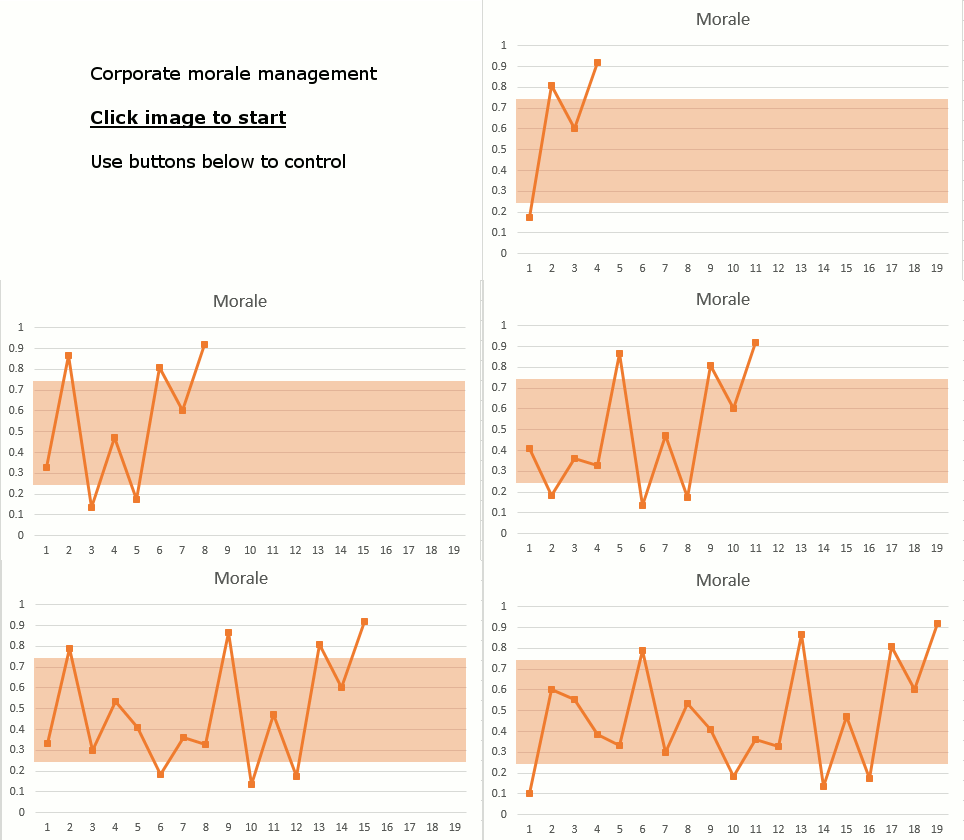
    BEFORE YOU READ THIS POST, WHY NOT PLAY THE GAME?

    • Take a look at the graph below – it represents the changing staff morale over time of a (fictitious) organisation, as measured by a regularly administered survey instrument.
    • You’ll see you have two buttons, one of which administers a rebuke to staff for poor performance, the other offers praise for excellent performance.
    • Your task, as manager, is to ensure that morale remains within the orange-bounded band – too low, and staff are too demotivated to perform, too high and staff are insufficiently engaged with corporate brand values.
    • There are 19 (equal) time periods, with a value given at the end of each. It moves quite quick so you really need to focus on your strategy.
    • The newest data point is always on the left, older points move towards the right.
    • Click the arrow button to begin and see how you get on.

    gamePress arrow to start, reload to replay.

    So how did you get on? Did you find the right balance of rebuke and praise to maintain morale? Did you learn how to react when morale suddenly dipped or soared? How did your staff morale end up? What would you do if you played again? Did you realise you’ve been pressing buttons linked to absolutely nothing whilst watching an animated gif?

    Chances are you developed a narrative around the data displayed and your “interactions” with it. It is only an 20 frame gif so you probably couldn’t develop a truly compelling story based on the data (over which you had no control whatsoever). But if I’d expanded it (or if I was Martin Hawksey and was able to figure out how to do a live random number plot with Google Charts) you’d have eventually become as unshakably certain in your internalised policy rules as David Cameron.

    Here he is, running the country.

    David Cameron on his iPad
    “Rebuke! Praise! Praise!… no! Rebuke!…”

    His iPad visualisation displays a variety of socio-economic indicators in real time, including sentiment analysis (and was developed by none other than Rohan “year of code” “silicon roundabout” “exploding cheese” Silva). His iPad, of course, has an email function allowing him to request action on the hoof, as it were. As much as I’d love to tell you that his email actually goes to “null” I fear this is not the case.

    Anyway, let’s get back to how much you sucked at playing the “corporate morale management simulator”. Here are some questions you didn’t ask:

    • What was the survey instrument used? Why was it chosen? What did it measure?
    • Why were the only options to “praise” and “rebuke”? Why couldn’t you do something else?
    • How large was the company? What did it do? What did the staff do?
    • Why did morale have to stay in the orange zone? Where did those values come from?

    Why didn’t you ask these questions? No, not because you suck, but because I presented the situation as a game. If you’re playing Flappy Bird, you don’t ask why the bird has to flap or why he can’t just land on the green Super Mario Bros pipe-thing. It’s more fun not to ask, and to go along with the premise.

    Suspension of disbelief: great for games, bad for policy.

    In Joseph Heller’s “Closing Time“, the president (referred to only as “The Little Prick”) plays a fictional computer game named “Triage”, one of a suite of war-themed games he keeps in an annex to the Oval Office. Triage simulates the planning of preparations for ongoing life post nuclear strike, in particular allowing the player to decide who to allow access to underground bunkers.

    Of course, policy becomes based around the constraints of the game, and when he (inevitebly, after Chekov) triggers the “real” nuclear football, his subsequent choices are based on game logic – and are characterised by his unwillingness to question the logic of the “game”.

    In times of uncertainty and rapid change, an ability to question the rules of the game are an essential prerequisite in adding value to decision making. And though access to data is helpful, this must be coupled with a deep understanding of the limits and constraints of the data, something that requires that you are able to comprehend it as a messy and contradictory corpus, away from the clean lines of your dashboard app.

    So – our great generation of leaders – look with concern at dashboard apps and anything else that restricts your decision-making by design. And imagine how the morale in our imaginary company must have dipped if you had been randomly praising and rebuking them in the mistaken belief that it was effective.

  • #digifest14 session on “MOOCs”

    I ran, in the loosest possible sense of the word, a session at the Jisc DigiFest on 12th March in Birmingham.

    The premise of the session was this – the big, platform-led (x)MOOCs are just one colour on the open education palette, and the other tones and shades may more closely fit an institution, team or individual need. We hoped to demonstrate a range of colours for those who were just beginning to explore the area,  and in that I feel we succeeded.

    I am entirely beholden to the patience and talent of my speakers, whom I didn’t even manage to introduce properly – so:

    From left: Viv, Antonio, Lou, me, Lorna, George, Jonathan
    From left: Viv, Antonio, Lou, me, Lorna, George, Jonathan

    Lou McGill

    Lou blogs (primarily) at LouMcGill.com and manages to run a gallery alongside her work as a consultant. In open education circles she is known for her work on the UKOER Evaluation and Synthesis Wiki (which more people should be drawing on as it is amazing)and the UKOER Infokit. If it wasn’t for Lou’s early efforts in Jisc , UKOER would not have happened. In this session Lou talked about the long, and powerful, history of “open” in education.

    Lou’s blog | Lou on twitter | OER E&S Wiki | UKOER Infokit

    Lou McGill slides (ppt) | Lou’s blog post

    Jonathan Worth 

    Jonathan began teaching photography in 2009 at Coventry University, as a part of a sublimely impressive career in photography. His thoughtful investigation of the problems faced by educators and photographers led to Phonar and the range of projects around Open Media in Coventry. Phonar has seen huge international success, and won a prestigious Reclaim Open prize in 2013.

    Jonathan on Twitter | Phonar

    Jonathan’s slides (ppt) | That film he showed (Dalia Khamissy “The Missing”)

    Antonio Martinez-Arboleda

    A former SCORE fellow, Antonio is a part of the team that made the University of Leeds Open Education Resources policy a reality, incorporating OER into student activity and staff development.

    Antonio on Twitter | Leeds OER Policy (pdf)| Leeds Jorum Window

    Antonio’s slides

    Viv Rolfe

    Viv led and inspired a variety of projects around health and life sciences during her time at De Montfort University. She’s maintained these despite her move to the University of the West of England, and has recently branched out into researching the MOOC phenomenon.

    Viv’z blog | Viv on twitter | Viv’s Open Education Projects

    Viv’s slides (ppt)

    George Roberts

    George has led the Oxford Brookes First Steps In Learning and Teaching programme (FSLT) since 2011. This was initial a Brookes-only course for those new to teaching in HE – George’s open techniques have made the course multi-institution and international.

    George’s blog | George on Twitter | FSLT

    George’s slides (ppt)

    Lorna Campbell

    Lorna is one of the Knights of CETIS, the near-legendary education technology centre now based in Bolton, UK. She’s been working in her own time to develop OpenScotland, attempting to bring open education policy to the attention of Scottish policy-makers and to unite and galvanise those interested in open education north of the border.

    Lorna’s Blog | Lorna on Twitter | OpenScotland

    Lorna’s slide (ppt) | Lorna’s blog post on the session

    Audrey Watters 

    Audrey is one of a very small number of journalists who understands and can interpret the business of education technology. Long a friend to the open education movement, I would (and do) recommend her weekly summaries of the world of EdTech to anyone.

    )

    Audrey’s blog | Audrey on Twitter | Audrey’s 2013 OpenEd keynote

    David Wiley

    In a near 20-year career in education and technology, David Wiley has been a part of every major movement towards the goal of truly open education… not for nothing is his influential blog entitled “iterating towards openness”. One of the organisers of the annual Open Education conference. he has recently left his post at Brigham Young University to work with his start up Lumen Learning, and to take the opportunities offered by his Shuttleworth Foundation Scholarship.

    )

    David’s blog | David on Twitter | Lumen Learning

    Jim Groom

    “Reverend” Jim “The Bava” Groom, alias “Snake Pliskin” is a charlatan and a fraud, a self-confessed “used car salesman” clawing his way into the glamour of the education technology keynote circuit via the efforts of his oppressed minions at the University of Mary Washington’s DTLT and beyond. The monster behind educational time-sink ds106 and still recovering from his bid for hipster stardom with “Edupunk”, Jim spends his days using his dwindling credibility to sell cheap webhosting to gullible undergraduates and getting banned from YouTube for gross piracy.

    (actually Jim’s one of the most amazing people I’ve ever met, and I have just written the above to try and get into the testimonial list on the right-hand side of his blog – a long held dream of mine)

    Jim’s Blog | Jim on Twitter | ds106 (warning: this link will change your life) | Reclaim Hosting