
Warning: Constant MAX_INLINE_MENTION_LENGTH already defined in /home/dkernohan/public_html/wp-content/plugins/semantic-linkbacks/includes/class-linkbacks-handler.php on line 4

Warning: Cannot modify header information - headers already sent by (output started at /home/dkernohan/public_html/wp-content/plugins/semantic-linkbacks/includes/class-linkbacks-handler.php:4) in /home/dkernohan/public_html/wp-content/plugins/indieauth/includes/class-indieauth.php on line 257

Warning: Cannot modify header information - headers already sent by (output started at /home/dkernohan/public_html/wp-content/plugins/semantic-linkbacks/includes/class-linkbacks-handler.php:4) in /home/dkernohan/public_html/wp-content/plugins/indieauth/includes/class-indieauth.php on line 257

Warning: Cannot modify header information - headers already sent by (output started at /home/dkernohan/public_html/wp-content/plugins/semantic-linkbacks/includes/class-linkbacks-handler.php:4) in /home/dkernohan/public_html/wp-content/plugins/indieauth/includes/class-indieauth.php on line 257
FOLLOWERS OF THE APOCALYPSE – Page 12 – Purity * Truth * Beauty
Warning: Attempt to read property "plugins" on null in /home/dkernohan/public_html/wp-content/plugins/styles/classes/styles-customize.php on line 150
  • The tyranny of iteration, or feedback in the age of noise

    "This flower is scorched
     This film is on
     On a maddening loop
     These clothes
     These clothes don't fit us right
     I'm to blame
     It's all the same" - Michael Stipe

    There are some musicians who can “play” guitar feedback as if it were a musical instrument – Neil Young is the usual citation (though I like to cite Peter Buck’s work on “Automatic for the people” and “Monster“… there are thousands of other notable examples from all over the musical spectrum).

    Without going into any great depth, guitar feedback happens when the sound coming out of your amplifier makes your guitar vibrate. This vibration moves your strings, this movement is picked up by your guitar pickups and send back to the amp, where it manifests either as a sustaining of the sound you were already playing, or a new sound that is related in a variety of ways to the existing note you were playing. This comes out of the amplifier, makes the guitar vibrate and so on/so forth.

    Guitar amplifiers amplify a whole bunch of stuff that isn’t the note you are intending to play (mains hum, handling noise…). A part of the terror and delight of “playing” feedback is that you don’t know whether you are going to be re-amplifying your signal or the noise – and this unpredictability (being on the edge of having control over the sounds you are making) is – to me – what makes guitar feedback exciting. You have agency, but not complete control.

    Engineers and cyberneticians describe this form of feedback as “positive feedback“, an existing signal is strengthened by the process. Mark Johnson uses the idea of a “caress” to describe an interpersonal instance of positive feedback – a signal (be it physical or intellectual) generates a response that reinforces the signal and may also add new aspects to the signal. Hysteresis is another name for this modulation of the present state by the state of the system in the immediate past. Mark’s use of the “caress” here is useful, as it adds in a range of other inferences – repetition, expectation and (yes) desire.

    But the position remains that in most situations feedback cannot be reliably predicted without some kind of a model of the system in question, and even then predictions are patchy and limited.

    In education management feedback has a different meaning – it suggests a single loop where learners respond to managers about their experience with educators, the latter of whom are pressured to modify their practice to “improve” feedback. This process is repeated at the end of every arbitrary chunk of learner experience, and in some circumstances a digest of this “feedback” is analysed alongside other data around what learners actually achieve, demographics, previous attainment and any other categorisation that is attached to either money, prestige or both.

    In this respect it is barely feedback at all, as it doesn’t naturally self-perpetuate. (I’m separating out the way in which an educator and group of learners actually respond to each other and modify their responses iteratively as this largely happens below the radar of institutional managers). There is no direct link between the modification of the initial signal and what is returned (not least because it is a different cohort of learners each time!) so it is impossible to play the feedback. In Mark Johnson’s terms:

    [I]t is performance which I am particularly interested in with teaching. We perform our knowledge with our bodies, artefacts, our institutional context and tools. I might start talking, but then reach for a resource to amplify what I am saying; or use the resource in conjunction with a tool, or turn the class situation around and get learners to do the talking. The ebb and flow of all this seem to have a family resemblance to musical and sexual examples.

    That paragraph nicely illustrates the idea of a performance that incorporates the “playing” of feedback in education

    Modification of activity based on activity-derived feedback is an idea is often seen in the little-known(!) world of Big Data, where algorithms supposedly learn from the effects of their previous actions.  Google use a variety of activity data streams to feed you things that you might be interested in, and one of these is the way you respond to recommendations such as this. But this works because the data is available near-instantaneously, so a fast pace of iteration gives the illusion of personalised responsiveness.

    In contrast Amazon recommendations rely more on the overall volume of user activity rather than your personal activity, so you are in to the realms of “nudge” theory (people like you who like x also like y…) rather than personalisation. I’ve always been sceptical of the value of these suggestions, but you often see them cited as a good idea when people talk about learning object discovery! You can’t really “play” this feedback, which I’m arguing is why it is less interesting.

    So in order to “play” feedback fast iterations appear more effective than slow ones, and proximity to the individual adds to this sensation. 

    I’ve tried to map various “responsive” systems across these two axes: speed of iteration and proximity to the individual, and indicated a “playable” zone (where any autonomous agent in the system would feel that they had some control over the system as a whole) with a nice orange blob.
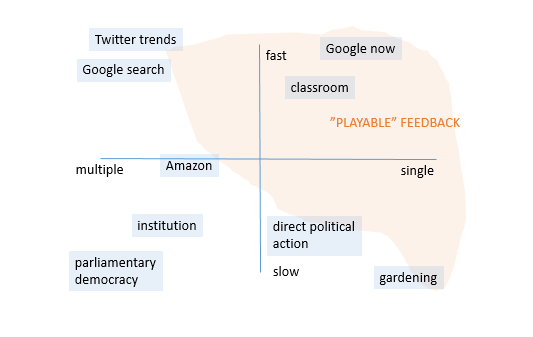
    ... a nice orange blob
    … a nice orange blob

    You’ll note I sneaked “parliamentary democracy” and a few other wildcard ideas in there. I’m not the first to see big data systems, education and government reform on the same continuum by any means (and indeed, I’ve identified it as a trend for 2014!)

    Eugene Morozov (the link above) sees a tendency towards individual “play” with feedback systems as a de-politicisation of engagement:

    If Participation 1.0 was about the use of public reason to push for political reforms, with groups of concerned citizens coalescing around some vague notion of the shared public good, Participation 2.0 is about atomized individuals finding or contributing the right data to solve some problem without creating any disturbances in the system itself.

    The use of individually responsive systems is argued:

    to redefine participation from something that arises from shared grievances and aims at structural reforms to something that arises from individual frustration with bureaucracies.

    Now, as usual with Morozov (the Michael Moore of big data skepticism, if you will…), he’s half-right and largely overstated. You can get playable feedback in both large scale system change and petty bureaucracy, though only one runs the risk of losing control.

    The issue comes when the combined force of all the data that has been gathered swamps any meaningful impact your activity can have and you no longer feel like you are “playing” the system – we’re moving here into self-oscillation where the overall noise swamps your original signal entirely.

    In educational terms, these big student feedback initiatives may be doing something similar, and to put the student at the heart of a self-oscillating system seems like a particularly cruel joke.

  • How I got a “first” on a FutureLearn MOOC with one weird old trick…

    I’ll be having a celebratory pint tonight, having aced my FutureLearn MOOC “The Secret Power of Brands” with an unheralded 87.4% mark for the module.

    A career in branding is surely only weeks away, and my inbox is braced to deal with the influx of job offers.

    But how did I do it?

    (a) I learnt a lot about branding from the informative course content and readings?

    (b) I’m stupendously smart and a branding “natural”?

    (c) I cheated by getting a branding expert to answer all the questions?

    (d) It is very easy to write bad MCQ assessments?

    Yup, it was (d) all the way.

    Methodology

    To ensure a fair test, I did not look at any of the materials, readings or discussions (exceptions: a bit of a play on week one to see what the platform was like, and a video about how they branded FutureLearn in week 2). There was to be no connectivism here, this was a pure exercise in strategic learning.

    I did, however, look again at an amazing presentation that I once saw UK learning&teaching legend Phil Race give ten years or so ago, which included the legendary “content free test”.

    The presentation is here (midway down the page, called “Designing Multiple Choice Questions”). For those of you who don’t want to download a .zip file (yup!) of a PowerPoint deck, a blogger named Carole Bower summarises the guidance here. The original source of this guidance is given as (Conners, B , (1983) Assessment of Students in Distance Education, James Cook University)

    So, using these principles I was able to answer the vast majority of questions in the end-of-week test. Towards week 6 or 7 we started to see more questions related to specific knowledge, rather than general ideas. So I allowed myself to use wikipedia and corporate websites to look up “in which year…” and “who owns…” type questions.

    The only exercises I did were those marked “test”. I did wonder whether the discussion sections would contribute to my final mark, but I guessed not.

    Conclusions

    As FutureLearn currently does not offer any indication of “results” from a MOOC course, I am guessing at my final results – simply by adding up the total possible marks and my total actual marks, and finding a simple percentage.

    I was expecting to do at least slightly better than 50%, in line with an expected probability of guessing the right answer. Nearly 90% was utterly unexpected.

    An alternate explanation would be that “branding” as an academic subject is a load of bobbins, a series of half-arsed generalisations and principles dressed up with a a couple of pseudo-academic references. I wouldn’t feel qualified to test that.

    FutureLearn itself, as a platform, appears no better and no worse than any of the major xMOOC competitors. Putting the discussion sections in amongst the videos rather than in a separate corner is probably a good idea, the extra videos from Robert Jones did make reference to them but it didn’t feel like I was missing anything by not being in there.

    Multiple choice questions can be use effectively for formative and summative tests, but you need to follow established good practice to make them work.

    And pink is still horrible. Sorry.

  • 9 things to watch out for in 2014

    1. Virtual Reality

    A lot of people in education seem to be playing with Occulus Rift. At first look you’d be forgiven for thinking it was a retro-geek Virtual Boy, but Moore’s Law has brought a greater degree of immersion and realism to the structure. The combination of immersion and haptic/guesture technology (the Xbox Kinect system going some way to normalise this) could be useful in simulations for medicine and engineering to name but two.

    The overlay of information onto a live video image from a phone camera is another idea that may finally be having its day. Projects like Scarlet are using such technologies successfully with artefacts and images, a more focused implementation than the very early experiments of just overlaying wikipedia on the view from your office window.

    Those of us who have been round for a while will be thinking “second life” at this point – but given the experiences of stuff like fathom.com the xMOOC shouldn’t have happened even slightly. I prefer to draw the analogy with the animated GIF – a supposedly antiquated technology that enough interesting people are doing interesting things with that it just might become unexpectedly everywhere.

    2. Algorithmic policy and the knowledge worker shift

    Gone are the days when you could look knowledgeable just by using the words “big data” in conversation. Without going through any of the usual meaning-making or testing processes, it suddenly is an (enormous) fact of life. I think 2014 will be the year when we see policy development staff begin to be replaced by databases. After all, if big data can reduce every problem to a bar chart, you don’t need people to choose the option that the machine tells you will make the numbers go up.

    Already we have machines that generate internet memes (often with truly terrifying results) as a warning regarding what can happen when you take humans out of decision making. One of your holiday tasks is to watch “All Watched Over By Machines Of Loving Grace” again. And start thinking about telling better stories about how humans add value to decisions.

    3. Data literacy

    Leading on from the above, those of us who wish to continue being knowledge workers need to start making sense of data (and for that matter finance, but that’s maybe another story). If every policy position is “justified” by a slew of numbers, we need more people that can make sense of these numbers. Maths – naturally – is hard and we’d all rather be shopping or watching cat videos. But if we want to understand the decisions that affect the world around us, we need to learn to read numbers and to be confident in disputing them. Policy is now quantitative – we need to get better at teaching people how to participate.

    4. Personal data trails

    Our government’s loan shark friends Wonga already mine social media data when allocating loans. Moves by facebook, microsoft, sony and especially google (the so called “Nymwars“) to use real names in online social interactions makes this process easier.

    We’ve all heard the horror stories of graduates losing jobs because of photographic facebook evidence of them enjoying themselves in some way. But the implications are greater than this. Slane Girl’s youthful indiscretion would once have been something she regretted in the morning and laughed about ten years later – in 2013 she was named and pilloried within hours. One mistake, one unguarded thought expressed online, and your life could be ruined.

    My own position has always been is that if someone wants to attack you, they will find and use something online. Without context, without human feeling, every tweet is a weapon that can be used against you. Perhaps 2014 will be the year that we can no longer convince our learners to share.

    5. Corporate courses (or whatever happen to the MOOC?)

    With Udacity and Coursera moving towards to the corporate provision that early competitor Udemy moved to a long time ago, and even newcomer FutureLearn trumpeting employer and industry sign-ups rather than participation rates (I wonder if 90% of employers will drop out in the first 5 weeks?)  the “open” O feels like a very bad joke. But these entities aren’t leaving higher education entirely in search of profits, they are attempting to destabilise one of the most profitable parts of it.

    MBAs and related courses are a huge earner for traditional institutions, not least because fees are generally paid by employers and can be ratcheted up to astronomical levels without your average blue-chip blinking. They are usually bought for rising stars, but given the growing trend of treating generation X and Y appallingly badly it is not inconceivable that rising stars could be fobbed off with a bad video of Andrew Ng in the future.

    Coursera have been making some noises about being a publisher, whilst actual publishers are diversifying into accredited awards and learning technology. Convergence, anyone?

    Against earlier expectations, institutions are beginning to ask questions about exactly what they are getting from the MOOC platform they work with, given the amount of staff time and reputation (and often hard currency) they are putting in. But the “pivot” could be seen as a victory for traditional education, when it is just a better profit targeting system.

    6. Open classrooms

    The unexpected stars of the Reclaim Open awards have been “open classes” that run alongside traditional class tuition, but in multiple locations. The venerable ds106 (the weird uncle of the MOOC) has led this movement, with simultaneous iterations in institutions across the world and even inside corporate boundaries. Participants each benefit from participation in the global community around the course, with encouragement and peer learning key to retention.

    Coventry University’s Phonar, incredibly, is now delivered in hundreds of institutions in hundreds of countries around the world via the World Photo Org. And the FemTechNet DOCC (winner 3 of 5) has a similar nodal structure.

    These programmes add value to the experience of traditional paying students whilst encouraging the world to join in. I’d hope and expect to see more of these initiatives in 2014, which manage to make pedagogic and financial sense.

    7. Challenges to institutions

    You may not realise it but 2013 has been a huge year for student and staff activism. Just in the last fortnight 7 UK institutions were in occupation, a major multi-union strike action brought many more campuses to a stand-still and students and staff worked together (#3cosas) to deliver living wages and conditions to some of the very lowest paid staff in The University of London. Despite the fears of educational commodification, we have the most politically active student body for a generation.

    Combine this with the sad and sorry rise of casual contracts for academic and support staff, and you have both sides of the “student experience” equation reacting with open hostility to the structures that are constructed to confine and control them. Strikes and activism will be a major theme for UK education in 2014, and my limited understanding of the US, Canadian and major European systems suggest that this is a global movement. (Antipodean, South American, African readers – I’d love to learn if this is true for you too.). Will 2014 be the year in which Higher Education leads the way to a better deal for workers, during a near-decade long wage freeze? We can but hope.

    8. Effectiveness metrics

    More big data, I’m afraid. The way in which you do your job will be measured in more and more intrusive ways. From countless student surveys, to meaningless research impact metrics, to email CRM, much academic time is spend either actively measuring oneself or passively being measured. Older readers may suggest ’twas ever thus, but the corporate fashion for big data and (*shudder*) dashboarding has heightened and increased a tendency already manifesting in bureaucracies. (and I write this as someone who likes bureaucracies…)

    Gamification is the other end of this story – students are also measuring themselves against themselves and their (real and imagined) peers, maximising the benefit they get from the work they put in. You can imagine both of these trends expanding in 2014, with much that has so far been experimental becoming mandatory. Looked at long term, it is a cyclical peak that last occurred in the 50s with “time-and-motion” studies, but for those living through it, it is scant consolation. This is another one that needs to be answered with some work on the value of human decision-making next year.

    9. More funding chaos

    Just today, a UK government minister announced the largest expansion in higher education funding since the 90s, all paid for by the dubious practice of selling loan books. Most serious wonks have been tending towards seeing this as a superficially pleasent short term political act, shoring up a broken funding system for the year and a half before the election. But we already know about the black hole in the heart of the BIS budget, and it is increasingly apparent that we will see another painful change in the funding system early in the next parliament.

    Institutions in the HE system, meanwhile, have been celebrating the current tsunami of cash in the system by spending some of it on shiny stuff to impress prospective students and banking the rest to build up a reserve for when the whole thing goes pear shaped. The design of the funding system makes investment in running costs, like – er – staff a bad move, so many institutions have been laying off departments and using more casual staff to cover fluctuating course sizes.

    The big winners, of course, are our friends at Pearson, who have coined it in due to a massive growth in fee loans to students studying lower-level HE awards in private colleges. Edexcel (a Pearson company) award most HNC/Ds in the UK via these private colleges.

    The UK economy still struggles in the eyes of most of those living in it because the costs of living have risen whilst wages have stagnated. We are in a very fragile “paper” recovery which is meaningless to everyone but treasury accountants. There is not going to be enough money for the continued expansion of the HE system, and I’m predicting the rumours of the cuts to come and poorly managed loan sales to dominate the HE wonk news cycles in 2014. (Ed M, if you are reading this, how launching an independent study into HE Finance? Next year sometime would be good. I could probably round up some wonks for you if you like?)

    (Bonus number 10: User data bubble – because targeted advertising is still not effective however many billions of dollars of venture capital is betting that it is. I’ve been saying this for two years, this is a long term prediction  but one that scares me more than most of the above because it would make 2008 look like a mild market correction.)

    Overarching theme of the year for 2014 – the loss of human agency in decisions that affect the lives of human beings. Cheery stuff.

  • Hipsters, MOOCs and the KLF: In, Against and Beyond the Accelerationist University

    I’m going to step right up and say that I have neither the philosophical nor the political chops to do what I am about to attempt, but I know a fair few people that do and I hope they will comment. But that’s not going to stop me from having a try.

    Allow me to start with an infomercial.

    This, if you can make it out through the 19th generation VHS hiss and extreme Scottishness, is none other than Bill Drummond, who would go on to release a string of what were possibly the greatest pop recordings of the early 90s as one half of the KLF, and then burn the proceeds in the name of art before disavowing recorded music in favour of the experimental amateur choir The17.

    “The Manager” (occasionally, “The Manager’s Speech”) was the b-side to a very early single entitled “Julian Cope Is Dead” – Drummond had briefly managed Cope‘s band (The Teardrop Explodes) and worked as a manager/A&R man at WEA records (now Warner).  In it, he laments that “the music… THE MUSIC… is spiritually bankrupt, there is nothing there…”, and sets out a basic three point plan to reform the industry.

    1. Musicians are not allowed to spend any more than 10 days recording any one LP

    2. The Musician’s Union have to formulate a standardised contract with all the record companies.

    3.  As for advances, they go, we don’t have them anymore.

    Further clarity and rulings can apparently be gained by sending a cheque for £100 to “The Manager” at a PO Box address somewhere in Aylesbury, but I am not sure whether this is still valid. Which is a shame, as further clarity is always welcome.

    I mention this here not only because it is a damned interesting bit of UK music history, but because this first act prefigured so much of the rest of Drummond’s artistic work. If you like, he has made a career out of appearing to turn away from artforms he used to enjoy back to earlier (and to him, more meaningful) forms of art. From 90s acid house, to 80s hardcore (one of the pivotal moments of my musical history – 1992 Brit Awards no less!), to 60s conceptual art and now to the unrecorded (literally!) depths of musical history.

    So far, you may think, so proto-hipster. We know all about the fetishisation of early mass production – a chicken in every pot, jobs for all, forty acres and a mule, and a can of Pabst in the ironic velour saddle-bag of every fixed-wheel bike. We all know that none of these promises were ever fulfilled too – and that a colder, poorer and less equal society now lurches from crisis to economic crisis.

    Within this painful reality, we can and should all have our personal searches for reality within the maelstrom of art that it is possible for one to experience, sitting alone at a laptop computer in the UK during the early second decade of the third millennium. But has even this well been poisoned? Certainly Drummond states that:

    Within days of getting [an] iPod, I was having unforeseen problems – I found myself skipping through tracks. I would hear a few bars of one of my all-time favourites and then decide it was not what I wanted to listen to and skip to something else. Nothing seemed to satisfy, even though in theory I had every recording on it that I had ever wanted to listen to. Was this just part of the ageing process? Was my palette getting jaded? Then I noticed other people doing the same thing, people in their early teens, 20s, 30s, not just blokes like me who were fast approaching 50. The iPod was changing something in all of our relationships with music. I love it when things change.

    There’s two responses to this. One is to yearn fervently for the death of the ipod, the internet and similar technologies and a return to the artistic Fordism of the 60s and early 70s – a time when people would form intense personal relationships with mass-produced copies of artworks. The other is Drummond’s way, to welcome the change as a necessary one – a required clear-out of the the old processes and practices, and the chance for something better. Far from heading into the past, Drummond is excited about the possibility of a more meaningful music in the future.

    You could read the #Accelerate Manifesto as a political restatement of this excitement in moving beyond old systems and towards new ones, that may (I emphasise the “may”) provide a better deal. Or you could read it as a reclamation of the idea of “progress” by a political left who are often seen as protesting against every change (“We need a National Union of Students that fights for something, not just against something” as current president Toni Pearce notes). Or, as Charles Stross (an interesting article, go read) cites Joshua Johnson as saying:

    Accelerationism is the notion that rather than halting the onslaught of capital, it is best to exacerbate its processes to bring forth its inner contradictions and thereby hasten its destruction

    In, against and beyond capital, if you will.

    I work in the fast-moving field (haha! no really!) of education technology – an area where everyone seems to be “revolutionising learning – for an uncertain future”. Some appear to want to use technology to bolster and support educators and the institutions that support them, others to see both done away with. Most are agreed that everything needs to be done faster and more.

    I’ve written before about the need for “slow policy“, but even in the supposed ivory towers speed is of the essence. How many times have you heard institutional leaders urged to board the MOOC train before it leaves? Often this is obviously driven by financial interests, sometimes by a genuine desire to try something new, but perhaps also by those who see that existing structures are unsustainable and want to get past them to something less painful.

    Tempting, but no. The pressures on institutions, on people, on nations exist not through some natural calamity, or via market forces and the doctrine of disruption. The pressures have been designed. Designed by people – often very smart people who should know better – who are in thrall to the logic of capital. We (and they) can rationalise this by pointing to a bright future beyond, but it is difficult (though sadly not impossible) to imagine a way an education system could put more of those who work and learn in it under intolerable pressure.

    Seventy percent of academic staff in the US no longer have even the chance of a dependable full-time job. Do we believe that when it gets to 90% there will be some miracle that catapults us into utopia? With management structures already beholden to speed and capital, do we believe that substituting them with more efficient capitalists (who either run or invest in the big edtech darlings) will improve our lot?

    Of course not, which is why the Accelerationists propose that ” must develop both a cognitive map of the existing system and a speculative image of the future economic system.” Using – and I’m just picturing Audrey Watters’ face as I write this – BIIIIIIG DAAAAATAAAAA! Now, there are only two things you can actually do with big data – map existing systems (badly) and make (bad) predictions of the future state of these systems, or use data from existing measures of behaviour to plan new means of controlling this behaviour which totally work.

    Maybe – and this is a maybe – there will come a time in the future where teaching is entirely automated, along with a range of similar intellectual roles, resulting in an enormous surplus of knowledge workers. Who is thinking about what these knowledge workers will do? What is the job of academia outside teaching – how many do we need? As of yet, no-one is asking – much less answering these questions.

    So you’ll excuse me for not wanting to “Immanentize the eschaton” just yet – which brings us to discordianism, a huge influence on the art and music of Bill Drummond. And right now, I need a word with the manager.

  • Pulling out of Browne?

    Andrew McGettigan covers the bizarre government financial regulations that underline the issues caused by the new funding method over on Critical Education. Suffice it to say that although the scale of the non-repayment of loans will not become apparent for 20+ years, the anticipated shortfall that this creates needs to be managed from within the current budget.

    The RAB rises are caused primarily by poor overall economic performance – not by any particular issue with the sector. And, as the costs of student loans increase the value of CPI inflation, the increase in other costs amplifies the effect.

    This is a failure of policy design – and one which was expected by every serious UK HE policy wonk.

    • Firstly – an overall increase in recruitment, spurred by economic uncertainty and high quality marketing by traditional institutions, the government themselves and (especially) new institutions has increased the initial loan outlay.
    • Secondly – poor economic performance raises the likelihood that loans will be paid back late, incomplete or not at all. These are the rises to the RAB charge (RAB being “Resource Accounting and Budgeting”) – the percentage of money loaned that is not expected to be returned – which started at 30% in 2010 and now sit around 38-39% for the system overall and an estimated 47% at private (“alternative”) providers of HE.
    • Thirdly, private institutions are maximising their benefits from the new system of loans by changing the shape of pre-existing courses to fit funding requirements – this, after all, is what private institutions do.

    In 2010, HEPI estimated that at a RAB charge of 47% the new loan system would cost the government more money than it saved. It is now arguable that at least the private part of this system is already at this stage – and of course loans to private HE students represent a new cost over and above the late and increasingly lamented old system.

    David Willetts has long argued for RAB rates to be available at institutional level to shape investment priorities, here we have a RAB rate for a group of institutions that argues for complete disinvestment. This won’t, of course, actually happen – Willetts tied his ideological flag to the mast of private HE a long time ago.

    Meanwhile in the joss-stick waving hippie paradise of the public sector the Vice-Chancellor of Oxford University is arguing for a rise in student fees – which translates of course into a rise in initial government funding, year on year. Which he can whistle for, quite frankly, as BIS struggle to get a £1.4bn funding hole (caused, in part, by a real-terms increase in year-on-year government funding for HE since 2010) under control.

    To cover such a hole, BIS needs direct control over its spending, something which does not happen when students are at the heart of the system. Instead, discretionary funding – such as grants to under-represented groups and research funding – where the government does have direct control over spending, are targeted.

    So – what to do…

    • The new funding model is currently a very expensive hole in the ground into which money is being fed. Net beneficiaries are institutions of HE, particularly those who have seen recruitment increases under the MarginCore nonsense, and private providers who have maximised their possible income and will continue to do so because, y’know, profits are good.
    • The government is costing itself more money because it is being charged according to a best guess of the eventual depth of the hole, which keeps rising due to poor economic performance to which the level of student loan repayments is a contributing factor.

    The government will have to change the policies, or change the measures by which shortfall is calculated – and to do the latter would expose the polices as being the naked budgetary gaming that we’ve been saying we are all along.

    Lowering student fees to – say – £6,000 would also help, but would annoy institutions who suddenly would have much less money than they expected… there would have to be a corresponding rise in public funding which doesn’t currently look like happening.

    Remember when ministers used to argue that higher fees would help “clean up Labour’s mess” and lower the deficit? This turned out to be an enormous lie and someone needs to be taken to task on it.

    I’m intrigued by the notion of rethinking the way in which government financial processes work. Counting loans without the certainty of repayment as having a matched income stream is a risky gamble – but counting the full cost of loans within current expenditure would make for far more sustainable policies. It’s not difficult to imagine someone as interventionist as, say, Ed Milliband, making this argument and pointing to the way such an arrangement would make for more sustainable government spending…

    … all of which, would mean less money sloshing around the HE sector. Which, whichever way policy moves, is something we will have to get used to in the next couple of years. Especially if we work in private institutions.

  • I hate numbers

    So does Audrey Watters . At least that, was one of the strangest accusations made of our double-header keynote on day two of #opened13 (a conference I intend to document more fully in due course).  Followers of the followers will no doubt have seen the multimedia that I foisted on the audience instead of a proper keynote with inspirational pictures.

    NGskype

    But – yes, numbers = bad.  Here’s two stories I saw on twitter today.

    First up, another one of those millionaire rockstars looking to fix broken education with broken business analytics. Paul Tudor Jones is a hedge-fund manager who never learnt anything from his educational experience at all. But still, he feels that education – when properly business-ified – is a path out of poverty for millions. An early quote on his workspace tells us a lot:

    His computer projects his fund’s market positions onto the wall, blinking when any share changes price, its overall performance channeled into a moving graph (which just so happens, as with most days for the past few decades, to be pointing up). “I sit here and watch these all day,” says Jones, describing his daily work routine.

    So here we are, a man who makes things happen by watching numbers. Guess what he wants to do to the US public schools system? Go on, guess.

    Jones says his goal is to get the U.S. educational system in the top [PISA?] quartile of developed countries in the next ten years. Twenty years from now he wants the U.S. at number one. (The irony: Jones says he himself got very little out of his own education, with the exception of a journalism class. “My B.A. in economics was zero help in my profession today.” Instead, he says that countless hours playing games during his school years–poker, chess, backgammon–were the experiences that “prepared me for what I do today.”)

    Jones says this will entail a “vertically integrated approach at getting all stakeholders in this–the parents, students and teachers–to acknowledge the problem, then get involved in this transformation,” by working with schools, teachers and parent-teacher associations in applying the Robin Hood [the honest-to-god actual name of his charitable foundation] method of best practices. That means, among other things, longer school days and years, better teacher and principal training and true evaluation and accountability.

    Vertically. Integrated.

    Just when I thought the day couldn’t get any better, it transpires that Michael Barber and his friends at Pearson have been busy repackaging deliverology into the idea of efficacy. You can play along at home, either with a printout or by sharing your innermost educational secrets with a multinational publishing company.

    Barber, writing for the new Pearson “Open For Learning” [no really!] group on LinkedIn says:

    As we all know, this is an urgent challenge. Every child needs a high quality education, and we must do everything we can to provide this for all.

    So to provide this everyone’s favourite educational publisher wants to standardise the collection of learning (output) metrics so it can use graphs and such to prove that it has successful and useful products. As opposed to, I suppose, asking educational professionals whether they work. There’s a video, which features Michael Barber talking over some mournful-sounding piano and strings. (I should have patented that.)

    The tool itself draws heavily on the Deliverology approaches of traffic-lights (those special red/red-amber/amber-green/green ones) and trajectories, and is a sterling example of Barber selling the same 20 year-old discredited business process to someone else. I take my hat off to you, sir.

    So, in both of these cases we have people who by their own admission would rather deal with numbers and measurements than with people. Trying to make education better.

    I believe that metrics-first approaches like these are flawed for the following reasons:

    1. Lazy hypothesising. If you start from a premise that a larger number is better, you are buying in to a whole bunch of implicit and often under-theorised assumptions. It is required that we look at the actual measures themselves: what do they mean, what do they tell us, what do they not tell us?
    2. Poor quality data. Education is not, and will never be standardised. This is why serious educational researchers take a lot of care in choosing samples, and attempt to make them representative.You’d think that “big data” would be better than this, but larger samples tend to be self-selecting (eg learners that completed or were entered for a certain test). These, and other, artefacts in large data sets need to be identified and compensated for, because…
    3. Incomplete presentation. A graph on an infographic tells you nothing at all about education, without accompanying contextualisation, methodology, and highlighted anomalies. “But policy-makers are too busy to read all that” comes the response: frankly if people are unwilling to properly engage with data they should not be policy makers. It is very tempting just to look at a line-graph and choose the tallest line, but this is not policy making, this is shape-matching. And so many visualisations tell you nothing more than “we have lots of data”.
    4. An end to argument. You can’t argue with data. Well, you can, but to do so you need a set of conceptual and critical tools that are outside of the grasp of many (pupils, parents…) who interact with education every day. I can sit here on my smug little blog till the cows comes home and pick apart data, but I’ve benefited from a lengthy and expensive education and work in a role that gives me time to think about and investigate such things. If you start throwing numbers around as if they were facts, you are disenfranchising a large number of people whose voices need to be heard in these conversations.
    5. Comparison. If you give someone two sets of data the temptation is for them to munge them together in some way, so they can compare them. Serious data scientists know how hard this is, policy makers think you can just plot them on the same axis and make valid comparisons.

    Nobody – I repeat: nobody – is saying that quantitative approaches to research are invalid, but I am saying that such research should be done with the appropriate safeguards so the results can be used to make high-quality decisions. All too often we see nothing but context-less graphs and tables of test results, and in the wrong hands these are more dangerous than any weapon you care to name.

    I don’t hate numbers, but I do love people. The individual experience is the most valuable measure of educational effectiveness we have, but it tells us very little about how effective that same education may be for others. What it does tell us, though, is reliable and worth engaging with. We owe it to the world to end our fascination with big data and start engaging with real and messy reality.

  • Robbins: Bigger, better and uncut?

    Robbins (1963) is the Higher Education report every other report dreams it could be. A Critical Path, for instance, tried to be Robbins so much that it looked painful.

    But time and again, reports have been roundly derided, or quietly forgotten,as Robbins marches on unbowed. So David Willetts and a whole team of helper elves have decided to take the simpler path of re-writing Robbins to make it seem like he’d actually written a more erudite early-60s Browne Review.

    The headlines are the Minister’s sudden discovery that research funding competitions skew university priorities, the mood music is that Lord Robbins properly wanted income contingent loan repayments, but decided at the last minute to double government spending on Higher Education over 10 years.

    One submission to the Robbins review, by AR Prest, recommended income contingent repayment of student fees, and from this kernel, a whole organism is grown concerning Robbins marching arm-in-arm with Nick Clegg to demand fees of up to £9,000 a year for all students. All this for a man who clearly states

    “Loans to students would be on rather a different footing, for it is not to be supposed that they could be financed directly from the capital market.” (para 638)

    “Borrowing [to finance loans] at a time of inflation might increase the pressure on resources, whereas suitably devised taxation might be neutral, or even some restraint. Borrowing in a depression might tend to a reversal of the tendency, whereas taxation might deepen it. There are so many possibilities to be considered that it is difficult to achieve any simple generalisation. The one thing that is certain is that the loan method per se must impose exactly the same current use of resources as the revenue method.” (para 639)

    It is fair to note, and the LSE blog does so in typically thoughtful style, that Robbins did not make any recommendations on funding that have stood the test of time. But this is not a failing of Robbins, a serious economist and proto-monetarist (he appointed Hayek to the LSE, after all) who had learned by bitter experience to accept the need for state funding and intervention for public good. (As did Milton Friedman regarding HE for that matter, but this is maybe a story for another day). Funding was not within his remit, and had already been covered by the 1962 Education Act which laid out a common expectation for student support from local authorities.

    But Willett’s portrayal is of Robbins as a naive statist is as convincing of his citation of a tweet from Andreas Schleicher as proof of OECD blessing for our “sustainable” current funding model.

    Willetts cites a lecture Robbins gave at Harvard in the mid 60s:

    “I have little doubt that, as time goes on and the advantages of higher education are more generally perceived, and the burdens of financing its expansion are more severely felt, there may easily come a change in attitudes such that the equitable arguments for a considerable replacement of grants by loans will become practically relevant.”

    For clarity – Robbins here is talking about replacing maintenance grants with maintenance loans, and merely suggests that the attitudes amongst governments will change. Robbins was remarkably prescient about the future shape of HE, but he didn’t anticipate the decade of underfunding brought about by the Thatcher generation.

    However in “Higher Education Revisited”, at the age of 82 in 1980:

    “It is a matter of regret to me, personally, that I did not at the time sufficiently appreciate the advantages of the Prest scheme, in spite of the fact it had already been promulgated. My own inclination tended definitely against the policy of subsidy”

    You will note, of course, that he still stops short of wishing he had recommended it.

    More surprisingly, Willetts claims that “[..] taxpayers still pay 40 percent of the cost of degrees” (p61). Behind this soft statement lies a realm of equivocation. 40% may be true this year, but the aim of the new system of funding is to reduce this to less than 20%. And the estimated and *seriously* unsustainable RAB cost of fee loans (currently 35% and rising) is clearly not included.

    Charmingly Willetts is able to provide data and metrics to suggest that Robbins was right all along in various assumptions around participation and graduate benefit. As Willetts was able to provide data and metrics to justify his own flawed policies too, I think they can be safely ignored.

    But the funereal micturation continues in the conclusion. From one quotation from the original report

    “We think it likely that television, as a technique of educational communication, may be found to have considerable potential value as an ancillary both for part-time and correspondence study.” (para 821)

    Robbins is outed as a M**C-lover! The same over-egged claims we’ve heard from BIS at so many events over this year are justified, inexplicably, from Robbins. His point regarding televison was as an “ancillary” to new forms of study, not as a rolling tsunami of disruption against traditional institution.

    Willetts tries to make Robbins learn from the work of his goverment. But Willetts could learn far more from the work of Robbins, not least in designing a sustainable system of mass higher education that lasted, broadly unchanged, until 2010.

    And that, erstwhile report writers, is how you get your report remembered. Do something that works for nearly half-a-century, and recommend sustained investment in higher education.

  • Ada Lovelace Day: Nicola Pellow

    Ada Lovelace day is every 15th of October, and an opportunity to create content about amazing women in science, technology, engineering and maths.

    By now we all know the story about how Tim Berners-Lee invented the world wide web (not “the internet“, which was the US military) using an expensive NeXT computer in CERN in 1990. But one of the most mind-blowing things about the web, and the reason that it became such a global and lasting phenomenon, is because it is cross-platform. You can view (or could, until the comparatively recent and hopefully transitory rise of mobile browsers requesting mobile-friendly pages) the same world wide web on every flavour of device. How did that happen?

    The first cross-platform browser was developed by Nicola Pellow, a mathematics student on placement in CERN from Leicester Polytechnic (now De Montfort University). It was the deliberately simple “Line Mode Browser“, which ran on just about every major computer platform at the time and offered access HTTP, FTP and TELNET protocols amongst others.  She worked on the project with Berners-Lee and Henrik Nielssen.  It was so simple that a terminal with a screen only capable of showing 24 rows of 80 characters, and with no mouse, could run it.

    In those days the web was a much simpler place, with smaller pages far more reliant on plaintext, simply marked up in HTML. To see how the increased complexity of webpages has made cross platform compatibility harder, you can use a HTML5 version of the Line Mode Browser to view the web as it would have looked in 1992. Or hack this link to go to a web page of your choice. And here’s a lovely blog post on the joys of re-creating the experience at a CERN hack day, and the code and resources are available to play with at home.

    Other than the origination of the web itself, it is difficult to think of anything  that spurred the spread of near-universal access to information as much as Nicola Pellow’s placement year project, and for that reason alone I think that she deserves some FindingAda recognition.

  • “The rhythm is the bass and the bass is the treble”

    The Higher Education Commission (Policy Connect) report on “Regulating Higher Education” has one of those fashionably modish design concepts like the Browne Review did, immediately leading one to the broadly accurate conclusion that it will say little of any great surprise.

    However, unlike the Browne review, it does have a lot to say of great sense. It is a house-keeping report, not something to point the way to the future of Higher Education in England but to make the current models work in the way in which they were intended.

    In many senses, the report would have been better titled “I CAN HAZ H.E. BILL PLZ? – K THX BAI” as the central thrust is something that wonk-kind have been saying for ages – the current regulatory system is simply not fit for purpose without regulatory underpinning. In calling for a bill, if not this parliament then included in the manifestos of each major party, it subtly highlights the astonishingly poor quality of HE policy making by the coalition government.

    LOLcats and 90s hip hop, must be a Followers post...
    Silly humans!

    Going along with recommendations implicit in the Regulatory Partnership Group Operating Framework, it calls for a more streamlined system of sharing data on institutions – in particular the expanding “for profit” sector where very little data is currently held by anyone. There is a small degree of quango-munging (HEFCE, OFFA, an Office for Student Loan, and new functions within a putative name of the Office for Competition and Institutional Diversity) but respected independent (and UK-wide, as the report notes perhaps in deference to this very blog) bodies like the QAA, OIA and HESA remain independent.

    Within this new Council for Higher Education – yup, no Browne-ite “Higher Education Council” here! – amongst the plethora of “offices”, the OCID has a remit for new and weird institutional models, with the Coventry University College cited as a model for the kind of thing that needs attention. What I like about this is that it puts changes by existing institutions centre-stage – to me the risks from existing institutions changing form and function is greater to students than fly-by-night 16 student units, which none but the most foolhardy risk-taker would consider attending at this time. The OCID would also examine stuff like the New College of the Humanities and whatever spins out of the MOOC bubble.

    The idea of an “Equitable” playing field is a useful one, there are strange anomalies between public and private sector university regulation, and most of them need to be fixed to avoid the government being subject to legal challenge. A requirement for all institutions to register is just common sense (and they have to for many things anyway), a requirement for them to provide data – and open data at that – is just plain obvious if we are going to have the Barber-ite data-led market of parliament’s dreams.

    Most headlines will be taken by the recommendation for the ATOS-style insurance for students against failing institutions. Again – what is proposed is the best of a bad job. If the government is foolish enough to allow institutions to fail financially (with no recourse to the quality of the education they provide, I hasten to add) then it damn well needs to have some kind of safety net for students who have borrowed government money to spend there.

    This kind of report separates the true Wonk from the Wonk-passant. It has no vision for the future, no guiding ideals – it is almost (though where *are* the academic and collegiate structures in this new regulatory landscape?) ideology free. It simply seeks to make bad policy workable.

    There is no tweaking into a whole new era here.  CHE and OIA gotta regulate.

  • In Conversation With Mariana Funes #ds106radio

    {part1 – 45mins}

    {part2 -45mins}

    I’ve finally had chance to upload the recording of the conversation I had with Mariana Funes on #ds106radio a couple of weeks back.

    We ranged from storytelling, via “Twitter Verses Zombies“, to some fairly high-flown stuff on creativity, metaphor and intellectual property – she was a great interview and did her best to make me sound like I knew what I was talking about. Especially noteworthy was the fact it was her first time on DS106radio, not the last I’m sure.

    I think it can be easy for the observer to miss the level and quality of intellectual engagement that is found around ds106 – it can look like a lot of slogans and animated GIFs to the uninitiated. But really, it grapples with the big stuff … the place of art and creativity in general education, the active reinterpretation of the emerging norms of the internet, the need for regular (daily?) challenges to our preconceptions of what we can do.

    I don’t think we’ve ever shied away from talking about stuff like this, maybe it gets heard less. I’m really looking forward to a proper chat with Jim Groom about these things at OpenEd13.

    You can read Marinara’s blog at DoubleMirror, and see her ds106 work as “The DS106 shrink“. A very interesting woman indeed, and a welcome recruit to the small but growing arming of British ds106 adherents.