This is something that originated in mine and Amber Thomas’ paper “OER: A Historical Perspective”, which I took to #opened12 with Sheila MacNeill. I never managed to write it up on here, and as I refer to it a lot and it is becoming increasingly apposite, I thought I’d rectify that.
Basically, there are three strands of open education.
Firstly, what I call the “RLO” tendency, after the Reusable Learning Object movement where I think it is most purely expressed. This tendency is interested in providing an ordered and easily reusable collection of high quality materials for reuse – with corresponding interests in content packaging, interoperability, user metrics and automating discovery.
Secondly, I’d postulate the “Commons” tendency, which I associate with the Noughties OER boom. Release, and release under an creative commons license, is the key here, with less focus on quality or technical affordances, and an emphasis on learners as users rather than educators.
Thirdly, I initially called them the “DIYU” tendency but would now go for “disruption”. These are the “education is broken” crowd, looking to sweep away and replace the existing education system. Their language comes from business rather than education, and there is an emphasis on private funding and new financial models.
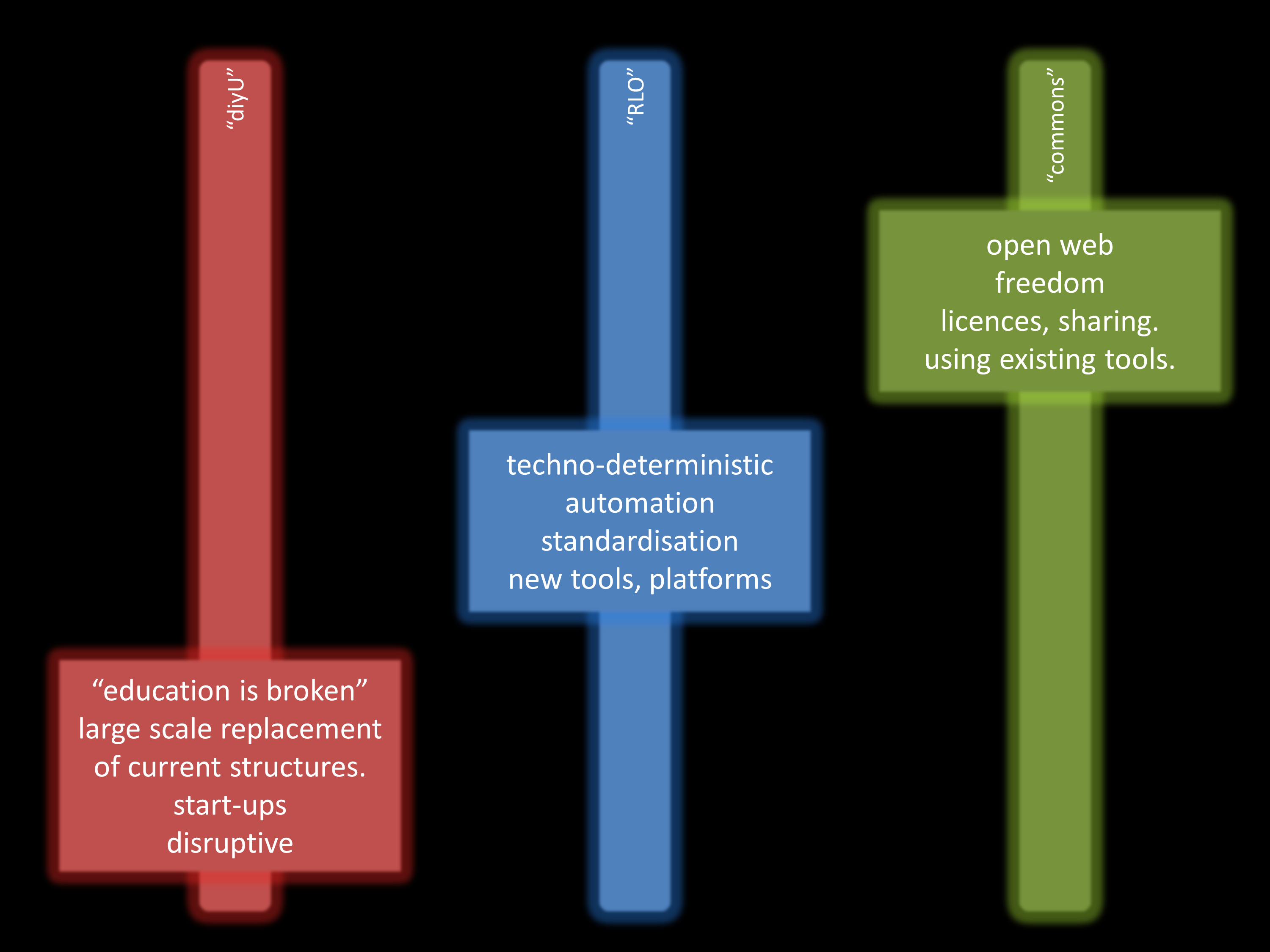
So you can view the “Open Education Movement”, such as it is, as a chimera, composed of these three strands, with different strands being in the ascendency at each time. For example, the current unpleasantness around MOOCs could be characterised as a mixture of the “disruption” and “RLO” strands, with the “commons” strand being a very tiny part of it.
In comparison, something like Oxford Podcasts could be seen as primarily “commons”, with elements of “RLO” and very little “disruption”.
I usually try to understand breaking news in open education by reference to each of these three strands. So, when I read today of the Pearson-owned OpenClass MOOC platform offering a collection of “high-quality” OER as a sign-up incentive, I consider it from each perspective:
- “RLO” – this provides use data to Pearson, who may use it for business purposes (eg via Knewton). The closed pool allows them to ensure compatibility and useability.
- “Commons” – this promotion of OER by a commercial publisher is a vindication of OER efforts in being “as good as” published material. But it may represent a landgrab of “open space” for a product offered in a closed environment.
- “Disruption” – by breaking the link to paying for academic content, this might undermine academic publishing models. But it does make it easier (and cheaper) to start building courses on the platform, rather than on an institutionally owned VLE/LMS
Often benefits and drawbacks for each strands are interlinked (as in this example). But in general significant initiatives (and significant commentators – for example you could easily link to a David Wiley blog post clearly situated in all three strands!) tend to be active across the spectrum.
I present this as a partial explanation of why it can often feel as if open education is pulling in multiple directions, and why initiatives too centred in one strand can become divisive. It is certainly instructive that MOOCs are now beginning to encompass the “commons” ideas of resources open to all, whilst letting go (a little) of the “disruptive” idea of destroying universities and the “RLO” dream of a perfect universe of resources and data.
And with the re-emergence of “blended learning” and “resource banks”, maybe the future is beginning to learn from the past…
(of course, Trey Parker and Matt Stone already did a much-swearier verison of this post [nb not safe for work, consistent bad language from the start. Marvellous])
Leave a Reply