We are, as we are continually told, in a new era of higher education management. The student is at the heart of the system, and all the decisions are based on a need to improve the student experience above all else. Because funding directly follows the student, plans are necessarily short term and thus unstable.
But what could have more impact on the quality of the experience than the staff that institutions employ who deal directly with students. Every aspect of the much-fetishised student survey returns to this need – calls for “better feedback” are calls for more time with academics, calls for “better resources” are calls for the employment of staff to enable and support access to resources. But staff – good staff, motivated staff, secure staff – represent a long term institutional investment.
People are expensive, but what people can do is beyond price.
This is in contrast with the nearly £700m that UK HE spends annually on commercially published resources. To be clear this is an annual figure – covering journal subscriptions, updated textbooks, access to digital resources and general academic and source publications. It doesn’t, however, include the time that academic staff spend writing, updating and peer reviewing these resources (about another £130m just for the peer review).
These figures keep rising (I use 2010-11 figures in the paragraph above) – it is now fair to assume that UK universities contribute more than a billion pounds to commercial publishers. Each year.
I couldn’t argue that we should cut all spending on library resources (and some of these are very very good resources indeed) – but clearly something has gone wrong here and we need to consider alternate models.
Enter Open Educational Resources. A way of replacing resource spending with investing in and empowering staff to create and share their own. Thus improving the student experience. For staff:
Engagement with OER release generally has fostered reflection on existing teaching practice, increased technical skills, improved understanding of IPR and legal aspects, improved use and application of licenses and changes in content production processes.
Or so an independent report into three years of UK OER activity claimed. They make powerful and direct evidence-based claims about the impact of the work on registered (and non-registered) students:
Evidence suggests that registered students and other learners are gaining confidence through their engagement with OER, including greater confidence in their learning, increased use of online ‘open’ resources (e.g. YouTube views/followers), enhanced student projects, collaborations and shared initiatives, including internationally, such as blogging and OER editing/production.
OER-related activity carried out by students alongside their tutors has been shown to be a truly transformative experience.
[O]ne of the most significant impacts of the UKOER Programme was evidence of the changing relationships between academics and students. This was also echoed during our interviews with selected stakeholders following the detailed survey and was highlighted by many as one of the more exciting and challenging aspects of change emerging from their activities. These changes have the potential to flatten the traditional hierarchy and change the balance of power in learner/teacher relationships.
There is much more on this, and I would recommend reading the amazing report written largely by Lou McGill and Allison Littlejohn.
So, to conclude – OER (and UKOER) has been – and continues to be – an enormously positive experience for academic staff and students. It is breaking down traditional boundaries, supporting independent and project learning, and offering staff the confidence and respect that their amazing work deserves.
All this on around £5m each year for three years. Funding which has now ceased, though the activity and associated benefits continue to be realised.
If I were asked whether OER or commercial publishing has had a more positive impact on the student experience … there is only one answer I could possibly give.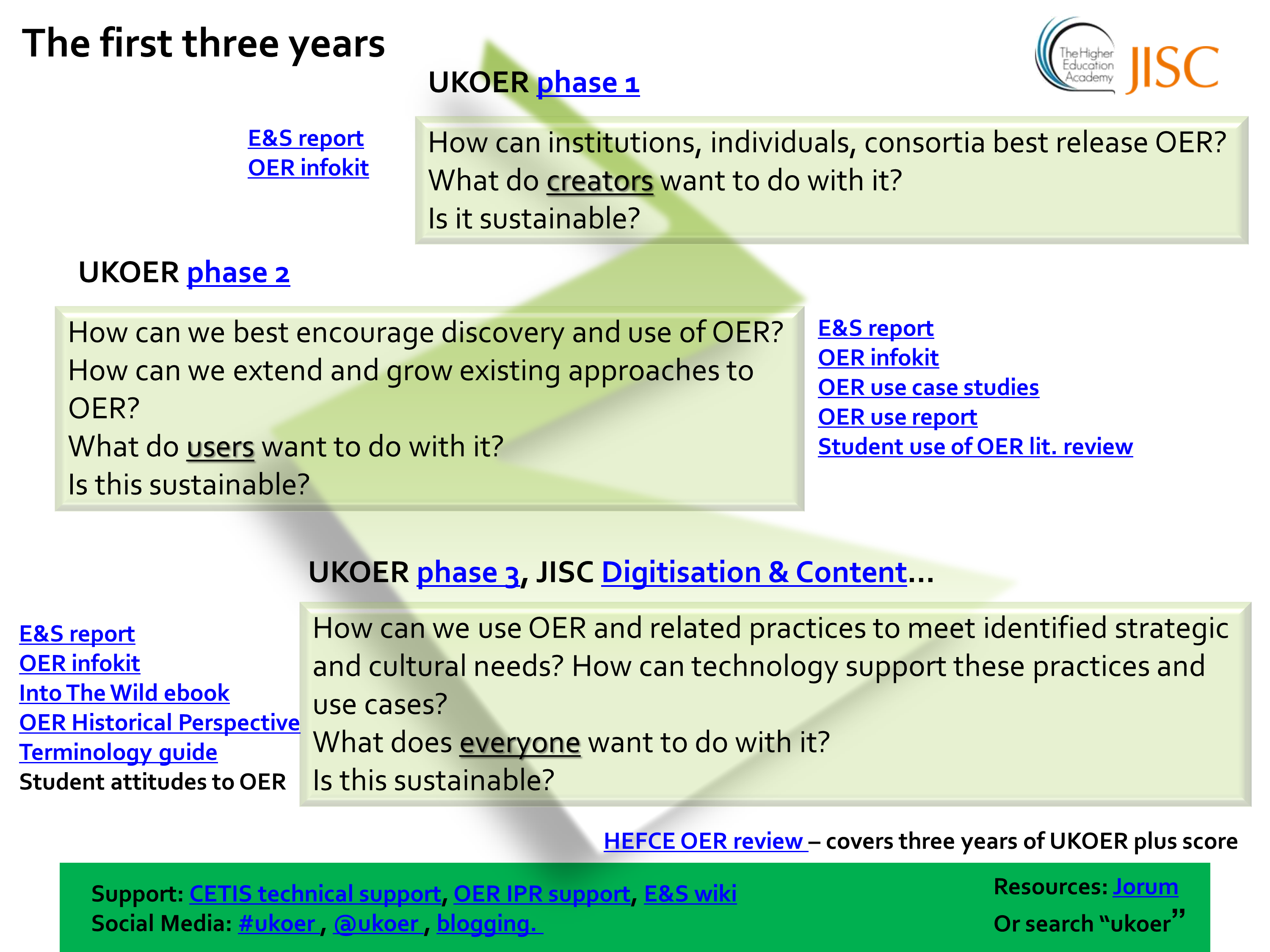
Leave a Reply