Warning: Constant MAX_INLINE_MENTION_LENGTH already defined in /home/dkernohan/public_html/wp-content/plugins/semantic-linkbacks/includes/class-linkbacks-handler.php on line 4

Warning: Undefined array key 3 in /home/dkernohan/public_html/wp-content/plugins/wp-youtube-player/wp-youtube-player.php on line 85

Warning: Undefined variable $doing_rss in /home/dkernohan/public_html/wp-content/plugins/wp-youtube-player/wp-youtube-player.php on line 92

Warning: Undefined array key 3 in /home/dkernohan/public_html/wp-content/plugins/wp-youtube-player/wp-youtube-player.php on line 85

Warning: Undefined variable $doing_rss in /home/dkernohan/public_html/wp-content/plugins/wp-youtube-player/wp-youtube-player.php on line 92
Uncategorized – Page 14 – FOLLOWERS OF THE APOCALYPSE
Warning: Attempt to read property "plugins" on null in /home/dkernohan/public_html/wp-content/plugins/styles/classes/styles-customize.php on line 150

Category: Uncategorized

  • He’s got a little list! The new Regulatory Framework.

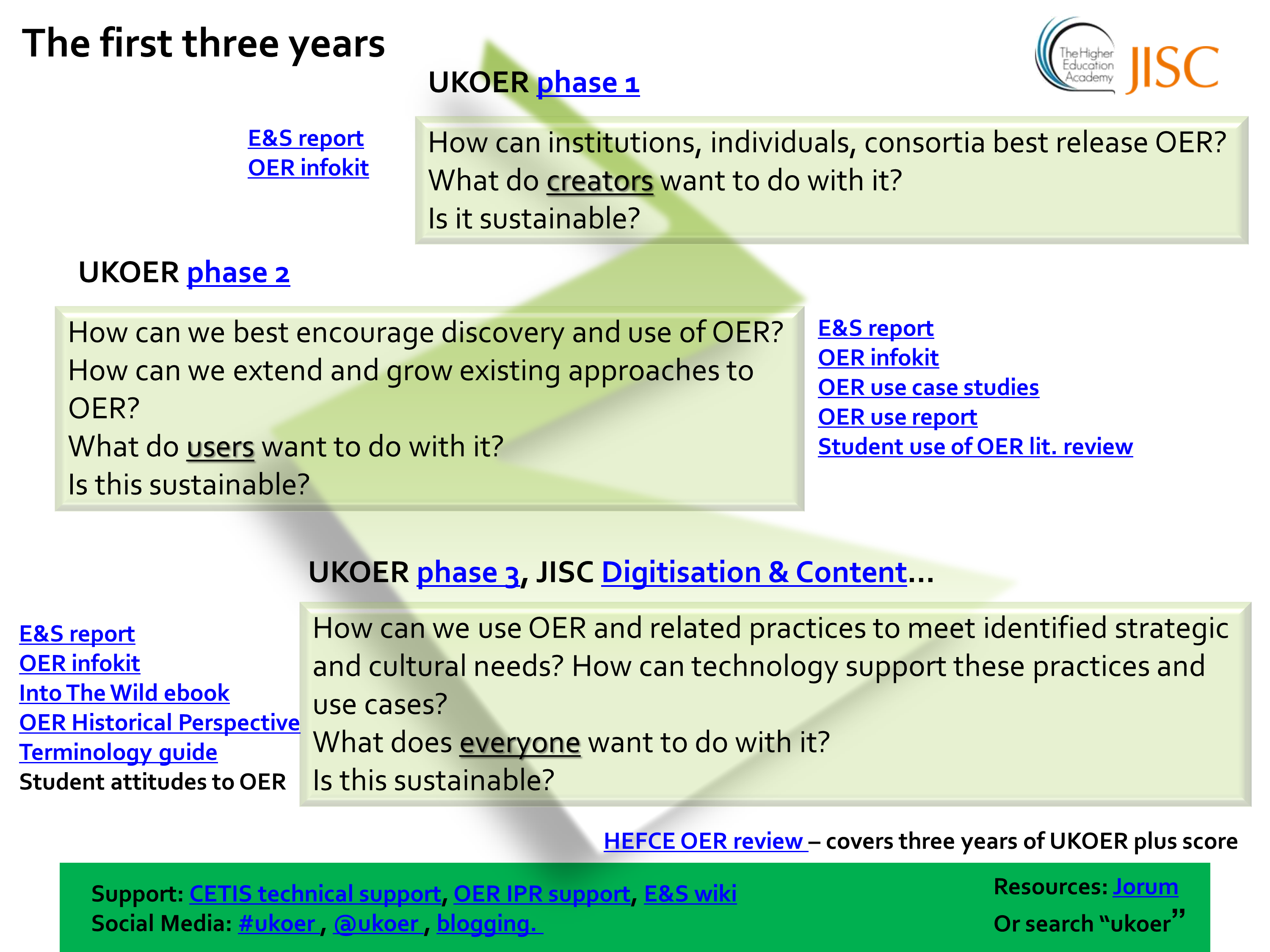
    So, it’s the hottest day of the year so far in the UK, and here I am slaving over statutes and university designation processes. I had an early look at this a year or so ago, but I wanted to come back to the idea in the light of the recent pronouncements from the Rt Hon David Willets, MP.

    These changes are a part of a wider package to fill the hole left by the now dead-in-the-water HE Bill, and are principally related to the designation of institutions for particular purposes. You’d think that there is just one big list of universities and colleges that the government would use for this – there are in fact currently three:

    • Recognised bodies. These are institutions that have their own degree awarding powers and can award any degree. (there are also a small number of institutions that can only award specific qualifications, which are known as recognised awards). Recognised bodies are registered via their inclusion in the Education (Recognised Bodies) Order.
    • Listed bodies. These are institutions the deliver courses that lead to a degree awarded elsewhere, and there is an Education (Listed Bodies) Order for each of the Home Countries to manage this list.
    • The Home Office “Register of sponsors”, which is a list of all the institutions that are allowed to sponsor immigration using a student visa (tier 4).
    • The Privy Council have probably got a list somewhere (I imagine on vellum in blackletter script) of Universities that are allowed to call themselves a “University”. This list is not online, of course, because this internet thing is just a passing fad.
    • Of course – there aren’t just four lists. I lied. These are just the ones with official status. There’s also a list of institutions funded by HEFCE, and a list of institutions where students are eligible for loans, there’s an OFFA list of Universities that can charge more than £6,000 a year, lists relating to NHS and teacher training funding… there’s bloody loads of the things.
    • … not forgetting a new and growing list of Alternative Providers which have specific courses designated for the availability of HEFCE funding to the institution and/or loan (including fee loan) availability to the students. These “designated courses” are not the same as the “recognised awards” above)

    Clearly, this was becoming an enormous headache – so a bunch of people from HEFCE and the Student Finance England got together to try to simplify things. Their big idea was to merge all these lists, and have one big list that could have columns – showing which of these designations each institutions had.

    From next year HEFCE will be bringing together this list of “Designated Providers”, which will be available from 2014, and will use data from all of these various sources described above. It will also have a list of institutions that are not on the list – I imagine you could think of this as ” institutions of interest”, where they are not subject to the HEFCE regulatory framework but still worth keeping an eye on.

    This “one list to rule them all, and in the darkness bind them” is the central plank of the government’s way of giving HEFCE the powers they need to actually do their regulatory job in the brave new HE market place without daring to put more coalition-threatening stuff about Higher Education to the House of Commons. From this little list, problems with quality and financial stability can be read across to bring about sanctions and penalties in student support designation.

    Everyone is sharing a single list, and the laudable commitment to transparent data sharing means that HEFCE can keep all the useful stuff from their “Financial Memorandam” even thought they won’t be giving many institutions any actual finance after 2014-15.

    You probably think I am making all this up, but I am not. It is real. HEFCE and SFEngland published their “Regulatory Framework” this week, and the Right Honourable Member for Havant dashed off a quick response in between MOOC-related meetings yesterday.

    His next step will be to amend the 2011 Education (Student Support) Regulations to make reference to this shiny new spreadsheet. Because he’s got a little list. Yes, he’s got a little list.

    There’s also a new-ish set of guidance for designating a course for student support, that I want to have a look at another time. Because it’s sunny damn it! And it’s lunch time. And I’m 250 metres from the pub….
     

  • Eighteen Percent?

    “A recent poll in the UK suggests that just 18 per cent of people think that a university
    education is a good preparation for today’s labour market. In response,
    Wendy Piatt, speaking for the top universities, rejected this perception
    and said that in fact the education was ‘ideal’. If she is right, at the very
    least she has a major communications challenge on her hands.”

    (p47 “An Avalanche Is Coming“, Pearson/IPPR, 2013)

    For anyone reading at Pearson, that thing in the brackets above is called a “citation”. It means that anyone reading this blog post can quickly refer to the sources of information I am referring to. I’d recommend them to you as good academic and journalistic practice.

    The “eighteen percent figure” is regularly repeated in presentations linked to the Avalanche report. I remember commenting at the time that the report was badly referenced – alas this poor referencing seems to extend to the slides. It is a good soundbite, but we should always be suspicious of statistical soundbites without sources.

    So I turned to google – thinking that Wendy Piatt at the Russell Group probably doesn’t refer to things as “ideal” very often, especially not  in reference to the figure 18.

    There are in fact three results for searching “Wendy Piatt ideal 18” on google. The first is a BBC News story about vocational education, published on 28th November 2012. The opening paragraph?

    “UK universities should offer more practical and vocational learning, a survey for a think tank suggests. A poll for Policy Exchange found 55% of adults believed too many people studied narrowly academic subjects. Only 18% said universities had the right balance between academic and technical subjects. Dr Wendy Piatt of the Russell Group of universities rejected this saying they were “the ideal learning environment which produces ‘work-ready’ graduates”.

    The timescale and Piatt quote fit, but this report suggests that 18% of the surveyed adults felt that Universities had the right balance between academic and technical subjects. Which is a fair opinion, I suppose. But is emphatically NOT the same thing as saying 18 per cent of people think that a university education is a good preparation for today’s labour market

    But let’s be fair, maybe the underlying work supports the  inference that Sir Michael Barber draws. The survey was carried out by the fairly reputable YouGov for the less reputable right-wing Policy Exchange thinktank (seriously, it was founded by Michael Gove for godsake…) in support of a report called “Technical Matters“, published by Policy Exchange on 21 January 2013. Page 16 deals with the poll:

    “Polling carried out for this report indicated that …55% of people agreed that “Too many young people in Britain study academic subjects at university, we need more people to study for practical and technical qualifications”, with 8% indicating that too many people study practical qualifications, and 18% indicating that the balance was about right”

    So the same issue remains. Even if you wanted to cite a figure suggesting that not many people felt that universities are good preparation for the labour market – and were prepared to overlook the issue that studying practical qualifications (whatever they might be) might not be a good preparation for the labour market – you would use either 26% (the % of the sample that felt that there were enough or too many practical qualifications) or 45% (the % of people who did not say that there were too many young people studying academic courses).

    I know the second one is a bit dodgy, but it is such a bad question – containing two separate propositions, the second not leading directly from the first – that to be honest you might as well.

    But YouGov did the poll, and they are fairly solid statistically. Even though they were co-founded by Michael “Belize” Ashcroft. Let’s look at the source data. The note in the “Technical Matters” report (note 45, note fans) says:

    “Yougov polling for Policy Exchange. All figures, unless otherwise stated, are from
    YouGov Plc. Total sample size was 1,624 adults. Fieldwork was undertaken between 25th – 26th November 2012. The survey was carried out online. The figures have been weighted and are representative of all GB adults (aged 18+).”

    And YouGov publish the majority of their results in an online archive. Searchable by month and year.

    But alas, amongst the important polls about time travel and Nadine Dorries, results of this survey are nowhere to be seen. Neither have Policy Exchange published them – I checked.

    So, this headline assertion by Pearson/IPPR is

    • uncited
    • seemingly based on a BBC News Story about a Policy Exchange commissioned YouGov poll, for which full results are not available
    • is not backed up by what we do know about the poll.

    Well played, chaps.

  • UKOER – supporting the student experience

    We are, as we are continually told, in a new era of higher education management. The student is at the heart of the system, and all the decisions are based on a need to improve the student experience above all else. Because funding directly follows the student, plans are necessarily short term and thus unstable.

    But what could have more impact on the quality of the experience than the staff that institutions employ who deal directly with students. Every aspect of the much-fetishised student survey returns to this need – calls for “better feedback” are calls for more time with academics, calls for “better resources” are calls for the employment of staff to enable and support access to resources. But staff – good staff, motivated staff, secure staff – represent a long term institutional investment.

    People are expensive, but what people can do is beyond price.

    This is in contrast with the nearly £700m that UK HE spends annually on commercially published resources. To be clear this is an annual figure – covering journal subscriptions, updated textbooks, access to digital resources and general academic and source publications. It doesn’t, however, include the time that academic staff spend writing, updating and peer reviewing these resources (about another £130m just for the peer review).

    These figures keep rising (I use 2010-11 figures in the paragraph above) – it is now fair to assume that UK universities contribute more than a billion pounds to commercial publishers. Each year.

    I couldn’t argue that we should cut all spending on library resources (and some of these are very very good resources indeed) – but clearly something has gone wrong here and we need to consider alternate models.

    Enter Open Educational Resources. A way of replacing resource spending with investing in and empowering staff to create and share their own. Thus improving the student experience. For staff:

    Engagement with OER release generally has fostered reflection on existing teaching practice, increased technical skills, improved understanding of IPR and legal aspects, improved use and application of licenses and changes in content production processes.

    Or so an independent report into three years of UK OER activity claimed. They make powerful and direct evidence-based claims about the impact of the work on registered (and non-registered) students:

    Evidence suggests that registered students and other learners are gaining confidence through their engagement with OER, including greater confidence in their learning, increased use of online ‘open’ resources (e.g. YouTube views/followers), enhanced student projects, collaborations and shared initiatives, including internationally, such as blogging and OER editing/production.

    OER-related activity carried out by students alongside their tutors has been shown to be a truly transformative experience.

    [O]ne of the most significant impacts of the UKOER Programme was evidence of the changing relationships between academics and students. This was also echoed during our interviews with selected stakeholders following the detailed survey and was highlighted by many as one of the more exciting and challenging aspects of change emerging from their activities. These changes have the potential to flatten the traditional hierarchy and change the balance of power in learner/teacher relationships.

    There is much more on this, and I would recommend reading the amazing report written largely by Lou McGill and Allison Littlejohn.

    So, to conclude – OER (and UKOER) has been – and continues to be – an enormously positive experience for academic staff and students. It is breaking down traditional boundaries, supporting independent and project learning, and offering staff the confidence and respect that their amazing work deserves.

    All this on around £5m each year for three years. Funding which has now ceased, though the activity and associated benefits continue to be realised.

    If I were asked whether OER or commercial publishing has had a more positive impact on the student experience … there is only one answer I could possibly give.UKOER


  • Three strands of open education, or reading Open Education news.

    This is something that originated in mine and Amber Thomas’ paper “OER: A Historical Perspective”, which I took to #opened12 with Sheila MacNeill.  I never managed to write it up on here, and as I refer to it a lot and it is becoming increasingly apposite, I thought I’d rectify that.

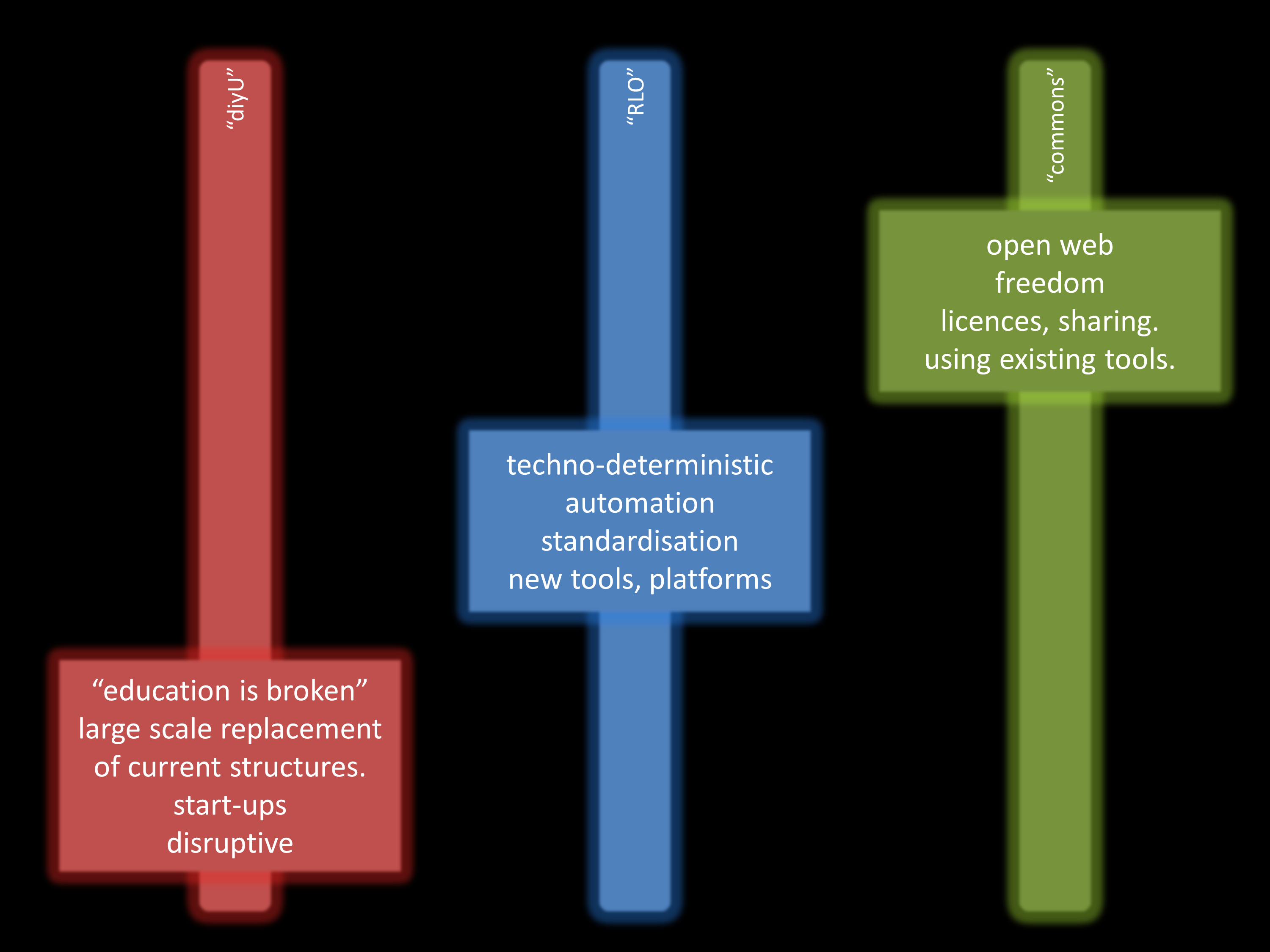
    Basically, there are three strands of open education.

    Firstly, what I call the “RLO” tendency, after the Reusable Learning Object movement where I think it is most purely expressed. This tendency is interested in providing an ordered and easily reusable collection of high quality materials for reuse – with corresponding interests in content packaging, interoperability, user metrics and automating discovery.

    Secondly, I’d postulate the “Commons” tendency, which I associate with the Noughties OER boom. Release, and release under an creative commons license, is the key here, with less focus on quality or technical affordances, and an emphasis on learners as users rather than educators.

    Thirdly, I initially called them the “DIYU” tendency but would now go for “disruption”. These are the “education is broken” crowd, looking to sweep away and replace the existing education system. Their language comes from business rather than education, and there is an emphasis on private funding and new financial models.

    moocEUNIS

    So you can view the “Open Education Movement”, such as it is, as a chimera, composed of these three strands, with different strands being in the ascendency at each time. For example, the current unpleasantness around MOOCs could be characterised as a mixture of the “disruption” and “RLO” strands, with the “commons” strand being a very tiny part of it.

    In comparison, something like Oxford Podcasts could be seen as primarily “commons”, with elements of “RLO” and very little “disruption”.

    I usually try to understand breaking news in open education by reference to each of these three strands. So, when I read today of the Pearson-owned OpenClass MOOC platform offering a collection of “high-quality” OER as a sign-up incentive, I consider it from each perspective:

    • “RLO” – this provides use data to Pearson, who may use it for business purposes (eg via Knewton). The closed pool allows them to ensure compatibility and useability.
    • “Commons”  – this promotion of OER by a commercial publisher is a vindication of OER efforts in being “as good as” published material. But it may represent a landgrab of “open space” for a product offered in a closed environment.
    • “Disruption” – by breaking the link to paying for academic content, this might undermine academic publishing models. But it does make it easier (and cheaper) to start building courses on the platform, rather than on an institutionally owned VLE/LMS

    Often benefits and drawbacks for each strands are interlinked (as in this example). But in general significant initiatives (and significant commentators – for example you could easily link to a David Wiley blog post clearly situated in all three strands!) tend to be active across the spectrum.

    I present this as a partial explanation of why it can often feel as if open education is pulling in multiple directions, and why initiatives too centred in one strand can become divisive. It is certainly instructive that MOOCs are now beginning to encompass the “commons” ideas of resources open to all, whilst letting go (a little) of the “disruptive” idea of destroying universities and the “RLO” dream of a perfect universe of resources and data.

    And with the re-emergence of “blended learning” and “resource banks”, maybe the future is beginning to learn from the past…

    darkside


    (of course, Trey Parker and Matt Stone already did a much-swearier verison of this post [nb not safe for work, consistent bad language from the start. Marvellous])


  • “Just a dream and the wind to carry me” – PA Consulting HE leaders survey 2013

    As in previous years the mighty post-Taylorist consulting enterprise PA Consulting have produced a survey of the views of HE Leaders (basically anyone in charge of an institution).

    Swapping some deliberately falsified user-data for a copy of their full report I settled down with a good cup of coffee to peruse their yacht-bedecked and nautical-pun-filled analysis – the full, unexpurgated data not being made available.

    As with other mid-2013 commentary, the once-vaunted “avalanche” of change facing HE has been downgraded – this time to a slightly rough sea, prompting a reshaking of the sector (or sectors, as one respondent with an eye on keynote gigs points out: “there is no such thing as a HE sector”) rather than widespread carnage.

    There seems to be a confidence that traditional HE, in a recognisable form, will prevail. This meshes with the recent disruption downgrade, change and adaptation in education now being expected to occur within existing structures – echoed by a notable turning away from the idea of a “no frills” model of low priced (sub £6,000) education becoming dominant.

    But,

    The greatest worries expressed by HE leaders
    relate to the uncertain outlook for student
    demand and related revenues

    which is exactly what you would expect to see. The main effect of Willetts-Browne funding has been to at uncertainty and instability to a sector the used to be able to make long-term plans. Institutional management has become an increasingly short-term enterprise – I’ll leave it to the reader to decide whether this is good use of public funds.

    My sources are telling me that we are looking at seeing each of the three main parties coming into the next elections with proposals to reform the HE funding method, policy-makers finally agreeing with the wonks that the current model is not and will never be sustainable. This is fairly common knowledge amongst VCs, and may have something to do with the atmosphere of becalmed stasis that permeates these survey responses.

    “Well it’s not far back to sanity, at least it’s not for me
    And if the wind is right you can sail away and find serenity”


  • The real online learning revolution

    With apologies to HP Lovecraft. And MOOCthulu.

    If you are unlucky enough to have any kind of budgetary authorisation powers in a university you will most likely spend a fair part of your day dealing with people who want to sell you stuff (their insidious voices a constant backdrop, never ceasing as your mind turns and turns without respite) .

    The remainder of your day is probably spent dealing with people who are convinced that there is a crisis of some sort, that requires immediate action. This would be most of the staff and students of your institution, and a wide range of excitable journalists, bloggers and policy wonks (those strange, pale-fleshed, siren-voiced aberrations against nature) .

    By “day”, I am not referring mainly to your working day. Even during your limited time away from your desk and meeting rooms one and two, it is likely that you will keep seeing things (even those squamous creatures that infest your dank fitful dreams, drawing you ever nearer to the nameless dread lurking beneath the inky black waters of your softly-evaporating soul, calling to you repeatedly and clearly across the starless night, come to us, come near to us, let us embrace you and make you more than human, and whose dimly glimpsed forms still twist and squirm at the edges of your scarlet-rimmed eyes…) that give you the impression that the world will end unless you authorise that invoice.

    Don’t you wish you could make it all go away? (Don’t you plead in the darkest moments of your pre-dawn torments that you would offer anything to MAKE THEM STOP! MAKE IT ALL STOP!)

    A range of international companies are now offering what can only be described as “online learning in a box”. They provide and maintain a platform, develop online marketing, devise and produce course materials and assessments, even provide staff to teach. And they even give you money.

    And all they ask in return is your soulinstitutional branding rights.

    These companies are starting to become more aggressive in their sales techniques. If a senior manager is being unresponsive, they will go around them to others. They will make vague, non-specific promises – show case studies that are at best related to reality.

    I don’t want to name these companies (as to name them would be to summon them, dragging the nameless dread from the elder times from their seabed bower, where they lie dead, dreaming…) but I do want to enumerate their demands.

    For firstly, they demand to have possession of your institutional brand, for the purposes of selling their online courses. And do not be mistaken. These are their courses, not yours.

    For secondly, they require that you agree to any daemonic aberration of a course that they happen to come up with that might “sell”. They will use their staff – who may also teach courses for other “institutions”, their resources, their tools.

    For thirdly, they will design banner adverts of horrific countenance (some of which will animate) and plaster these all around the web. You may already have branding guidelines – prepare to see them swept away.

    For fourthly, they will react with a less than complete delight when you realise how easy it actually is to run your own courses and begin to do so. For alas, you will no longer have the right to.

    For you see, they are the high priests – you are a novitiate – you see only the immediate advantages, they understand the long-term value of what you are giving them freely and without reservation. Ask yourself who has an online learning operation you admire – chances are they are running it themselves.

    Invest instead in your own people, your own capacity, your own understanding. Use the statutory seven-day cooling off period to educate yourself online: read, research and ask your expert networks. If you don’t have an expert network, ask someone else’s.

    (For the day and the hour are coming where the Elder Gods will rise and lay waste to your pitiful existence, the soft choking darkness will engulf your body and the dim red lights behind your eyes will pulse to an ancient rhythm… Ph’nglui mglw’nafh Cthulhu R’lyeh wgah’nagl fhtagn! Ph’nglui mglw’nafh Cthulhu R’lyeh wgah’nagl fhtagn! Ph’nglui mglw’nafh Cthulhu R’lyeh wgah’nagl fhtagn! )

  • Damnatio memoriae -the IPPR’s “A Critical Path”

    (post originally written for Wonkhe.com)

    Sometimes in reading a report you spot what is missing before you see what is there. In reading through the latest IPPR report “A Critical Path: Securing the Future of Higher Education in England”, one is struck by the lack of references to another (comparatively recent) report, “Securing a Sustainable Future for Higher Education“. Such has been the slump in fortunes of the Browne review that a report just three years later covering almost identical ground does not see fit to offer it a single mention.

    Despite this, there are a number of eerie echoes between the two.

    • both call for a merger between HEFCE, OFFA and the QAA, ignoring the QAA’s UK-wide remit, and the legendarily efficient way that the three bodies already work together.
    • both make a lot of noise about an improved deal for part-time students, but do not offer any real answers. (Browne suggested wider eligibility for loans to counterbalance a rise in fees – it turned out only a third of part-time students were eligible, and only 20% of them actually took the loan. IPPR suggest slightly relaxing ELQ rules [where the government refuses to support students studying a qualification of equivalent level to the one they have], slightly addressing the former problem whilst completely ignoring the latter)
    • both wring hands about the need for increased government investment in HE (currently among the lowest in the developed world, Fig 2.9 in the IPPR report) but stop short of calling on the government to invest more.

    The IPPR review harks back instead to the Robbins report of 1963, a far more radical document which explicitly called for greater government investment to support social mobility. Lord Robbins produced a report that is still seen favourably by government and academia, something which Lord Browne and his committee appear not to have managed.

    And social mobility remains an issue for the university system, as a recent Guardian FOI-led story shows.

    The IPPR answers to the decrease in social mobility opportunities that the rise in student fees has led to are twofold; one – sensibly – is to end the money-saving presumption that student bursaries should be in the form of fee waivers, the other – questionably – is to extend the questionably attractive “Coventry University College” model of cut-price degree courses. Neither of these really addresses the issue of local students living at home studying to fulfil local needs (chapter 4 of the IPPR report), but at least the first idea breaks down the barrier of living costs for full time study – a more pressing issue for 18-year-olds without rich parents than the amount repayable during their post-graduation working lives.

    Other coverage is likely to centre on the rebadging of FE institutions offering employer-linked courses as “polytechnics” and giving them degree awarding powers. This is a politically powerful announcement, playing to a common-sense conceptualisation of the recent past – but changes nothing from the current state of affairs, where colleges are often delivering courses at a number of levels linked to employers and are free to apply for degree awarding powers should they so wish.

    There is also an expectation that new open online course models (or MOOCs) will take some of the widening participation strain.  Despite the only recommendation in this vein being that the OU offer accreditation to students studying on their FutureLearn MOOC platform (something that they have explicitly said they would not do, not least because of no arrangements yet being in place to address quality assurance and plagiarism detection), the real interest comes from a complete absence of the MOOC boosterism in the recent IPPR publication “An Avalanche is Coming” (though there is a grudging mention in the bibliography). With both the Browne review and “Avalanche” ignored, Sir Michael Barber (a key part of both) must be looking carefully at the IPPR entry on his Christmas card list.

    An initial delight in seeing the bold (and emboldened statement) “we have concluded that the current student funding system is unsustainable.” is mitigated by the realisation that the bought in analysis (with figures from London Economics, same place as last months Million+ report on the same issue) is riddled with errors, both technical – there is a frequent confusion between immediate government spending and long term financial exposure – and ideological, in that there is no countenance offered to the idea that the government just needs to spend more on HE. To anyone seeking a more thorough and reliable examination of these issues, we could only recommend a read of Andrew McGettigan’s “The Great University Gamble”.

    It is good to see that the continuing crisis in postgraduate support is at least being brought to the attention of politicians, but again the report offers few lasting answers – the introduction of fee loans would compound the financial black hole that the undergraduate support system is already dragging DBIS into.

    This report is probably only of interest to two groups – wonks like us who want to unpick the politics and positioning, and politicians like Stephen Twigg who want a policy idea for a headline. Like the Browne review it is unlikely to be referred to even in three years time, but (also like the Browne Review) it foregrounds the need for a proper examination of funding for higher education in England and in the UK.


  • The house always wins: big data and legal loan sharks

    Like many twitter using this morning, I’ve read and retweeted this amazing article from Charisma about the way Wonga (the payday loan company) uses big data to make loan decisions.  You might think that your social media use may have little bearing on whether or not you are eligible for credit, but social networks like Facebook are one of a range of sources that the company uses to confirm identification and assess lending risk.

    This slate.com article on the same topic includes a wonderful quote from ex-Googler Douglas Merrill, now at ZestFinance (a company who sells aggregations of data to aid credit decisions):

    “We feel like all data is credit data, we just don’t know how to use it yet. This is the math we all learned at Google. A page was important for what was on it, but also for how good the grammar was, what the type font was, when it was created or edited. Everything.”

    Everything.

    You’d think with all this big data goodness that Wonga and the like would have no trouble with getting their repayments on time, wouldn’t you?  But Wonga wrote off £77m of debt the year before last (when it made £46m of profit). UK Member of Parliament and campaigner against payday loan companies Stella Creasy notes that 57% of customers miss at least one payment and half are unable to repay entirely.

    It would appear that many customers choose to “roll over” the loan – borrowing again to pay off the existing loan + interest. And companies like Wonga charge fees for missed payments, and have a very aggressive approach to debt collection.

    Is it too much of a leap to suggest that maybe all this “big data” is being used to identify the most profitable customers, rather than the most suitable? Social media data can supposedly be used to make inferences about a persons lifestyle and IQ, after all.

    Data may have presumptions of neutrality, but any commercial enterprise looking at using data to enhance decision making would most likely have an eye on profit. And what is good for business may not be good for people.

  • FOTA Radio Vol. 6 : Obsolete?

    FOTA Radio Vol. 6 : Obsolete?

    It’s been a while but FOTA Radio, the infamous #ds106radio show, is back and as brutal as ever.

    This particular show looks at ideas of nostalgia, loss, obsolescence and the ways an oppressive government can bring these about, through the lenses of:

    The music of the UK Rave scene was characterised by the use of (often incongruous) dialogue samples, so you’ll hear a lot more stuff you recognise, both within the music and added by me.

    As far as there is a story, you could imagine numerous characters attempting to return to and reassert their beliefs based on their formative years, only to find that their early years are not as innocent as they remember – precisely because of (their? others?) over reliance on a detailed examination of these beliefs.

    I’ve used Cakewalk Music Creator 6, Audacity, and audio sourced from my personal collection and ripped from various video hosting sites.

    For a limited time only, the show is available to download here ( & google drive mirror), it will eventually make its way to MixCloud or SoundCloud, along with earlier episodes.

    fota6flyer

  • There is no news

    It can hardly have escaped your attention that there is a new game in town – and that game is blended learning. Both disruptive action man Clayton Christensen and free-course behemoth Coursera have recently swung round to the idea of educational institutions not being broken, merely tired-looking.

    The thinking being that the whizzy and exciting private sector can provide content and materials, because learner engagement is all about being presented with shiny things to coo at. And if those shiny things are on a computer, even better.

    In other words, Coursera and Christensen have invented ACADEMIC PUBLISHING.

    Now publishing was a great way of making money right up until the invention of the internet. These days, even huge and faintly terrifying enterprises like the mighty Pearson are issuing profit warnings, due to the huge and increasing amounts of high quality content available freely online.

    Sales are so far down that they have moved into the murky (and now, oh so nostalgic) world of the MOOC. And have begun spouting the kind of  disruptive natural event nonsense that Christensen was doing in 2011. (exclusive video footage of celebrity mountain goat Michael Barber describing the issue in measured terms)

    Both academic publishing and what I guess I’ll now call “alternative education structures” are predicated on the idea that there is somehow money in delivering higher education. I mean  – just look at the money universities can charge students! There must be something in that?

    Student fees are rising because public investment in HE is dropping.  The canonical example of tuition fee madness is the US, and this article neatly debunks the all-consuming meme.

    “Tuition revenues are up substantially due to higher prices and more enrollments, but not enough to offset losses of public funding,”

    But such has been the anti-education hype (for example, the always useless Fast Company)  that it is generally assumed that Universities are just greedy.

    Both universities and the (private sector) supporting industries around them are squeezed because of a deliberate global policy decision to end the  conceptualisation of education as a public good.

    So – there is no gold. There is no news.

    Just a largely defunct industry and a mess of clueless entrepreneurs chasing a non-existent pot of gold.

    [see also: Hapgood on spotting this coming, Martin Weller on the MOOC bubble bursting]